Parents and adults in Thailand who are unsure of their measles vaccine history should check it, as the disease is still causing outbreaks in many countries. The World Health Organization (WHO) reported on 27 November 2026 that about 72,000 people died of measles worldwide in 2025. That was 91% fewer than in 2000, but more than 29 million children had still received no vaccine or not all doses.
Deaths are down, but immunity gaps remain
The figures are modelled estimates, not actual counts. WHO estimated about 9.8 million cases in 2025, compared with 37.8 million in 2000, when about 770,000 people died. It estimates that measles vaccines have saved more than 60 million lives since 2000.
Globally, 84% of children received a first dose in 2025 and 77% a second. In low-income countries the rates were 69% and 57%. Large or disruptive outbreaks hit 59 countries, defined in the report as at least 20 confirmed cases per 1 million people over 12 months.
In November 2026, Bolivia, Mexico and the United States lost their measles elimination status. That left 92 countries with the status, down from 95 at the end of 2025. WHO Director-General Dr Tedros Adhanom Ghebreyesus said elimination is not the finish line and must be maintained with 2 vaccine doses for every child everywhere.
WHO's South-East Asia Region, which includes Thailand and has 10 member states, had about 4.6 million cases in 2025, or 47% of the world total, and about 23% of global deaths. These are regional totals and do not show how many cases Thailand had.
Regional coverage among children was 96% for the first dose and 93% for the second, though WHO warned that high averages can hide gaps between countries and local areas. No country in the region met the threshold for a large or disruptive outbreak in 2025. Four were verified as having eliminated measles: Bhutan, the Maldives, North Korea and Timor-Leste.
Measles symptoms and who is at higher risk
Measles is highly contagious. It spreads through coughs, sneezes and breathing in the virus, which can remain in the air or on surfaces for up to 2 hours. One patient can infect up to 18 people. Patients are contagious from 4 days before the rash appears until 4 days after.
Symptoms usually start 7-14 days after infection. Early signs are fever, runny nose, cough and red, watery eyes, and there may be small white spots inside the cheeks. A rash usually appears 3-5 days after the first symptoms, starting on the face and upper neck and spreading downward. Thailand's Department of Disease Control (DDC) advises seeing a doctor promptly for high fever with a raised red rash.
Complications include blindness, encephalitis (brain inflammation), pneumonia, severe diarrhoea and ear infections. They are common in children under 5 and adults over 30. Measles during pregnancy can endanger the mother and cause miscarriage or premature birth. There is no specific treatment.
How to check for 2 measles vaccine doses
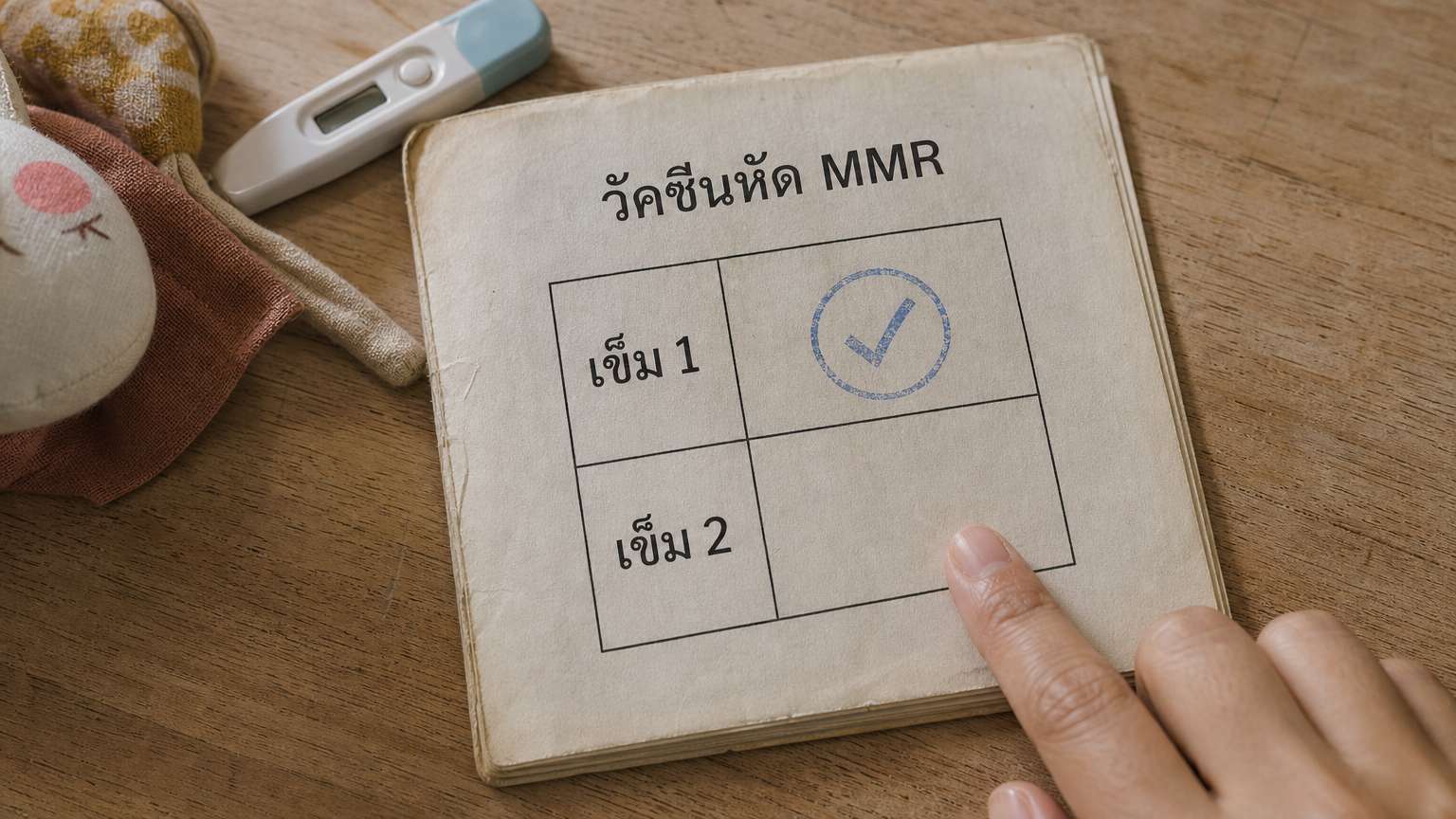
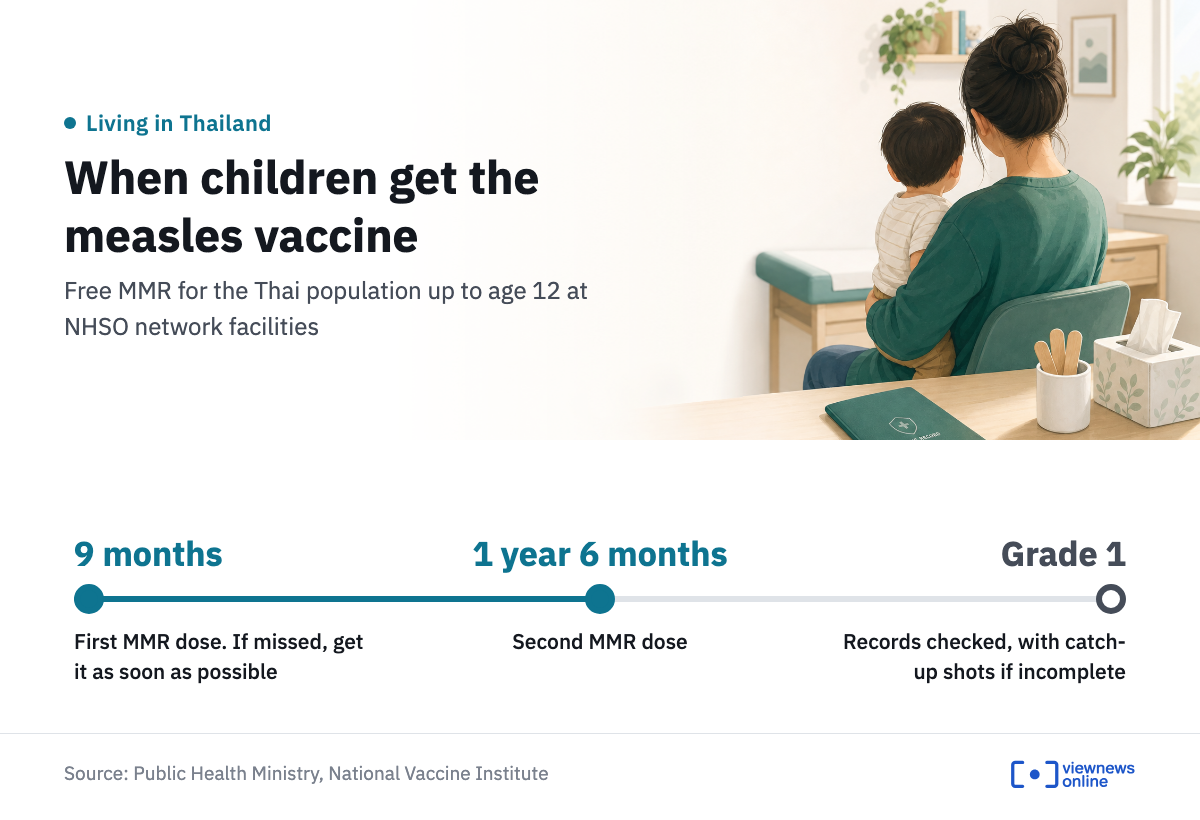
Children receive the combined measles, mumps and rubella (MMR) vaccine under the Public Health Ministry's schedule:
- At 9 months: first dose. A child who missed it should get it as soon as possible.
- At 1 year 6 months: second dose.
- In Grade 1 (ป.1): records are checked and children with incomplete doses get catch-up shots.
Adults should start by finding proof of vaccination, such as a vaccine record book. Under the DDC's 2024 guidelines for people exposed to a case, a person is considered immune if any of these apply:
- Aged 9 months to under 18 months and has had 1 dose of MMR or measles-rubella (MR) vaccine.
- Aged 18 months or older, including adults, and has had 2 doses.
- Has had a laboratory-confirmed measles diagnosis.
- A blood test shows immunity to measles.
Anyone else, including people with an unknown history, is considered not immune. The same guidelines provide 1 dose of MR vaccine to at-risk groups with incomplete, uncertain or no records. Examples include medical and public health staff and students, soldiers, prisoners, prison officers, workers at business establishments and members of the public who want the vaccine. Adults should ask a health facility about availability and cost before going.
MR and MMR vaccines must not be given to pregnant women or people with weakened immunity. Women of childbearing age must check for pregnancy before vaccination and avoid becoming pregnant for at least 4 weeks afterwards, according to the DDC's 2025 guidance on vaccination at evacuation centres.
Foreign residents: eligibility and clinic fees
The National Vaccine Institute says the Thai population can receive basic vaccines, including MMR, free up to age 12 at facilities in the National Health Security Office (NHSO) network. Its statement does not say whether foreign children qualify, so parents should check with the hospital or health centre first.
One paid option in Bangkok is the Thai Travel Clinic at the Hospital for Tropical Diseases, which says it vaccinates both Thais and foreigners. Its price list, updated on 5 June 2026, shows MMR at 390 baht per dose. During regular hours there is also a 200 baht doctor fee, a 100 baht hospital fee, a 20 baht injection fee and a 20 baht registration fee on the first visit. Extended hours cost more and prices may change without notice. Booking is strongly recommended, and visitors should bring any previous vaccination record.
Before travel or after contact with a case
The DDC advises unvaccinated people travelling to countries with measles outbreaks to get 2 doses of measles-rubella vaccine, or at least 1 dose, at least 2 weeks before departure. Anyone who has fever, rash or red eyes after returning should see a doctor promptly, wear a mask and report their travel history.
People exposed to a patient at home, in the community, at school, at work or through medical duties should contact a health facility quickly. The 2024 guidelines target post-exposure vaccination at people aged 9 months to 40 years. Those in this group who are not immune and are at least 12 months old should be vaccinated within 72 hours of exposure, if there is no medical reason against it. For those who have already had a first dose, the next one must be given at least 4 weeks after it. If that first dose was given at 9 months to under 12 months of age, the gap should be at least 3 months.
Exposed children aged 9 months to under 12 months, younger infants, people over 40, pregnant women and people with weakened immunity should consult a doctor promptly. For severely weakened immunity, a doctor may consider immunoglobulin. All contacts should watch for fever with rash for 21 days and seek medical advice quickly if measles is suspected.
Consult a doctor or pharmacist before getting a vaccine or starting or changing any treatment.
Source: World Health Organization, United Nations, Department of Disease Control, National Vaccine Institute, Thai Travel Clinic (Hospital for Tropical Diseases). This article is adapted from ViewNews' Thai-language report.