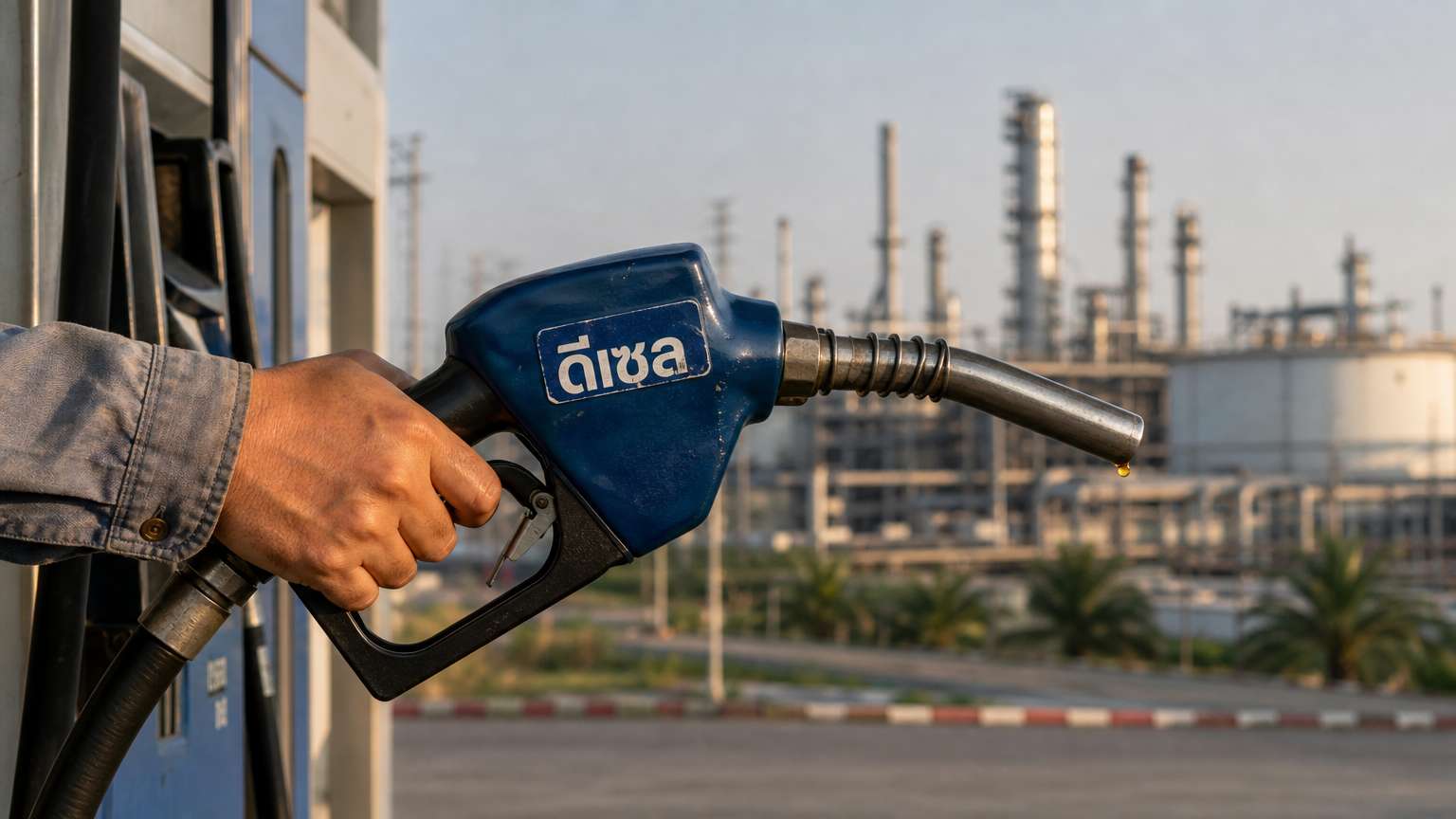
Thailand has set a new discount on diesel at the refinery gate for 1 to 26 December 2026, but drivers cannot subtract it from the price at the pump. The Committee on Energy Policy Administration (CEPA) cut the ex-refinery price (ราคาหน้าโรงกลั่น) by 1.73 to 2.14 baht a litre, depending on the grade, in an order published in the Royal Gazette. The difference matters to anyone budgeting for diesel, including motorists, transport operators and farmers.
December rates compared with November
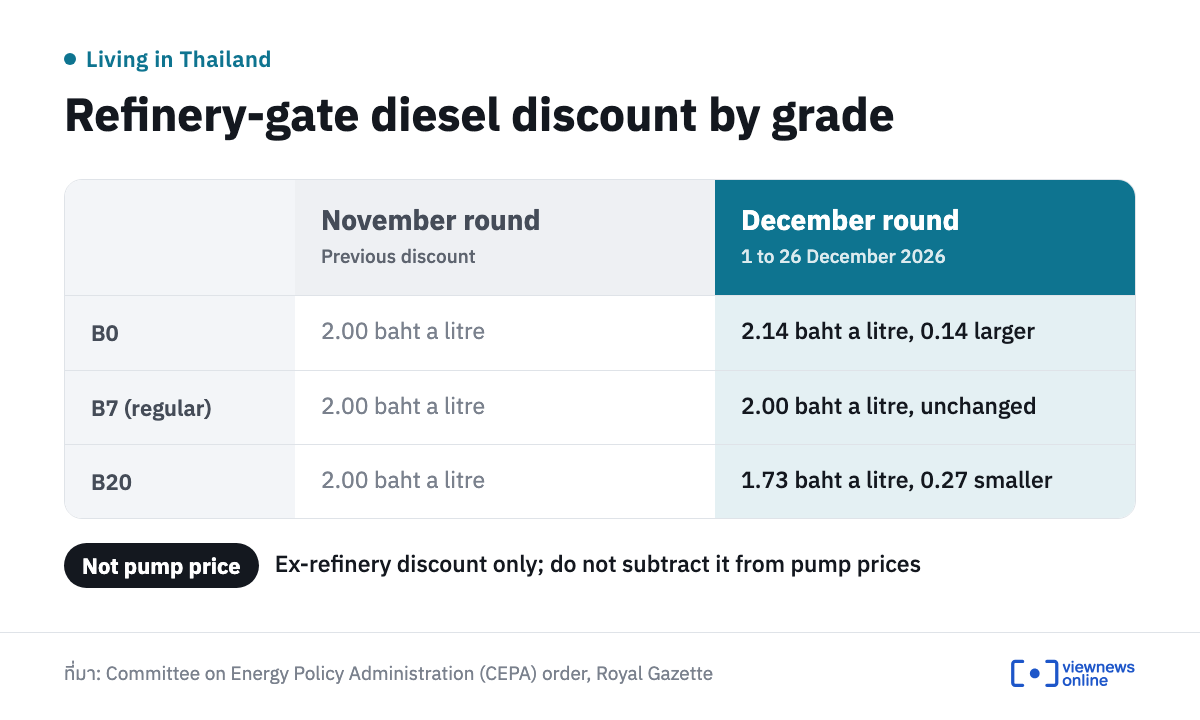
In the November round, B0, B7 and B20 high-speed diesel all had the same discount of 2.00 baht a litre. The new round sets separate rates, so no single figure applies to all diesel.
- B0: 2.14 baht a litre, compared with 2.00 baht previously. The discount is 0.14 baht larger.
- B7, or regular high-speed diesel: 2.00 baht a litre, unchanged from the previous round.
- B20: 1.73 baht a litre, compared with 2.00 baht previously. The discount is 0.27 baht smaller.
These comparisons show only whether the refinery-gate discount has grown or shrunk. They do not show what the retail price of any grade will be.
CEPA approved the new rates at its 16th meeting of 2026 on 25 November. Its order said the conflict in the Middle East involving the United States, Israel and Iran showed no sign of easing soon, affecting supplies of crude oil and refined products to the world market. Domestic oil prices also remained highly volatile. The measure is intended to resolve and prevent fuel shortages.
Refinery price is only one part of the pump price
The Energy Policy and Planning Office (EPPO) says the ex-refinery price, or the price of the fuel itself, is the price of refined fuel before taxes, fund payments and the marketing margin. Thailand's price structure for refined fuel has 8 components, and the fuel from the refinery is only one of them.
Taxes and fund items in the structure include:
- Excise tax
- Interior Ministry tax, or municipal tax, charged at 10% of the excise tax
- The Oil Fuel Fund
- The Energy Conservation Promotion Fund
- Value-added tax (VAT) of 7% on the wholesale price
Another component is the marketing margin (ค่าการตลาด). This is the return oil traders receive from the retail fuel business as a whole. It covers expenses such as oil depots, transport, service stations, sales promotion, operations and staff. EPPO says the margin is not all profit. It represents business costs with profit included. A separate 7% VAT applies to the marketing margin.
Some fuels must pay money into the Oil Fuel Fund, while others receive subsidies from it. The aim is to keep domestic fuel prices stable. The fund's rates are announced by the Oil Fuel Fund Executive Committee, in documents separate from CEPA's orders on the refinery-gate discount.
What to check before estimating fuel costs
Anyone planning a fuel budget should first establish which price a news report refers to. A headline that quotes only the highest figure may be using the rate for a different grade from the one you buy. Check the following:
- Whether the figure is an ex-refinery price, a retail pump price or an Oil Fuel Fund rate
- Which diesel grade it covers, and whether your vehicle or machinery uses that grade
- The dates when it starts and ends
- Whether it was announced by CEPA or the Oil Fuel Fund Executive Committee
- Whether it is the full discount or the change from the previous round
For example, B20 users cannot apply a reported cut of "up to 2.14 baht" to their own fuel because that rate is for B0. Even the correct B20 rate is still a discount on the refinery-gate price. Actual costs should be based on the announced retail price on the day you refuel.
Oil Fuel Fund rates and what comes next
As of 29 November 2026, the latest fund rates were set out in the Oil Fuel Fund Executive Committee's Announcement No. 200 of 2026:
- Regular high-speed diesel: a subsidy of 0.92 baht a litre
- B20: a subsidy of 1.03 baht a litre
- Premium regular high-speed diesel: a payment into the fund of 1.50 baht a litre
These rates took effect before the new refinery-gate discount and replaced Announcement No. 199. They can change when a further announcement is issued.
The Oil Fuel Fund Office (OFFO) posts rate announcements on its website, along with a page showing oil price structures adjusted for fund rates. EPPO publishes the daily oil price structure on its own website. For retail prices, check announcements from the fuel retailer you use. With the current discount due to end on 26 December, the next point to watch is what rate CEPA sets after that.
Source: Committee on Energy Policy Administration order published in the Royal Gazette; Oil Fuel Fund Executive Committee Announcement No. 200 of 2026; Energy Policy and Planning Office; Oil Fuel Fund Office. This article is adapted from ViewNews' Thai-language report.