Thailand's Cabinet has approved in principle a draft rule that would let licensed non-bank payment companies offer the e-Withholding Tax (e-WHT) system. It is currently available only through banks. The decision, made on 24 November 2026, is still a draft with no effective date, so businesses cannot yet remit withholding tax through any non-bank service.
e-WHT lets a payer send withholding tax together with the money transfer to the recipient. The deputy government spokesperson said the Cabinet approved the principles of a draft Ministerial Regulation under the Revenue Code on tax remittance, as proposed by the Finance Ministry. It amends Ministerial Regulation No. 364 (2020) to widen the list of e-WHT providers. The new list would cover licensed electronic money transfer operators under the payment systems law, and the Bank of Thailand (BOT).
How e-WHT works today
With e-WHT, a payer sends the tax and the payment in one step. The participating bank acts as a collection agent and passes both the data and the tax to the Revenue Department on the payer's behalf. Without the system, a payer who must withhold tax has to deduct it, file the return and remit the money to the Revenue Department directly.
The Finance Ministry says the system reduces the burden on businesses in several ways:
- No separate withholding tax return to file
- No separate remittance of the withheld tax
- No need to prepare and send withholding tax certificates
- The party whose tax was withheld does not need to keep the certificate
- Both sides can check the data on the Revenue Department website
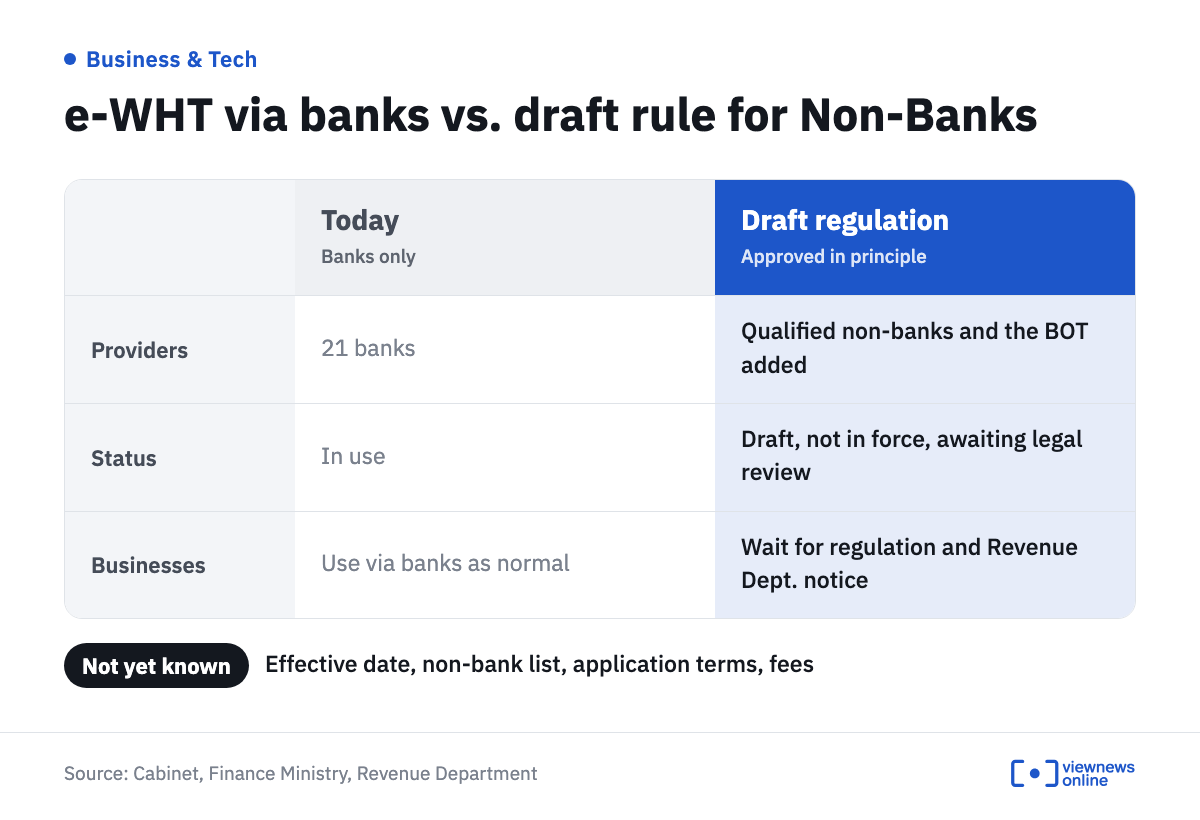
The limit today is the number of providers. Only commercial banks and specialized financial institutions, 21 in total, offer the service.
What the draft regulation would change
The draft has three main points. First, it adds as e-WHT providers any legal entity licensed to provide electronic money transfer services under the payment systems law. That includes non-bank firms that meet set criteria, so not every non-bank company will qualify.
Second, it allows the BOT to remit tax electronically in cases linked to its duties. Examples include when the BOT pays a foreign business for goods or services, or acts as registrar of government securities and pays income to holders. The BOT currently withholds and remits about 2,000 million baht a year in tax on debt instrument transactions and interest payments.
Third, it gives taxpayers another option. They could remit withholding tax, income tax and value added tax through a licensed provider together with the payment, for types of tax and under conditions still to be set.
On the safety of tax money, the Revenue Department and the BOT have been discussing standards for new providers since 2025. The focus is on each provider's qualifications and financial strength, the readiness of its IT systems, keeping prepaid tax funds in separate accounts, and the accuracy and completeness of the data and tax it sends.
Still a draft, awaiting legal review
The matter is still at the approval-in-principle stage. The Finance Ministry says the draft will next go to the Council of State for legal review. Once the regulation takes effect, the Revenue Department will issue a further notice setting the rules, methods and conditions for sending data and tax through e-WHT.
Several details are not yet known. These include the effective date, the list of qualifying non-bank providers, the application conditions and any fees. Businesses should not assume they can use e-WHT through any non-bank app or service yet.
The Finance Ministry says the change will not cost the state revenue. It adds channels and makes remittance easier, and does not cut or waive any tax rate.
The 1% rate is a separate measure
The Cabinet decision adds providers. It does not lower any tax rate. Businesses already using e-WHT through a bank can keep doing so as normal. Those who want to use a non-bank must wait for the regulation to take effect and for the Revenue Department to announce its rules. In the meantime, the one thing to check is whether your bank is among the 21 that offer e-WHT. If you are unsure, check with your bank or the Revenue Department.
The 1% rate is often confused with this decision. It is already in force. It cuts the withholding rate from 5%, 3% and 2% to 1% for certain types of income, when paid electronically, from 1 January 2026 to 31 December 2027. It rests on Ministerial Regulation No. 402 (2026) and Revenue Department Order Tor.Por. 371/2569. The 1% rate does not apply to every type of payment, so you need to check whether the income you pay qualifies.
The Cabinet has also previously extended a separate measure. It lets companies and juristic partnerships deduct twice the cost of investing in, and subscribing to, e-Tax Invoice and e-Receipt systems, subject to the existing cap of 10%, through the end of 2027. That measure is not part of the 24 November 2026 decision.
Source: Statement by the deputy government spokesperson on the Cabinet resolution, information released by the Finance Ministry, and Revenue Department tax measures.
This article is adapted from ViewNews' Thai-language report.