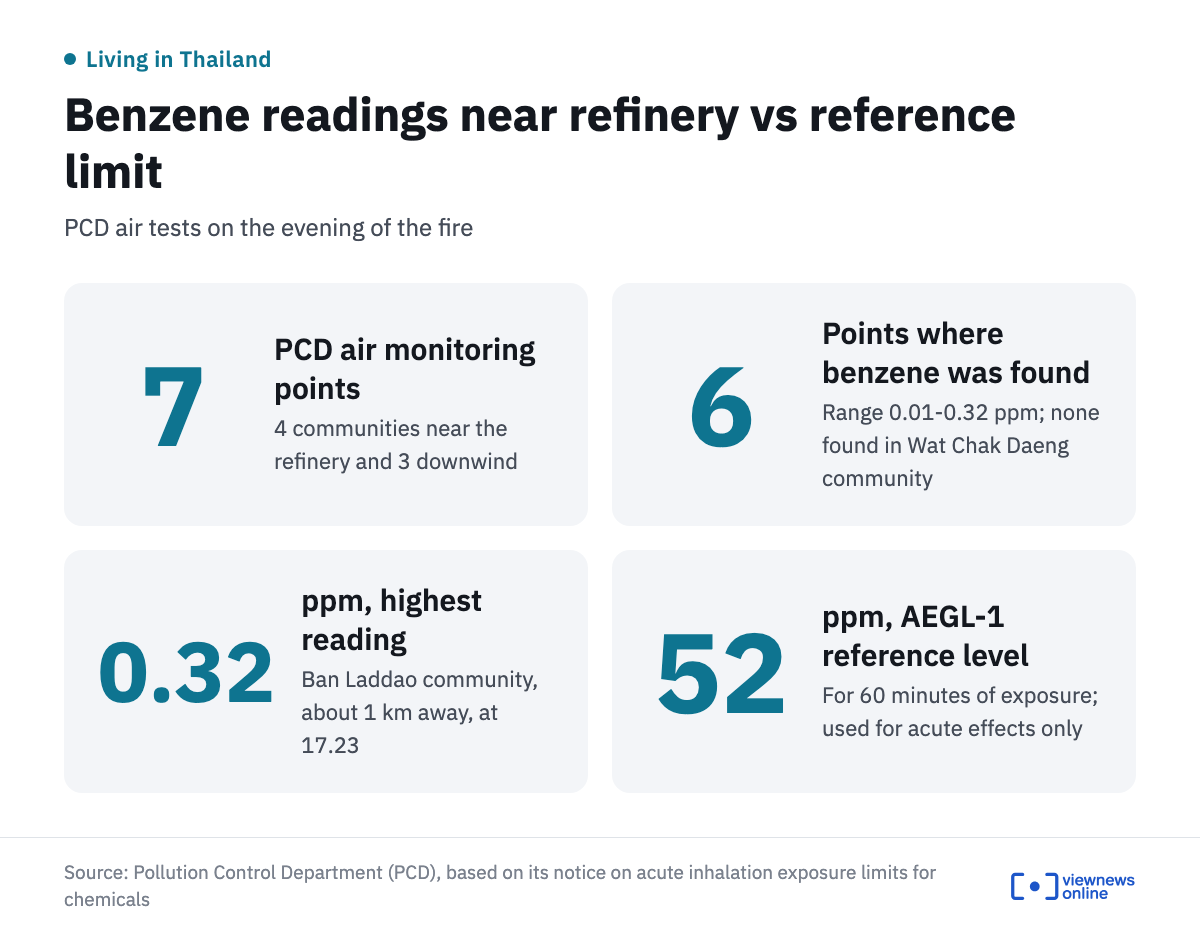
Thailand's Pollution Control Department (PCD) found benzene in the air at 6 of 7 monitoring points around the Bangchak refinery in Phra Khanong, Bangkok, after a fire there on 26 November 2026. Readings ranged from 0.01 to 0.32 ppm, far below the 52 ppm reference level the PCD uses. The PCD said every point was at a level that does not affect public health when judged against short-term (acute) exposure limits. The results cover the evening of the fire only, and the Department of Industrial Works (DIW) is still monitoring the air.
Residents and long-stay foreigners nearby may ask what these numbers mean, whether the oily smell some people noticed is the same thing the instruments measured, and what to do if symptoms appear. This case is a useful template for reading air test results after any factory or fuel depot fire near your home.
What happened at the refinery
Bangchak Corporation told the Stock Exchange of Thailand that a fire broke out at the hydrocracking unit of its Phra Khanong refinery at about 14.45 on 26 November. The fire was under control by about 15.15, roughly 30 minutes later. The company shut down all production units immediately. It reported 9 people injured, 2 of whom had gone home at the time of the report. The cause is under investigation.
The PCD took air measurements between 17.23 and 19.40 on the day of the fire at 7 points. Four were in communities near the refinery, within about 100 metres to 1 kilometre. Three were in downwind communities about 1-5 kilometres away. It tested for benzene, sulfur dioxide (SO₂) and carbon monoxide (CO).
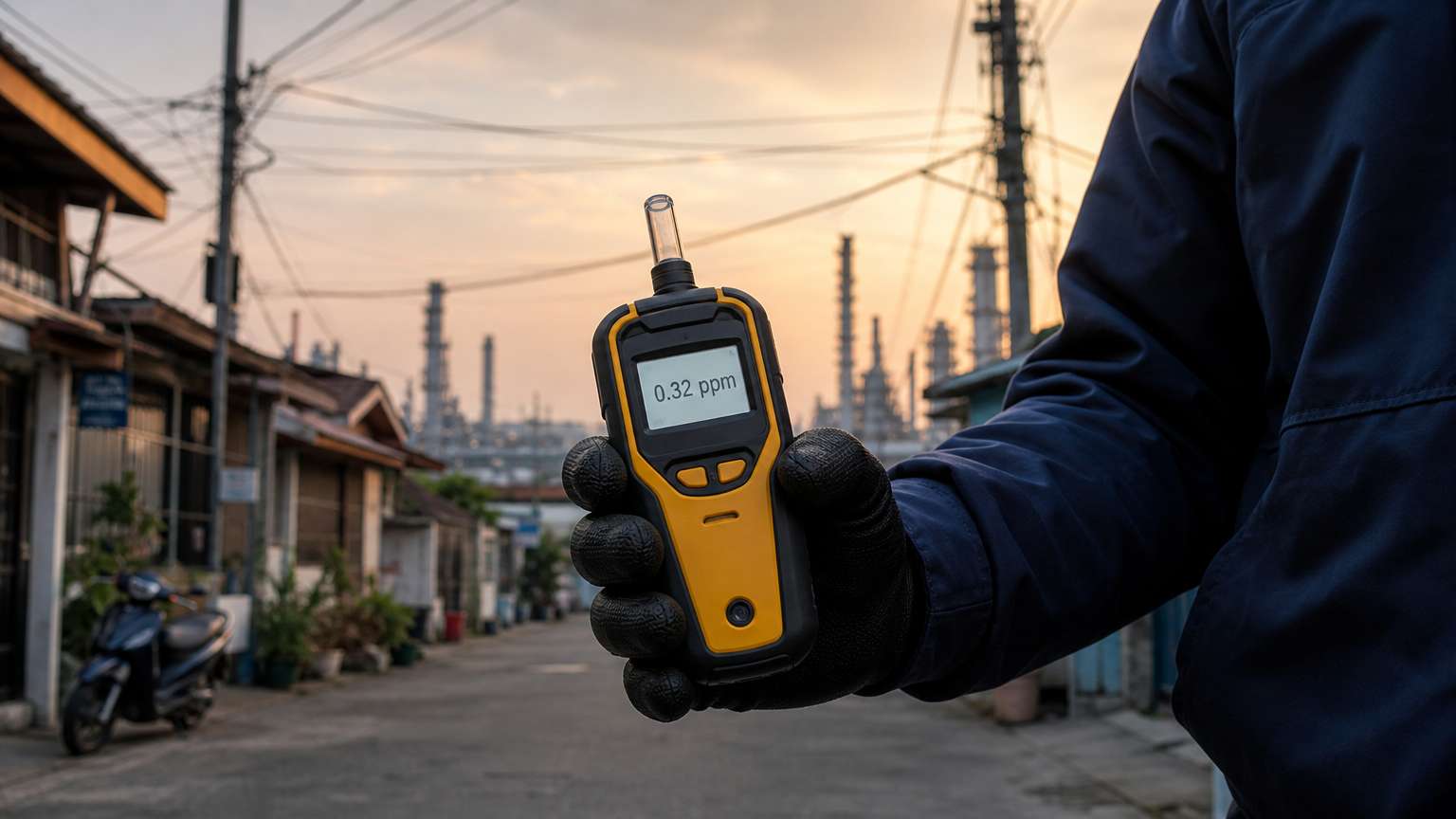
No SO₂ or CO was found at any point. Benzene was found at 6 points, at 0.01-0.32 ppm. The highest reading, 0.32 ppm, was in the Ban Laddao community about 1 kilometre away, at 17.23. No benzene was found in the Wat Chak Daeng community. Because the tests ran from 17.23 to 19.40, the point-by-point figures should not be read as a trend showing the chemical spreading or fading in any direction. Officials did not detect any chemical vapour smell while testing.
How to read the benzene figures
Benzene is a colourless liquid with a petroleum-like smell. It evaporates quickly into the air and catches fire easily. According to the US Agency for Toxic Substances and Disease Registry (ATSDR), it is a key ingredient of unleaded petrol and is also found in car exhaust and cigarette smoke. The ppm figure is a concentration, meaning parts of benzene per million parts of air. A smaller number means less of the chemical in the air.
The PCD compared its readings with the AEGL-1 level for benzene, which is 52 ppm for 60 minutes of exposure. AEGL-1 is a reference level at which people might begin to feel irritation or mild, temporary effects. It comes from a PCD notice on acute inhalation exposure limits for chemicals. The highest reading, 0.32 ppm, is far below it.
There is an important limit to this comparison. As the notice's title says, the benchmark covers acute exposure, which means breathing a chemical for a short time. It does not show that repeated exposure over a long period is safe. ATSDR says that breathing benzene for a long time can affect blood cells and bone marrow, and that long-term exposure can cause leukaemia. That information applies to people exposed continuously for long periods, such as workers where benzene is present. It does not mean this result is a long-term danger. It only means that one evening's readings, compared with an acute benchmark, cannot tell us what the long-term picture looks like.
Smell and instrument readings are a separate matter. The DIW used a mobile monitoring vehicle at 4 points around the plant. It found volatile organic compounds only at the front of Gate 1, which is downwind and where an oily smell was drifting. The other 3 points had none. The DIW said the level found does not cause serious harm but may irritate the eyes, nose and throat and cause headache and tiredness. The PCD, testing in the communities, did not detect a chemical vapour smell. The two reports come from different agencies, at different places, for different substances. They cannot be compared directly, and they do not contradict each other.
Refinery shutdown and continued monitoring
The DIW has stationed an air monitoring vehicle at Gate 3 of the plant. It will test around the clock until 30 November, until officials are confident the surrounding public is safe. Bangchak also said it has automatic air monitors at Phra Khanong, Bang Na and Bang Nam Phueng, and that readings around the refinery are within normal limits.
The Ministry of Industry used Section 39 of the Factory Act to order the refinery to suspend operations temporarily at all of distillation units 1-4 for a full safety check. The fire was at distillation unit 4 (the hydrocracking unit), not at an oil storage depot. The ministry will investigate the cause with the Ministry of Energy before it considers allowing the refinery to restart.
The Office of the Prime Minister said the prime minister has asked the Minister of Natural Resources and Environment to order the PCD to keep monitoring air quality.
What people nearby can do
The DIW says people with existing conditions such as allergies and asthma may be affected more than others. If you smell oil or see smoke in your area, avoid breathing it in. This matches ATSDR advice to avoid breathing smoke from fires.
The DIW lists irritation of the eyes, nose and throat, headache and tiredness as symptoms that the oily-smelling volatile compounds may cause. If you have these symptoms, especially if you have allergies or asthma, see a doctor. ATSDR says tests for benzene in breath or urine are not routine at ordinary clinics, and results cannot show whether health problems will follow. If you are worried about chemical exposure, talk to a doctor or nurse. If you do not speak Thai, check with your clinic or hospital in advance about interpreter services, as we could not confirm English-language support.
To file a pollution complaint, the PCD website (pcd.go.th) has a quick link on its home page to its pollution complaint system. You can call the 1650 hotline or report online. We could not confirm whether English-speaking staff are available, so check with the agency.
When new results are released, check four things before concluding anything about the air: the chemical tested, the time, the distance from the plant, and the benchmark used for comparison. If you have symptoms, or a condition that makes you sensitive to smoke and smells, talk to a doctor or pharmacist before starting or changing any treatment.
Source: Pollution Control Department (Ministry of Natural Resources and Environment), Department of Industrial Works (Ministry of Industry), Bangchak Corporation Public Company Limited (filing to the Stock Exchange of Thailand), the Office of the Prime Minister, and the US Agency for Toxic Substances and Disease Registry (ATSDR).
This article is adapted from ViewNews' Thai-language report.