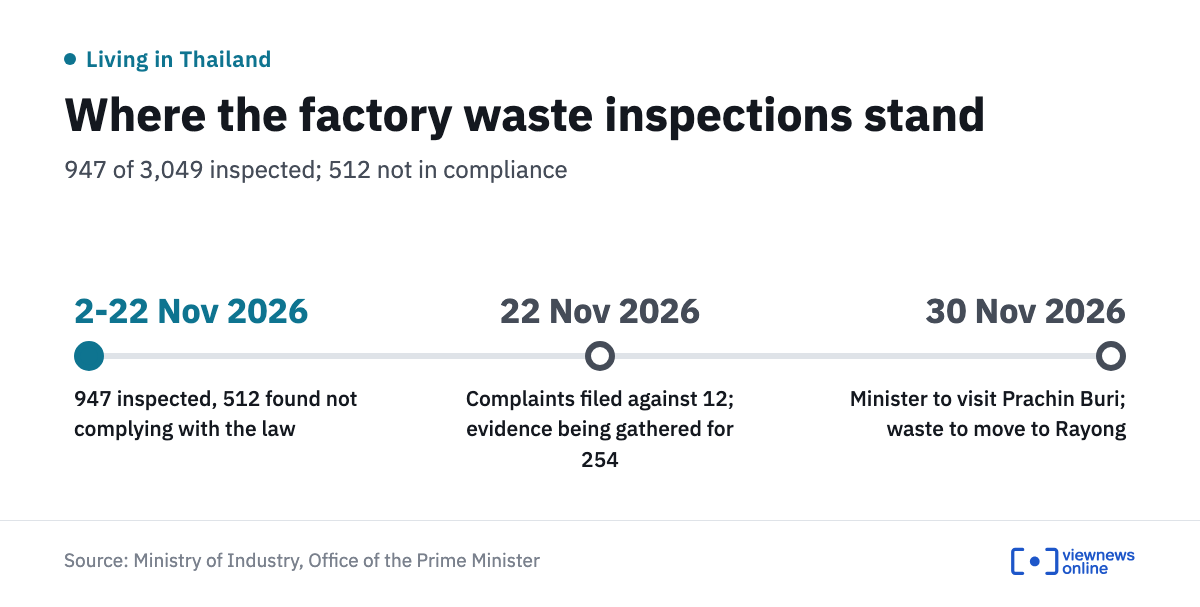
Thailand's Ministry of Industry says inspectors checked 947 factories that handle industrial waste and unused materials between 2 and 22 November 2026. Of those, 512 were not complying with the Factory Act. The figures matter to anyone living near an industrial area, but they are an interim count. They do not cover the whole country, and they are not the number of factories ordered to close.
What the inspections found
The factories inspected are those classed as Type 105 and Type 106 under the Factory Act. These are plants that process or dispose of industrial waste or unused materials. The ministry's target is 3,049 factories nationwide. With 947 done, it has completed 31 percent of the target. About 2,100 factories have no result yet.
Of the 947 factories, 435 complied with the law and 512 did not. More than half of the inspected plants had problems. That does not show what share of all factories break the rules, because inspectors have not yet reached one third of the target.
The ministry has named 10 provinces as priority areas. The target there is 2,381 factories, and 574 have been inspected so far (24 percent). Of those, 415 were not in compliance. The other 67 provinces have a target of 668 factories. Of the 512 non-compliant factories, 415 are in the 10 priority provinces.
Administrative orders and criminal cases
The ministry has issued administrative orders to 483 factories that broke the rules. Another 266 factories are considered liable to criminal prosecution. Officials have so far filed police complaints against 12 of them, in Prachin Buri, Samut Sakhon, Rayong and Chachoengsao provinces. Evidence for the rest is still being gathered. These three figures sit at different stages of the process, so they cannot be added together or compared directly.
An administrative order is a tool the ministry uses itself. For example, it can order an offender to dispose of industrial waste or hazardous waste properly. A criminal case must start with a police complaint, and investigators then collect evidence, so it takes longer. The figure of 266 means factories that may be prosecuted. It does not mean they have been charged in court or found guilty.
The figure of 512 refers to factories found not complying with the law. It is not a closure figure. The briefing gave no closure number, and it did not say that the 483 administrative orders were orders to shut down.
Offenders pay for disposal
The offender is responsible for the cost of disposal. If an offender does not follow an order, government agencies will step in and then sue to recover the costs in a civil case.
Disposal does not always have to wait for a court verdict. The ministry cites Section 35 (3) of the Factory Act and Section 54 (3) of the Hazardous Substances Act, which allow officials to seize evidence for a criminal case. If scientific tests confirm that the material is illegal and poses a high risk to people or the environment, officials treat it as an urgent case under Section 55 of the Hazardous Substances Act. They can then act without waiting for a verdict.
Before acting, officials must coordinate with the investigating officer and obtain a letter saying the investigator has no objection. This lets the disposal of high-risk waste go ahead alongside the criminal case.
What comes next
As of 22 November 2026, 31 percent of the target had been inspected. Police complaints had been filed against 12 factories, and the other 254 of the 266 liable factories were still at the evidence-gathering stage. Inspections of the remaining factories continue.
On 30 November 2026, the Minister of Industry, ministry executives and the Director-General of the Department of Industrial Works (DIW) are scheduled to visit Prachin Buri. They will follow the removal of industrial waste from a factory that has been subject to enforcement action. More than 10 trucks are due to carry it to a disposal site in Rayong. The operator is responsible for the cost of transport and disposal.
In the longer term, the government says the ministry is pushing for a new industrial waste law. It aims to increase penalties and allow the seizure of offenders' assets. Details of the draft have not been released. Residents who spot a suspicious factory should check the DIW's official website or channels for how to file a complaint.
Source: Ministry of Industry and the Office of the Prime Minister, from a briefing on inspections of Type 105 and Type 106 factories. This article is adapted from ViewNews' Thai-language report.