The Thai Red Cross Society's Organ Donation Centre lets people register online as organ donors, through the website organdonate.redcross.or.th or a mobile app. A donor must be no older than 65, must die of brain death, and must be free of infectious disease and cancer. When a registered donor dies, relatives should call the centre on 1666 straight away and must sign a written consent form.
Registering is called expressing an intention to donate. It tells the centre in advance that you plan to donate, but it does not settle the matter on its own. Your relatives still have a role on the day. This article sets out the steps, based on information from the Organ Donation Centre of the Thai Red Cross Society.
Ways to register your intention to donate
There are two online options: the website organdonate.redcross.or.th and the app "Donate Eyes-Organs" (บริจาคดวงตา-อวัยวะ). A "Register your intention" button is also on the home page of eyeorgandonate.redcross.or.th. You can register from a phone or computer without travelling anywhere.
To register in person, the centre lists these places:
- The Organ Donation Centre, Thai Red Cross Society, 5th floor of its building on Rama 4 Road. It is open 08.30-16.30, except on public holidays.
- Provincial Red Cross chapters, including every provincial Red Cross sub-branch office.
- Provincial hospitals under the Ministry of Public Health, or hospitals run by state universities.
- District offices, Bangkok district offices, municipalities and Pattaya City, but only those that issue Thai national ID cards.
Registration points reach down to province and district level, so people outside Bangkok have options near home. Check first that the place you plan to visit is one of the types the centre lists.
The centre's FAQ page does not say whether foreign nationals can register or whether a Thai ID number is required. It lists only age and health criteria. The eye donation site has a TH/EN switch in its header. If you are not a Thai citizen, call the centre on 1666 before relying on a registration.
Donor criteria for organs and eyes
The criteria for organs and eyes are different. An organ donor must be no older than 65, must die of brain death, and must be free of infectious disease and cancer. The centre also lists no chronic illness such as diabetes or high blood pressure, and no alcohol dependence. For eyes, the centre says donors can be aged 4-75.
If you are unsure whether you qualify, see a doctor first. The Eye Centre takes calls on 08 1902 5938 and 08 1836 4927 around the clock, or on 0 2256 4039-40 during office hours. For organs, the Organ Donation Centre uses 1666 and 0-2256-4045-6. The two are separate centres, so use the right number.
Which organs and tissues can be donated
According to the centre's FAQ, a deceased donor can give 2 kidneys, 2 lungs, the heart, the liver and the pancreas. Tissues that can be donated are heart valves, blood vessels, skin, bone, tendons and corneas.
Living donors are more restricted. They can give 1 kidney, part of the liver, or bone marrow, and only to a blood relative or to a spouse who has been legally registered as married for at least 3 years. A deceased donor, by contrast, can give several organs and the tissues listed above.
Donating your body for medical study is a separate matter from organ donation. If you are interested, ask the organisation that accepts body donations directly.
What relatives should do after a registered donor dies
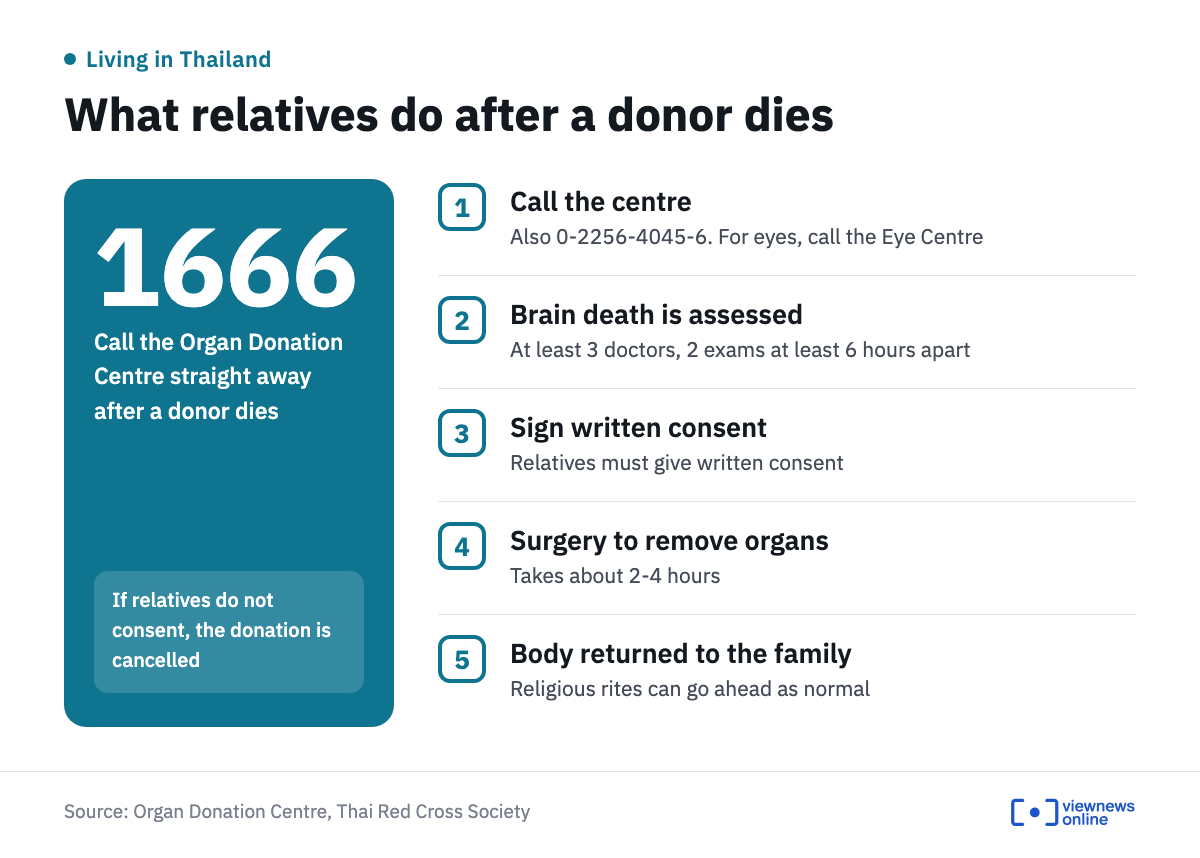
The first thing relatives should do is call the Organ Donation Centre on 1666 or 0-2256-4045-6. For eye donation, they should call the Eye Centre on the numbers above. Relatives should keep these numbers somewhere easy to find.
The centre highlights three points in the organ donation process:
- Brain death must be assessed by at least 3 doctors, in 2 examinations at least 6 hours apart.
- Relatives must give written consent.
- The operation to remove the organs takes about 2-4 hours. The centre then prepares the body and returns it to the family, so religious rites can go ahead as normal.
Why you should tell your family beforehand
The centre says that if relatives do not consent, the donation is cancelled, even if the person had registered. For that reason it advises telling your family in advance. Whichever channel you register through, let your relatives know that you intend to donate.
People with a long-term health condition, or with health concerns, should talk to a doctor before deciding. This applies especially to anyone thinking of donating a kidney or part of the liver while alive.
Source: Organ Donation Centre, Thai Red Cross Society (organdonate.redcross.or.th) and the Eye Centre, Thai Red Cross Society (eyeorgandonate.redcross.or.th). This article is adapted from ViewNews' Thai-language report.