Thailand's national disaster command headquarters on 21 November put Deputy Prime Minister Yodchanan Wongsawat in charge of tackling arsenic contamination in the Kok and Sai rivers in the far north. Yodchanan is also Minister of Higher Education, Science, Research and Innovation. Talks with other countries over cross-border pollution will continue until late December. Residents of the Kok and Sai river basins, and anyone buying rice or farm produce from upper northern Thailand, should know which steps have started, which await test results and which are still only discussions or studies.
Yodchanan to lead the response; China and Myanmar talks still at discussion stage
The meeting was held at Government House and chaired by Prime Minister Anutin Charnvirakul. It reviewed the situation and efforts to deal with contaminants in water sources, especially arsenic in the Kok and Sai rivers and other waters in the upper north.
The new element was the appointment of a team leader. Anutin assigned Yodchanan to oversee the response. He also told the Ministry of Higher Education, Science, Research and Innovation to coordinate academic and technical cooperation with China and friendly countries. The goal is for all sides to share reference data on toxin levels, standard values and measures to reduce or remove the toxicity.
On the cross-border side, the prime minister said the government has raised transboundary water pollution with China's leader. He said the problem is linked to mining and mineral processing in Myanmar, and that China has said it is ready to cooperate, including with technical support. These are the prime minister's statements. They are not a finding on where the arsenic in the rivers comes from.
Anutin also ordered tight checks on chemicals and electronic waste, out of concern that they could add to existing environmental problems. This is an instruction to inspect. It does not say problems from either have been found in the Kok or Sai basins.
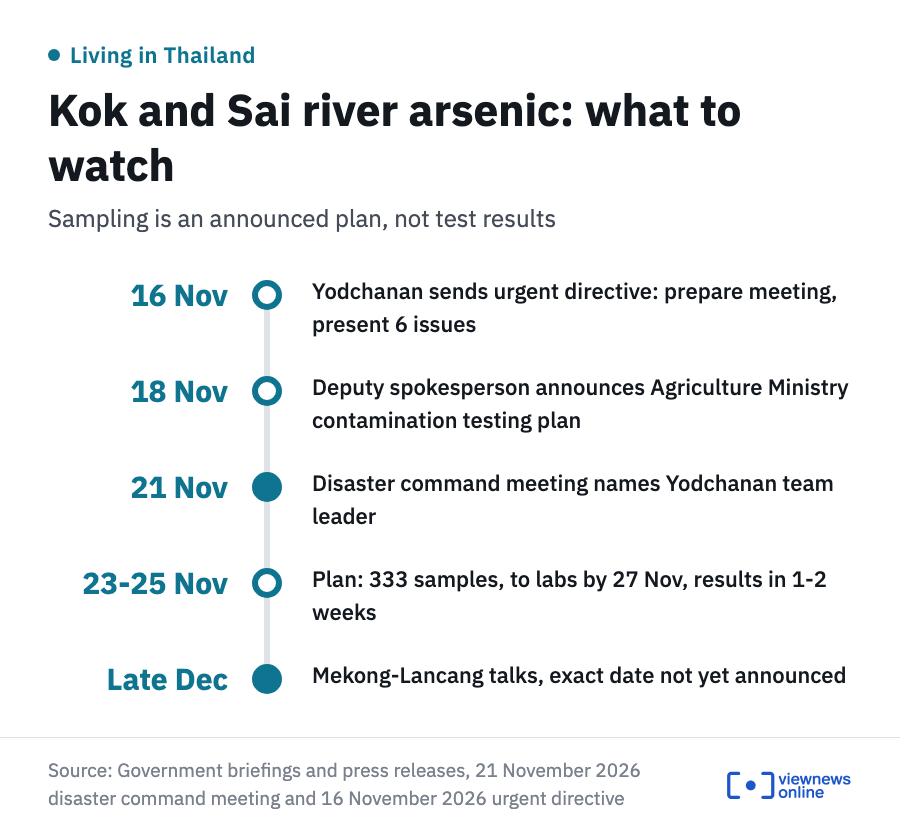
Timeline: from the directive to the Mekong-Lancang talks
Several agencies are working in parallel, and each item is moving at a different pace.
- 16 November: Yodchanan sent an urgent directive asking agencies to prepare for a meeting of the northern disaster committee and to present 6 issues.
- 18 November: A deputy government spokesperson announced the Ministry of Agriculture and Cooperatives' plan to test for contamination.
- 21 November: The disaster command headquarters met at Government House and named Yodchanan team leader.
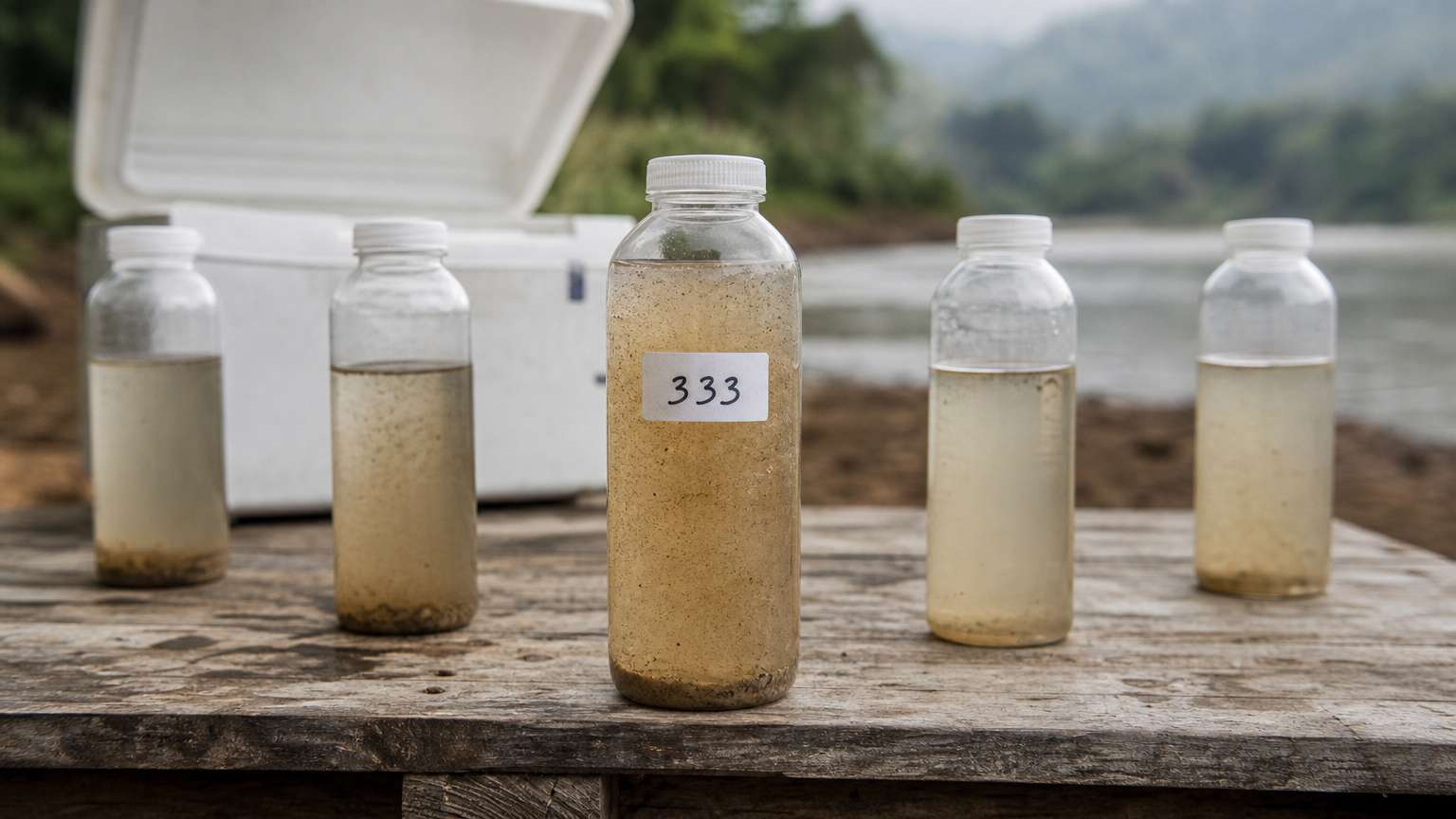
- 23-25 November: Under the announced plan, 333 samples are to be collected and sent to labs by 27 November. Results are expected within 1-2 weeks.
- Next week, according to the prime minister: talks under the cooperation framework of the river basin countries, followed by a Mekong-Lancang Cooperation meeting in late December. Dates for both have not been announced.
The team and the assignments are in place. The sampling is still an announced plan, and there is no confirmation yet that it is running on schedule. The international talks are waiting for firm dates. Once the government announces the dates and venues, observers can see whether the talks have produced any agreement.
To follow developments, watch government briefings and press releases, along with announcements from the ministries and agencies involved. These include the science ministry's oversight team, the Ministry of Agriculture and Cooperatives, disaster management agencies, and public health and food authorities.
Where things stand: done, awaiting tests, under discussion, unanswered
Done: a team leader has been named. The science ministry has been told to coordinate technical work with China and friendly countries. The government has raised cross-border pollution with China's leader, according to the prime minister.
Awaiting tests: the Ministry of Agriculture and Cooperatives plans to collect 333 samples. Of these, 250 are soil and water samples from farm plots and 83 are irrigation water samples. They are to go to labs on the planned schedule, with results expected within 1-2 weeks. These figures are a plan, not test results.
Still under discussion: international talks. The prime minister said they will take place under the river basin countries' cooperation framework and then at the Mekong-Lancang Cooperation meeting, which includes China, Myanmar, Thailand and other members.
Proposals and studies: Yodchanan's directive asked agencies to prepare approaches on 6 topics:
- controlling the sources of contamination and considering limits on mineral imports
- studying sediment-trapping weirs
- monitoring the environment and food
- protecting public health
- finding new raw water sources
- urgent help for residents
All of these are issues to be presented, not decided measures. Import limits and sediment weirs are still being considered and studied. Finding new raw water sources is not an approved project either.
Still unanswered: three questions remain open.
- Who will announce the sample results, and through which channel.
- The source of the arsenic. The prime minister pointed to mining and mineral processing in Myanmar, but that is a statement, not a technical conclusion.
- The effect on rice and tap water. There is no confirmed information on how far crops or tap water in any area have been affected.
Consumers should wait for test results and official announcements rather than rely on information with no clear source.
Source: Thai government briefings and press releases on the 21 November 2026 disaster command headquarters meeting; the 18 November 2026 briefing by the deputy government spokesperson on the Ministry of Agriculture and Cooperatives' testing plan; and Yodchanan Wongsawat's urgent directive of 16 November 2026. Details of the testing plan and the directive are as stated in those briefings and that letter.
This article is adapted from ViewNews' Thai-language report.