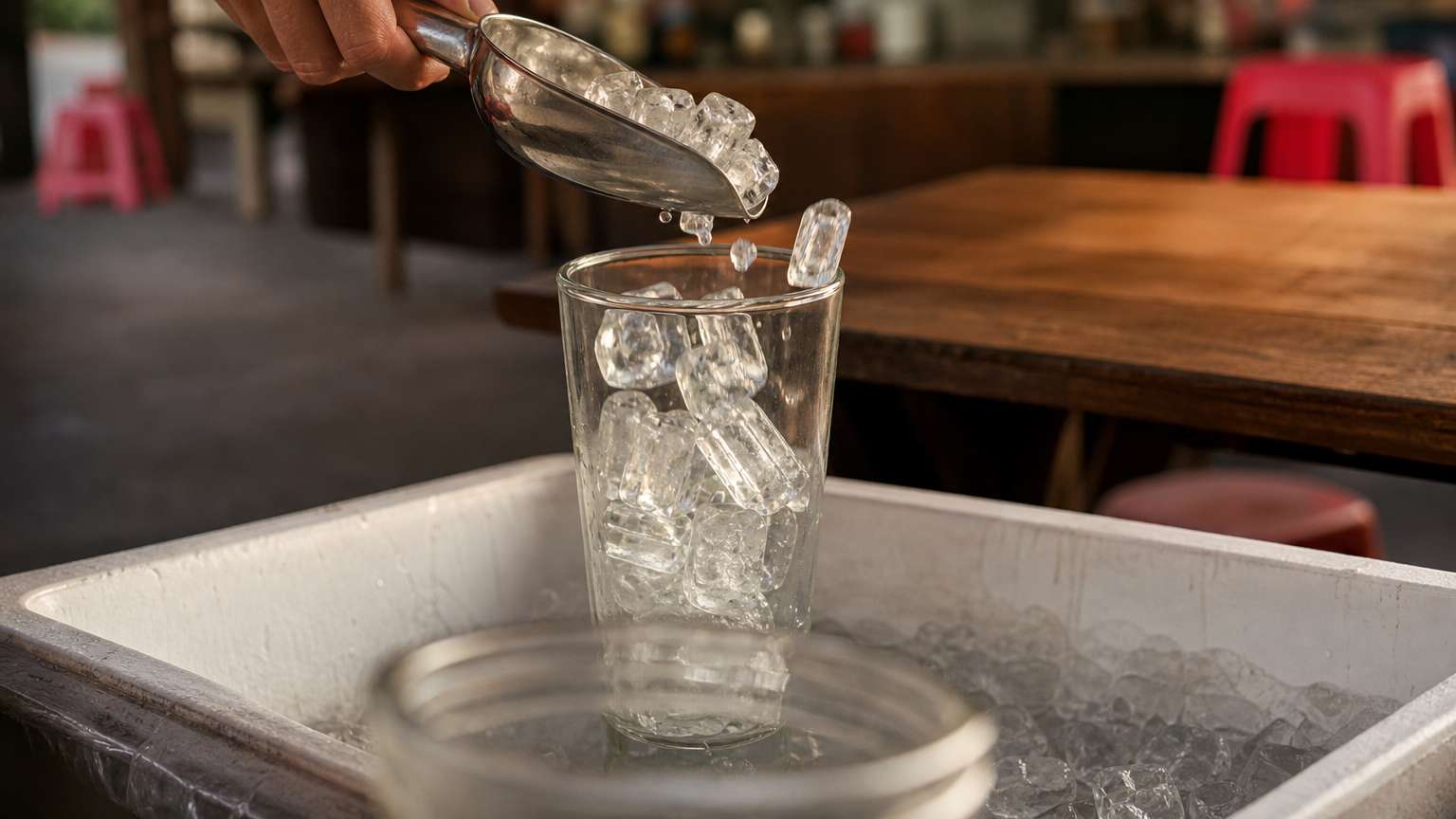
Thailand's Food and Drug Administration (Thai FDA) has issued guidance telling bottled water makers, ice plants and food producers to check their water sources and filtration systems for arsenic and other heavy metals. Boiling water does not remove arsenic, the agency said. The 0.01 mg per litre limit applies to drinking water in sealed containers and to ice.
The Thai FDA announced the guidance on 20 November 2026. Pharmacist Supattra Boonserm, the agency's secretary-general, said boiling cannot remove arsenic or heavy metals. Safety therefore depends on how producers manage their water from the start of production.
The agency said it is concerned about arsenic and heavy metal contamination in polluted water sources. It said arsenic and some heavy metals dissolve in water and usually have no colour, smell or taste, so they cannot be spotted by eye. High exposure, or exposure that builds up over a long time, can affect the nervous system, liver and kidneys. It can also raise the risk of some cancers.
The legal limit versus the recommendations
The figure that matters to consumers is in Ministry of Public Health Notification No. 462 (2025). It says drinking water in sealed containers, and ice, must contain no more than 0.01 milligrams of arsenic per litre. The same notification also controls cadmium, organic mercury and lead at set limits.
Food and ingredients must meet Ministry of Public Health Notification No. 414 (2020) on contaminants in food. The Thai FDA's announcement did not give limits for other heavy metals. It also did not list which provinces are considered high risk.
The 0.01 mg per litre limit is already a requirement. The producer measures are guidance. They cover choosing raw water sources, choosing filtration technology, checking that equipment works, and testing product samples in a laboratory. The Thai FDA used the word "should" for many of these steps and urged producers to follow them strictly. It did not state penalties, deadlines or an enforcement date.
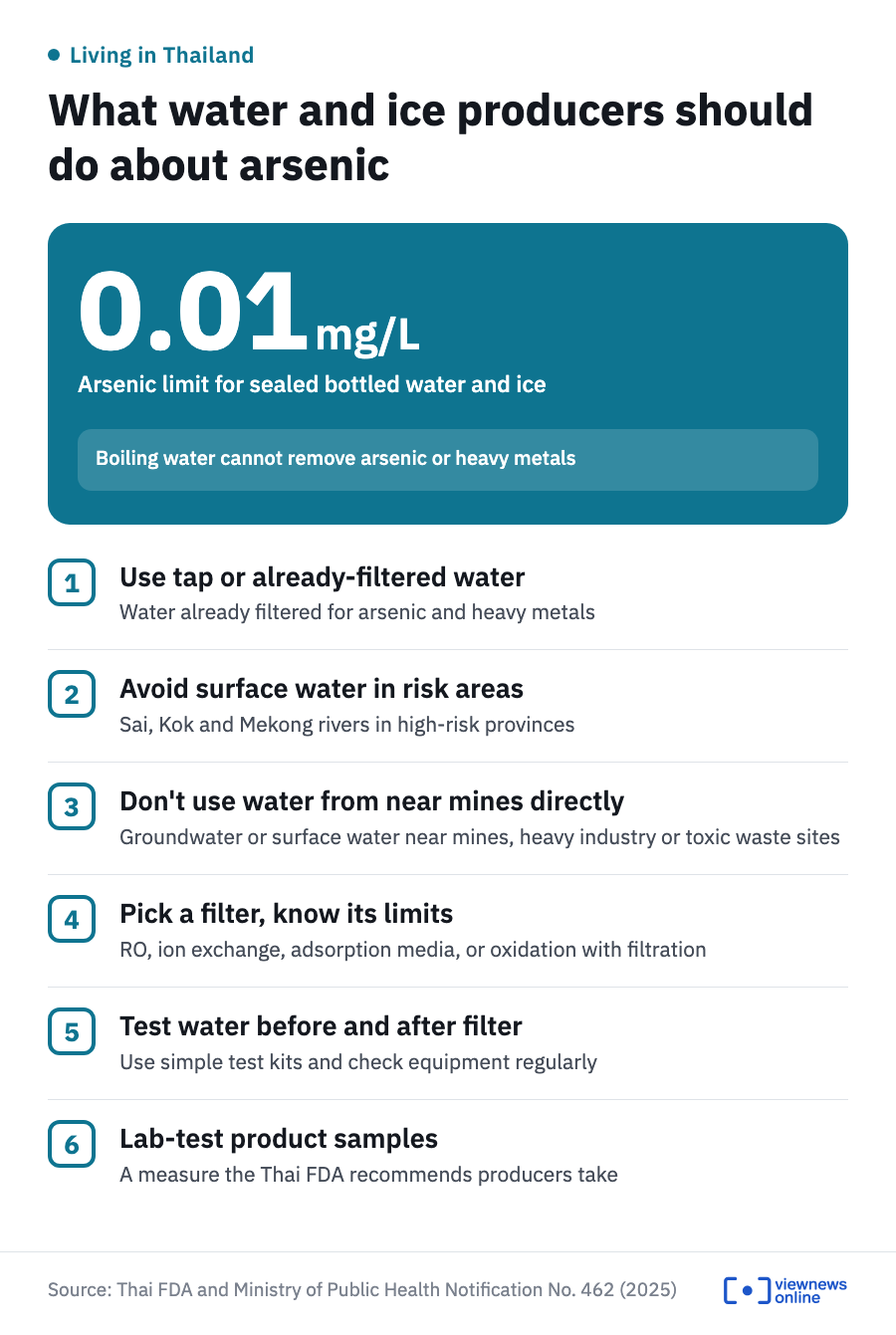
What producers should look for in water sources
The Thai FDA advises producers to use tap water, or water already filtered for arsenic and heavy metals, when making food. It says to avoid surface water from the Sai River, the Kok River and the Mekong River in high-risk provinces.
It also advises against using groundwater or surface water near mining areas, heavy industrial zones, or sites with toxic or industrial waste directly in food production.
Because these substances have no colour, smell or taste, clear water is no sign of safety. Producers have to rely on source selection, filtration and water testing, not boiling or visual checks.
Four filtration systems and their limits
The Thai FDA recommends four types of filtration.
- Reverse osmosis (RO): Water passes through a membrane with 0.0001 micron pores. The agency calls it the most effective option, removing more than 95-99% of arsenic and heavy metals. Producers must check the membrane's integrity for every production batch and clean it.
- Ion exchange: An anion resin captures the negatively charged forms of arsenic and heavy metals. It suits water with few interfering minerals. Producers must measure the electrical conductivity of filtered water. A high reading means the resin is exhausted and must be regenerated with acid or alkali.
- Adsorption media: Materials such as activated alumina or iron-based media hold arsenic on their surface and also adsorb other heavy metals. Performance depends on the water's pH. High fluoride or phosphate can compete for surface space and reduce effectiveness.
- Oxidation and filtration: Chlorine or ozone converts arsenic from As3+ to As5+. Alum or iron then makes it settle out, and the water goes through sand filtration. The Thai FDA says this suits large plants using a lot of water and can remove lead, copper and manganese. It is not suited to highly soluble metals that do not settle easily with iron, such as cadmium, mercury and nickel.
Whichever system is used, the agency advises regular checks of the filtration equipment. Producers should test water quality with simple test kits both before and after filtering.
What restaurants and buyers can ask suppliers
The announcement is written mainly for producers and has no steps for consumers. Restaurants, businesses that buy ice, and bulk buyers of drinking water can still use the guidance as a list of questions for their suppliers:
- Is the production water tap water, or water filtered for arsenic and heavy metals?
- Does the supplier avoid surface water from the Sai, Kok and Mekong rivers in high-risk provinces, and groundwater near mines and heavy industry?
- Which filtration system is used, and does the supplier know its limits?
- Are the membranes or filter media checked as that system requires?
- Is water tested with simple kits before and after filtering?
Good answers show a supplier knows the Thai FDA guidance. They do not prove the water is safe. The 0.01 mg per litre limit for sealed drinking water and ice applies to every producer under Notification No. 462.
Anyone worried about exposure to arsenic or heavy metals, or who has unusual symptoms, should see a doctor.
Frequently asked questions
Does boiling water remove arsenic? No. The Thai FDA says boiling cannot remove arsenic or heavy metals.
What is the arsenic limit for bottled water and ice in Thailand? No more than 0.01 milligrams per litre, under Ministry of Public Health Notification No. 462 (2025).
Can I tell by looking whether water contains arsenic? No. Arsenic and some heavy metals are usually colourless, odourless and tasteless.
Source: Thai Food and Drug Administration press release, and Ministry of Public Health Notifications No. 462 (2025) and No. 414 (2020) as cited by the agency.
This article is adapted from ViewNews' Thai-language report.