Thailand is preparing an income tax exemption for money spent repairing property damaged in the southern floods. It could apply to landlords, freelance professionals, contractors, business owners and companies. The Cabinet approved the principle of a draft royal decree on 17 November 2026, at the proposal of the Finance Ministry. It is still only a draft and not yet law, so nobody can claim the exemption now.
The draft is separate from a second flood measure approved in the same Cabinet resolution, a deduction for home and car repair costs. People affected by the floods should know who each measure covers, how they differ and what to prepare.
Who may qualify for the exemption
The draft royal decree is open to both individuals and companies. Individuals must have income under Section 40 of the Revenue Code, in four categories: (5) rental income from property, (6) income from independent professions such as lawyers, doctors, engineers and architects, (7) income from contracting work, and (8) income from business.
Eligible taxpayers would be exempt from income tax at 100 percent of income (expenses deductible at 2 times). Companies would get a similar corporate income tax exemption, limited to the amount spent on repairing property. This is the wording of the Cabinet resolution. How it works out in baht must wait for the actual decree, so no worked examples are possible yet.
On location, the property must be in an area the government has declared a disaster zone or an emergency disaster-relief area. If you are not sure whether your area is covered, wait for the official announcement and the published draft rather than guessing.
The Cabinet announcement, as reported, does not say whether the rules differ for non-Thai taxpayers. Foreign residents and foreign-owned companies with income in these categories should check with the Revenue Department before relying on the measure.
How it differs from the home and car repair deduction
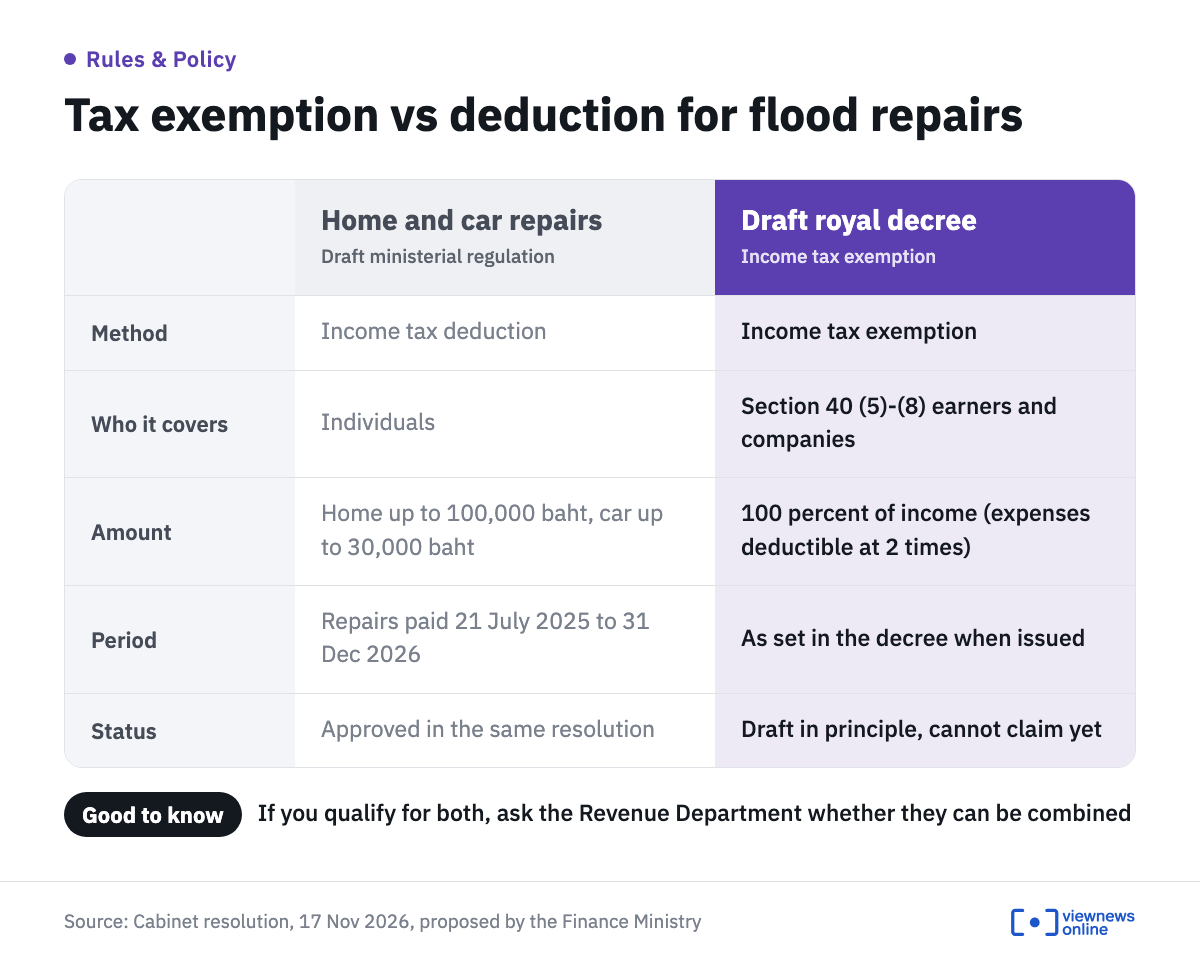
The home and car repair measure is a draft ministerial regulation. It lets individuals deduct repair costs from taxable income. Home repairs, including cleaning and materials, can be deducted up to 100,000 baht. Car repairs, including equipment and accessories in the car, can be deducted up to 30,000 baht. If you repair several properties or vehicles, the amounts you actually paid are added together, but the total cannot exceed those caps.
The first difference is the method. The home and car measure is a deduction with baht caps. The royal decree is an exemption from income tax. The second is who it covers. The royal decree names only Section 40 (5) to (8) income and includes companies, while the home and car measure is written for individuals.
If you qualify for both, ask the Revenue Department whether they can be used together once the rules are announced.
The home and car measure covers flood damage between 21 July 2025 and 31 December 2025, with repairs paid for between 21 July 2025 and 31 December 2026. Claims are made for tax year 2026 when filing personal income tax returns between January and March 2027. Those dates belong to the draft ministerial regulation. The draft royal decree has its own period, which should be checked in the text once it is published.
Where things stand
Under the 17 November 2026 resolution, the Cabinet has approved only the principle of the draft. It is not yet in force. The royal decree must be published in the Royal Gazette before anyone can use the exemption, and no date has been set.
For the home and car measure, the resolution says the Revenue Department must issue a notice setting out the procedures and conditions once the ministerial regulation takes effect. If you have already repaired your property or are still repairing it, keep your records and compare them with the actual conditions when they are announced.
Documents worth keeping
This is general advice, not an official requirement. The authorities have not yet said which documents will be needed. These records are basic proof of repair spending, so keeping them now is sensible.
- Receipts or tax invoices for repairs, cleaning and materials
- Proof of payment with a clear date, such as a transfer slip or a signed receipt
- The repair contract or the contractor's quotation
- Photos of the damage before and after repair
- Proof that you own or use the property, such as a title deed or lease
- Documents showing the property's location, to compare with the areas the government declares
Clear dates matter because the home and car measure is tied to the date of damage and the date of payment. If the royal decree has similar conditions, dated records will help. If you repair more than one property, keep documents separate for each, since the home and car measure adds up costs across properties. Business owners and companies may also want to list flood repair costs separately from ordinary business expenses, which makes later checks easier.
What is still unclear
Several points must wait. These include when the royal decree is published in the Royal Gazette and takes effect, how the exemption is calculated under the wording 100 percent of income (expenses deductible at 2 times), and which areas the government declares, which will decide whether each property qualifies. The period for damage and repair payments should be read from the draft once the royal decree is issued.
For individual cases, such as a property in an uncertain area or income of several types, ask the Revenue Department directly once the announcement is made. This article is not personal tax advice, and the details may change if the draft is revised before it is issued.
Source: Cabinet resolution, proposed by the Finance Ministry and announced by the Deputy Government Spokesperson, Prime Minister's Office.
This article is adapted from ViewNews' Thai-language report.