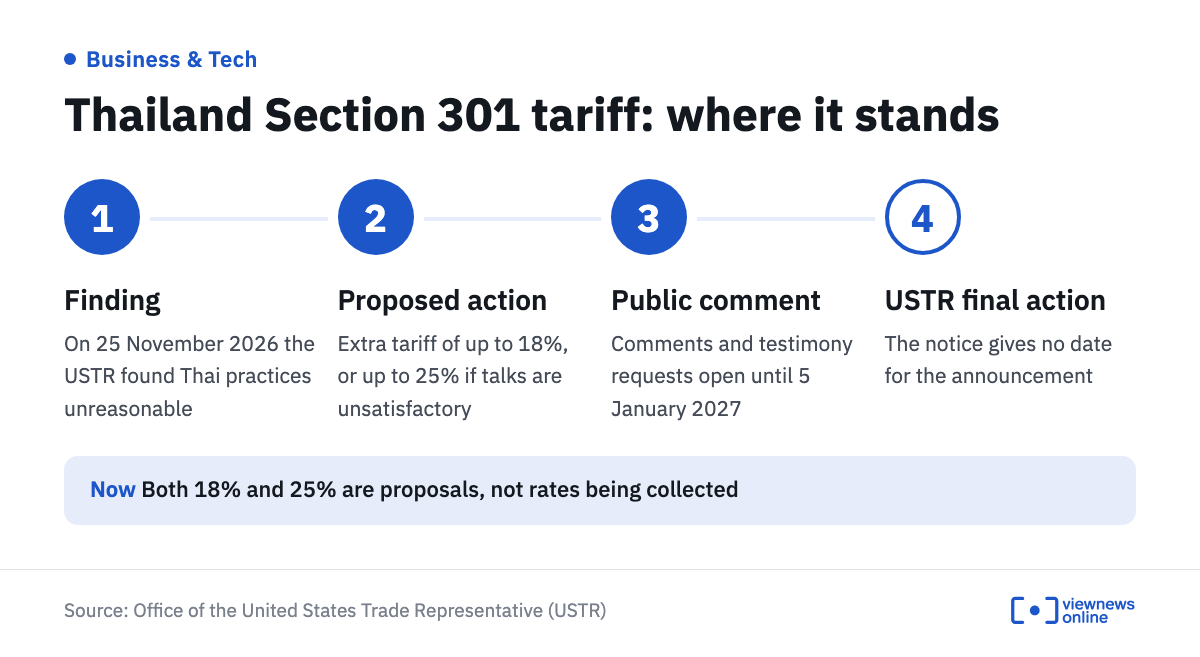
The Office of the United States Trade Representative (USTR) found on 25 November 2026 that Thailand's practices on structural excess capacity in manufacturing are unreasonable and burden US commerce. It proposed an additional tariff of up to 18% on Thai goods as its main proposal. It also set out an option of up to 25% if it finds that ongoing talks and existing commitments are unsatisfactory. Both figures are proposals open for public comment until 5 January 2027. Neither is a rate that is being collected.
No tariff under this action applies to Thai goods now. The USTR notice does not say when a final action will be announced. Anyone affected can file comments or ask to testify before the deadline. The proposal may matter to exporters, foreign-owned factories in Thailand and businesses that import or export through Thailand.
What USTR announced about Thailand
The USTR found under Section 301 of the US Trade Act of 1974 that the practices of 14 economies are unreasonable and burden or restrict US commerce. That makes them eligible for action under Section 301(b). The 14 are China, the European Union, Singapore, Switzerland, Indonesia, Malaysia, Cambodia, Thailand, South Korea, Vietnam, Taiwan, Bangladesh, Japan and India. The USTR has not yet made findings on Mexico and Norway, although both are part of the same investigation.
For Thailand, the USTR proposed considering an additional tariff of up to 18% on all Thai goods, except those listed as exempt in the notice. The notice also sets out the higher option of up to 25%. Both figures are put out for comment. Neither has been decided.
The notice names five problem areas in Thailand:
- State industrial plans aimed at expanding production and exports
- Barriers to market access for manufactured goods, such as import bans and import licensing
- Promotion of production and exports through special credit and other state support, especially in the auto sector
- Weak labor protection laws and enforcement
- Failure to deal with global excess capacity, including imports and direct investment from non-market economies
The USTR says the effects are clearest in electronics, vehicles, machinery and electrical equipment.
The notice also cites trade figures. It says Thailand's trade surplus with the United States was about US$34.5 billion in 2021 and rose to US$71.2 billion in 2025. The Thai government disputes the findings. It says Thailand's industrial development follows a transparent, rules-based framework designed to attract investment in line with long-term development plans. It also says capacity utilization in each sector matches or exceeds the global industry average. The USTR replied in the notice that it stands by its original findings.
Where the Section 301 process stands
Under Section 301, once the USTR finds that another country's practices qualify, it can act. That includes imposing tariffs or restricting imports from that country until the practices end.
The investigation began in early 2026 and covers 16 economies. One round of public comment and hearings has already taken place. The USTR asked to hold talks with Thailand on the day the investigation began, and the two sides did meet. The USTR says the talks did not resolve US concerns.
In the first round, more than 1,070 written comments were filed and nearly 140 witnesses testified. The USTR combined this with government-to-government talks and advice from advisory committees to prepare a report on each economy.
In terms of steps, the investigation has passed the finding stage and the proposal stage. It is now in the comment stage on the proposed action. The next step is for the USTR to decide on and announce its final action. The notice does not say when.
In this round the USTR is asking for views on several questions:
- Which goods should be taxed and which should be excluded
- What tariff rate suits some or all Thai products
- Whether the rate should be adjusted to reflect Section 301 and Section 232 tariffs already in place
- Whether to open multilateral negotiations to address excess capacity
Other countries, the framework and proposed exemptions
In its press release, the USTR proposed rates of up to 18% for Malaysia, Indonesia, Cambodia and Bangladesh, the same as Thailand. These are also proposals that must go through public comment.
The USTR says the proposal for Thailand takes into account the Section 301 and Section 232 tariffs already in force, the talks still under way, and commitments related to some of the concerns in the Framework for an Agreement between the United States and Thailand on Reciprocal Trade. It is asking how well the framework addresses the issues raised in the investigation. It also asks whether the rate should be adjusted to reflect those commitments and the rates announced in the framework.
Four groups of goods are proposed for exemption:
- Goods already subject to Section 232 tariffs: aluminum, steel and copper products; passenger cars and light trucks and their parts; medium and heavy trucks and their parts; wood products; patented pharmaceuticals; and semiconductor products
- Informational materials such as books, donations, and baggage accompanying travelers
- Goods listed in an annex to the notice, including raw materials where a tariff could cause shortages in the US domestic supply
- Certain iron ores and concentrates
The USTR is seeking comment on which products should be inside or outside the scope of the proposal.
What exporters can do while waiting
Anyone affected can submit comments or request to testify through the USTR portal at comments.ustr.gov. No account is needed. All documents must be in English. People filing on behalf of an organization, such as a law firm, trade association or customs broker, must give the organization's full legal name and a main contact.
- Written comments are due by 5 January 2027 under docket USTR-2026-0739.
- Requests to appear at the hearing, with a summary of testimony, are due the same day under docket USTR-2026-0741.
- The hearing begins on 25 January 2027 at 10:00 a.m. at the U.S. International Trade Commission (USITC), 500 E Street SW, Washington, D.C.
- Questions about filing can go to the USTR Section 301 help line at (202) 395-5725.
The USTR says it will announce more hearing details later. It says filing on time is a condition for comments to be considered. It will make submissions public, except information marked as confidential business information. Filers must mark that information clearly, certify in writing that disclosure would harm trade secrets or profits, and attach a public version.
While waiting, exporters can check their products against the annex to the notice and the Section 232 product groups. The USTR is asking specifically which goods should be in or out of scope. When commenting on products, it asks filers to say whether the product is an essential raw material whose tariff would cut US domestic supply or disrupt the wider economy. It also asks whether taxing the product would help end the practices the USTR has found.
Source: Office of the United States Trade Representative (USTR), press release on determinations and proposed actions in 14 Section 301 investigations, and the Thailand Notice of Determination and Request for Comments (dockets USTR-2026-0739 and USTR-2026-0741). This article is adapted from ViewNews' Thai-language report.