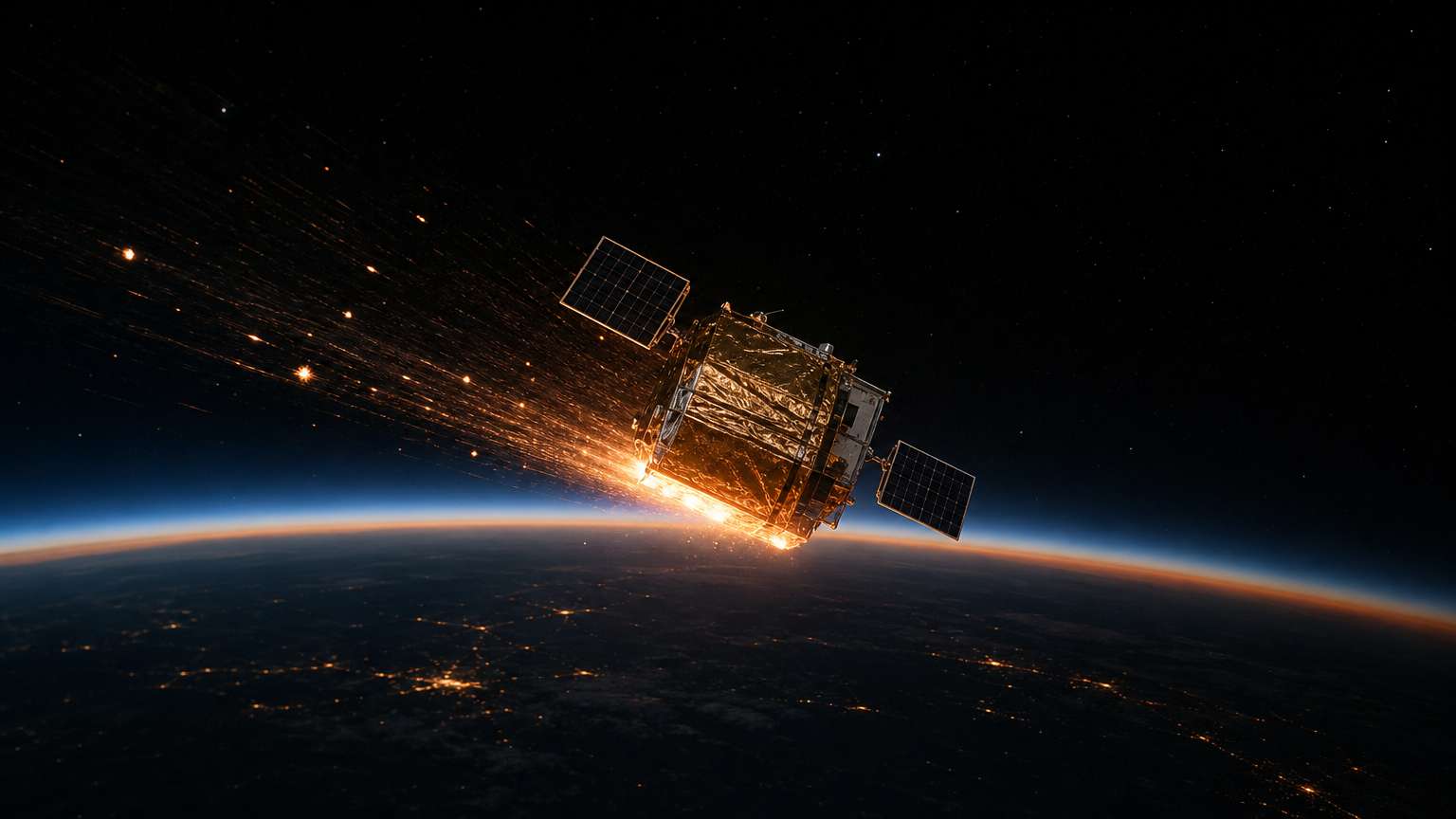
NASA's Swift satellite, which weighs about 3,200 pounds, is expected to re-enter Earth's atmosphere on Wednesday, 4 November 2026. Most of it will burn up, but some pieces will survive. NASA puts the chance that anyone on Earth is harmed at about 1 in 2,100 and calls that unlikely.
Surviving pieces can only land between 20.6 degrees south and 20.6 degrees north latitude. That band covers all of Thailand, according to the Thai Meteorological Department's coordinates. Being inside the band does not mean debris is expected to land in Thailand. This article explains how to read the timing, the risk figure and the latitude band.
When the satellite is expected to fall
NASA's Swift mission blog says the U.S. Space Force expects re-entry at about 03:30 EST on 4 November, with an uncertainty of 11 hours. The actual time could be up to 11 hours earlier or later. Swift was launched nearly 22 years ago. NASA says the mission ended before re-entry, and its Swift page says the science mission has been concluded.
The following conversion is our own calculation, not a NASA figure. EST is 5 hours behind UTC, and Thailand is 7 hours ahead of UTC, so the two differ by 12 hours. That puts 03:30 EST at about 15:30 in Thailand. Allowing 11 hours either way, the window runs from about 04:30 on 4 November to about 02:30 on 5 November Thailand time.
A window that wide means it is not yet possible to say whether re-entry will happen in Thai daytime or at night. NASA says it is tracking the satellite with the U.S. Space Force and will update its forecast on the Swift blog. Check that blog before believing a report that the satellite has already fallen, and look for NASA's confirmation of re-entry.
What "1 in 2,100" means
NASA's blog says the risk that anyone on Earth is harmed is unlikely, at about 1 in 2,100. The key words are "anyone on Earth". The figure covers everyone in the world as a single group. It is not the risk for any one country, and it is not a Thailand-specific risk.
Because it is a combined risk for everyone, the risk to any single person is only a small fraction of that figure. It is also not zero. NASA chose the word "unlikely", not "impossible". The sensible reading is that the chance is small but cannot be ruled out entirely.
The figure is NASA's own estimate of the combined risk. Read it on its own and avoid comparing it with numbers from other sources, which may be calculated differently. NASA says where surviving pieces land depends on when the satellite re-enters. NASA and the U.S. Space Force will keep updating the forecast.
The latitude band, and where Thailand sits
NASA says surviving pieces can land only between 20.6 degrees south and 20.6 degrees north. Debris from this satellite cannot land outside that band. For places inside the band, it is not yet possible to say where anything will land, because that depends on the re-entry time.
The Thai Meteorological Department says Thailand lies between 5 degrees 37 minutes north and 20 degrees 27 minutes north. Converted, 20 degrees 27 minutes is about 20.45 degrees. Thailand's northernmost latitude is therefore below the band's 20.6 degree edge, so the whole country is inside the band. This comparison is our own calculation. NASA does not mention Thailand.
Do not over-read this. Being in the band means Thailand is not excluded, as with many other parts of the world in the same band. It does not mean debris is expected to land in Thailand. NASA has not named any impact point.
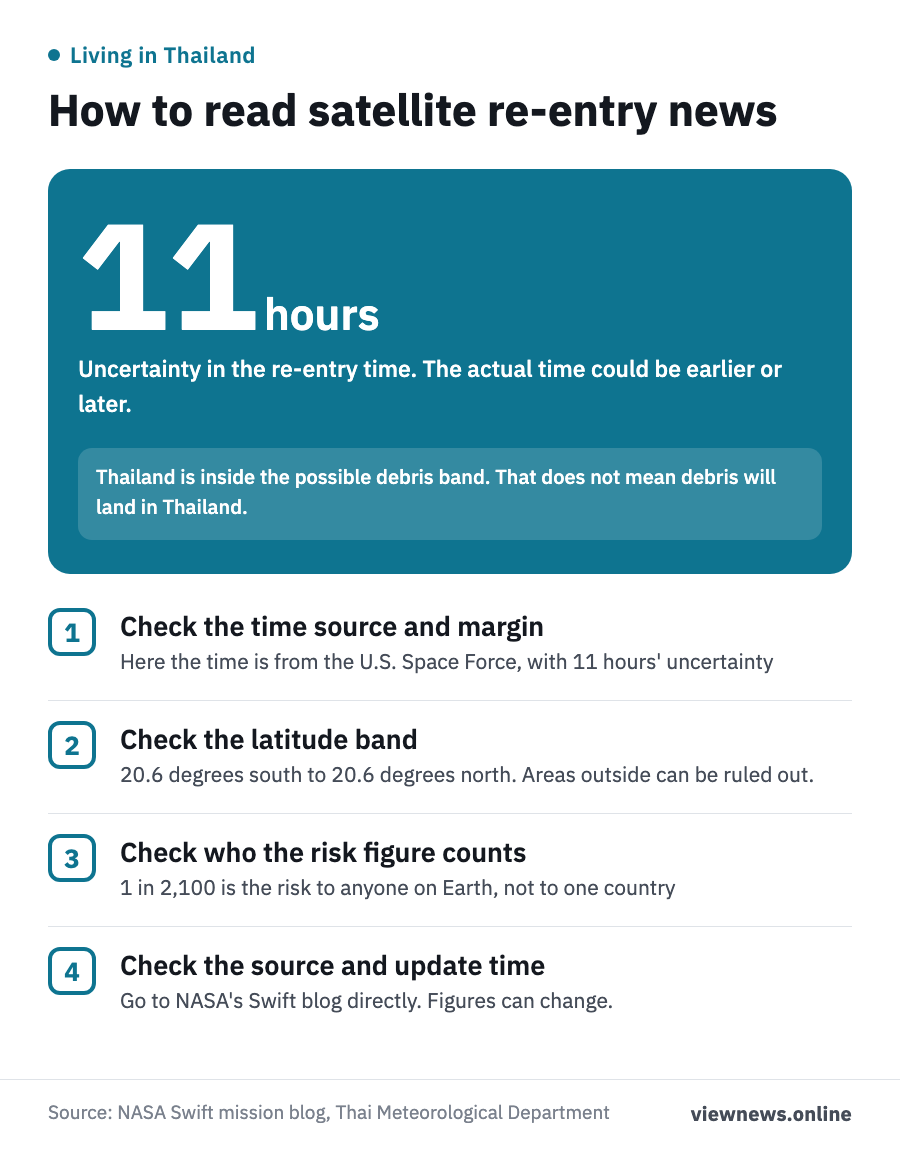
What to check when reading space-debris news
The Swift story offers a checklist for the next time a satellite or rocket stage falls back to Earth.
- Who gave the time, and how uncertain is it? Here the time comes from the U.S. Space Force and could be off by 11 hours. Be wary of a report that gives an exact time with no stated uncertainty.
- What is the latitude band? It shows which parts of the world are involved and which can be ruled out.
- Who does the risk figure count? A risk to "anyone on Earth" is a worldwide total. Do not read it as a risk to your country or to you personally.
- Does the data come from the source agency, and when was it updated? Figures for a falling object change as tracking continues. Check the source page directly. In this case that is NASA's Swift blog at science.nasa.gov/blogs/swift.
If you see a message claiming NASA has advised people on what to do if they find satellite debris, check the original source first. What NASA has said on this matter is the forecast time, the latitude band and the estimated combined risk.
Source: NASA's Swift mission blog (post dated 2 November 2026), NASA's Swift mission page, and the Thai Meteorological Department's page on Thailand's climate. This article is adapted from ViewNews' Thai-language report.