Train riders in Bangkok and surrounding provinces will pay no more than 45 baht per trip throughout 2027, after the Cabinet approved a joint fare measure on 3 November 2026. The initial entry fee under existing contracts must not exceed 17 baht, and riders will not be charged the entry fee twice when they change lines. The measure covers every urban rail line in the Bangkok Metropolitan Region.
Deputy government spokesperson Ploythalay Laksmeesangchan announced the decision, which the Ministry of Transport proposed. For regular riders, the key point is that 45 baht is a ceiling, not a price everyone pays.
The 45-baht figure is a cap, not a flat fare
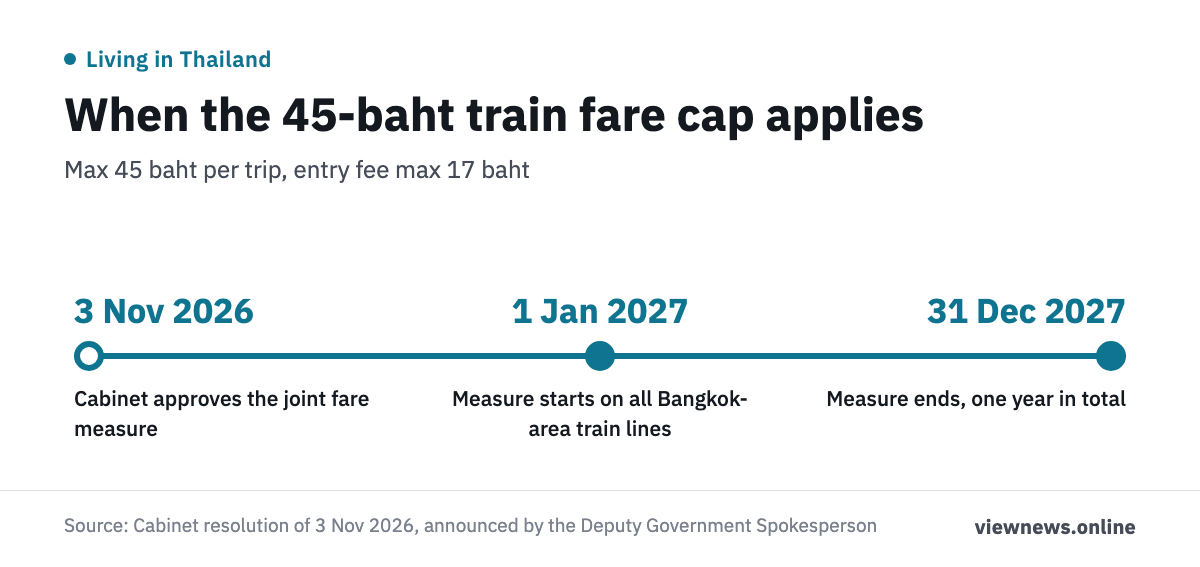
The 45 baht in the Cabinet resolution is the maximum fare per trip. It is not a flat rate for all riders. If you travel far, or change across several lines so that the total fare would exceed 45 baht, you will pay no more than 45 baht. Fares that are already below 45 baht will not fall automatically.
The resolution sets a second rule alongside the cap. The entry fee under existing contracts must not exceed 17 baht, and it must not be charged repeatedly when you transfer. This matters to anyone who changes lines mid-journey, because the measure is meant to remove the duplicated entry fee.
The measure applies to all train lines in Bangkok and surrounding provinces from 1 January to 31 December 2027, a period of one year. It follows a resolution of the second 2026 meeting of the committee driving the train fare policy, which was set up to ease the cost of living.
The Cabinet told several bodies to move quickly so the measure can start in early 2027. They are the Department of Rail Transport, the Office of Transport and Traffic Policy and Planning (OTP), the Mass Rapid Transit Authority of Thailand (MRTA), the State Railway of Thailand (SRT), the Bangkok Metropolitan Administration (BMA) and Krungthai Bank.
Who benefits, and who may not save
The clearest winners are commuters who change between several lines to reach work or school. The main benefit is lower costs on multi-line journeys, because the entry fee is not charged again and the total fare per trip is capped.
Because the measure sits under a committee created to cut living costs, the per-trip ceiling is aimed at travel spending directly, especially for people who ride every day and cross several lines regularly.
Riders who may not save anything are those on short trips, or on a single line where the fare is already under 45 baht. The cap does not lower those fares. How much each person saves depends on their route and what they pay now.
A simple check is to look at what you actually pay per trip on your usual route and compare it with 45 baht. If your total fare goes above 45 baht, or you pay the entry fee more than once, you are in the group the measure is designed to help.
Cost estimate of 5,807 million baht and a six-month review
The Cabinet acknowledged an estimated cost of 5,807 million baht for 2027. Of that, 5,785 million baht is fare compensation and 22 million baht is the fee for refunding money to riders for each transaction.
The figure is an estimate. The Cabinet only noted it and asked the OTP to request funds from the central budget for fiscal year 2027, under the reserve for emergencies or necessary spending. The OTP will also be the main agency managing subsidy payments as they actually occur. Actual spending will depend on how much people travel and how much compensation is paid.
The resolution also requires MRTA and the BMA to collect real ridership and revenue data for six months. They must also assess induced demand, meaning the extra passengers the measure attracts. The data will be used to negotiate a fair share of fare revenue with operators, so that operators return an appropriate portion of income to the state, with the results reported to the Cabinet. There are no negotiation results yet, because the data only exists once the measure starts.
Where things stand
So far the Cabinet has approved the principle, the fare cap and the duration, and has noted the cost estimate. The budget is still at the stage where the OTP must request it. It has not yet been allocated.
Practical details are still unclear. How to claim the benefit, which payment channels will be used and how refunds will work are still awaiting clarification from the responsible agencies. Foreign residents and visitors should check with the operators of the lines they use before the measure starts.
An earlier plan, reported on 10 October 2026, said the Ministry of Transport aimed to start on the first day of the measure period. It would accept payment by EMV card, an internationally used payment card standard. MRTA would run the central system, and Krungthai Bank would run the back-end system, including fare calculation between operators. That plan noted the Green Line uses the Rabbit card and that the ministry was discussing how to link it to the EMV system. This was the plan at the time, not a confirmed outcome. Riders should watch for announcements from MRTA, the BMA, the OTP, the Department of Rail Transport and Krungthai Bank before the measure begins.
Source: Cabinet resolution of 3 November 2026, as announced by the Deputy Government Spokesperson.
This article is adapted from ViewNews' Thai-language report.