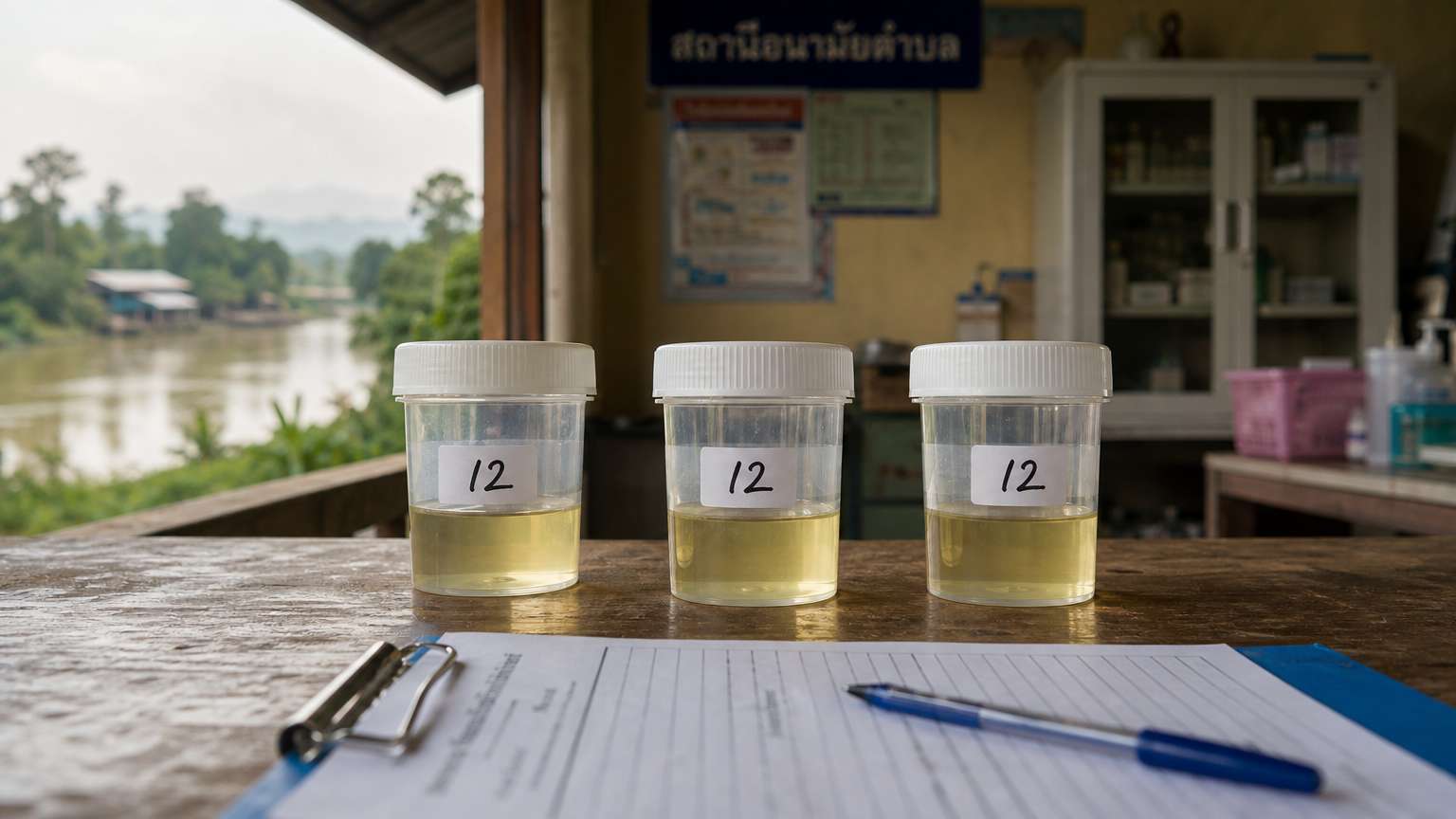
Thailand's Department of Disease Control (DDC) said on 4 November 2026 that arsenic levels in the urine of at-risk residents in the Kok, Sai, Ruak, Salween and Mekong river basins have trended higher in some areas between 2025 and 2026. Total arsenic in urine was higher in 2026 than in 2025 in Chiang Rai and Chiang Mai provinces. The department said no symptoms have been found so far, and experts judge the levels to be relatively low. People living in these basins are asked to stay alert without panicking.
The department compared results from its health surveillance of at-risk residents in 2025 and 2026. It said the proportion of people with relatively high arsenic levels in their urine has tended to rise.
How much have arsenic levels risen?
Only Chiang Rai and Chiang Mai were named as provinces where 2026 results were clearly higher than 2025. For other areas in the same river basins, the department said only that levels were higher in "some areas".
The department has not published figures by province, the number of people tested each year, or the reference values used to decide what counts as high or low. It is therefore not possible to say how large the increase is. Readers should wait for the department or local health offices to release more data, and should be cautious about comparing figures from other sources.
Experts say levels are fairly low, but monitoring continues
An expert meeting on 29 October 2026 heard that the amount of arsenic found in people's bodies is relatively low and is not yet affecting health. The DDC director-general added that no symptoms have been found so far in people with arsenic detected in their urine.
The experts also stressed that residents' health must be monitored over the long term. The two statements go together. The current levels are judged relatively low, but the department does not consider the matter closed because the 2026 results were higher than 2025 in two provinces.
The department cannot yet explain why people living in the same at-risk areas have different amounts of arsenic in their urine. The director-general said a disease investigation is needed to find the cause. The DDC and local public health offices are working to identify the risk factors for arsenic exposure. No conclusion has been reached on the cause or source, so claims blaming any single source should be treated with caution until the department announces its findings.
What to do if you live in a monitored area
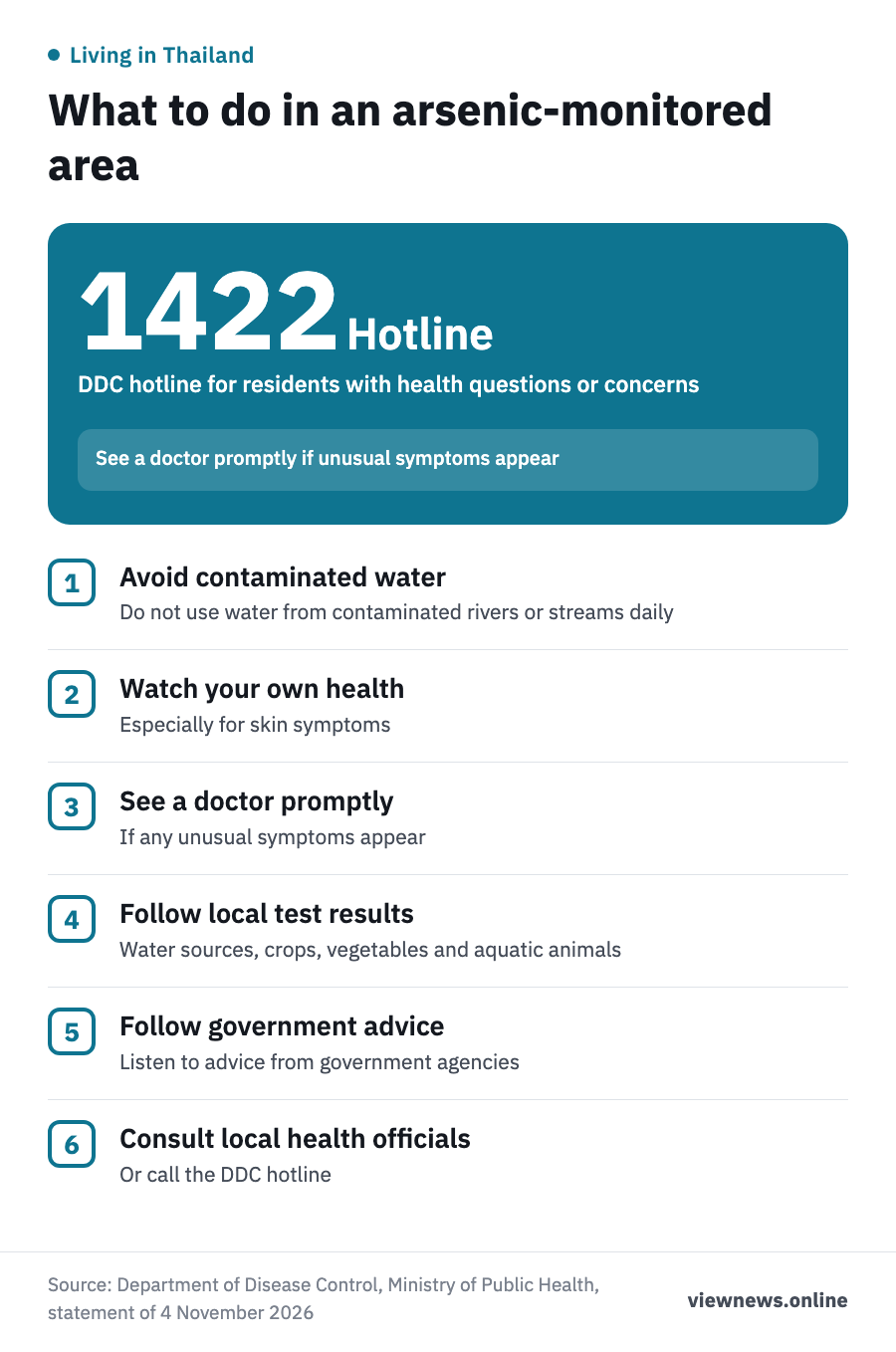
The department asks people in monitored areas to follow the principle "know the risk, don't panic, and protect yourself". It asks residents to:
- Avoid using water from contaminated rivers or streams for daily use.
- Watch their own health, especially for skin symptoms.
- See a doctor promptly if any unusual symptoms appear.
- Follow test results for arsenic in local water sources, crops, vegetables and aquatic animals.
- Follow advice from government agencies.
- Consult local public health officials, or call the DDC hotline on 1422.
The department described the skin warning only as "unusual symptoms, especially on the skin". Anyone who notices changes to their skin and is unsure should ask local public health staff or call 1422 without waiting for symptoms to worsen.
Test results for water, crops, vegetables and aquatic animals have not yet been released. It is not yet possible to say whether any water source or food is affected. Residents should wait for official announcements.
What happens next
As of 4 November 2026, the DDC is investigating the cause and will keep monitoring the health of at-risk residents. It is also pushing hospitals in the affected areas to strengthen surveillance of health effects from environmental pollution. It wants them to provide environmental medicine services that meet standards under the Occupational and Environmental Diseases Control Act of 2019, so that people can reach services that meet those standards.
The statement does not say which hospitals will start offering the services or when. People who want to use them should ask their local public health office or hospital directly.
Four things remain to be announced: the results of the disease investigation, test results for water, crops, vegetables and aquatic animals, long-term health monitoring results, and figures by province with reference values.
Anyone worried about their own health or a family member's should consult a doctor or public health officer before making decisions about care or treatment.
Source: Department of Disease Control, Ministry of Public Health, statement dated 4 November 2026.
This article is adapted from ViewNews' Thai-language report.