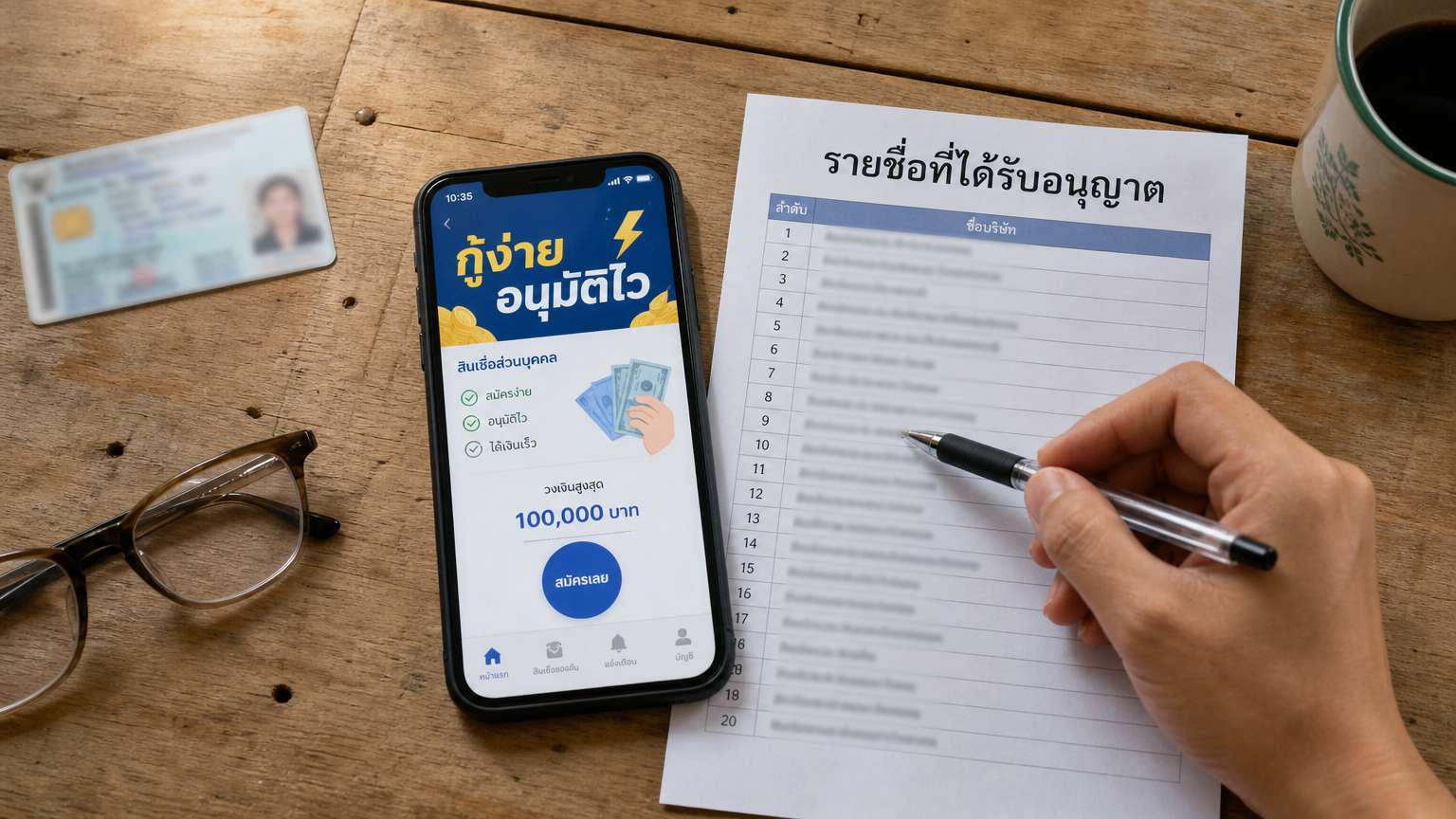
A legal loan app in Thailand must appear on an official list of licensed lenders, so borrowers should check before tapping apply. The Finance Ministry said on 16-17 November 2026 that it has never endorsed any illegal loan app. It has ordered inspections of all 1,201 licensed Pico Finance operators. An app that claims the ministry approved it, or that simply advertises easy loans, is not proof that it is legal.
A Finance Ministry spokesperson said the key rule of Pico Finance is that the lender and the borrower must be in the same area. Victims of illegal loan apps can file a police report.
What the Finance Ministry is checking
Pico Finance is the term for small provincial-level loans made by licensed operators under official supervision. As of October 2026, 1,201 operators were licensed and open for business.
The ministry ordered inspections of two groups. The first is operators whose names or Finance Ministry logos have been used without permission. The second is licensed operators that may have broken the conditions of their licence. Examples include lending outside the province where their head office is located, or charging extra fees.
If an operator is found to be non-compliant and does not correct the problem by the deadline, the ministry will consider suspending its business and then revoking its licence. If a licence is used as a cover for other offences, the ministry will work with the police to press charges.
The inspections have not concluded that any operator did wrong. The ministry ordered checks on every licensed operator, and the spokesperson stressed that many operators follow the rules. On complaints about a lender named Pico Finance, a company that lends through an app, the ministry said it is still establishing the facts and has not decided who is at fault.
The ministry will also revise its rules for online lending. Separately, the ministry and the Bank of Thailand (BOT), the central bank, are discussing changes to the law that supervises non-bank financial businesses. These are plans only and are not yet in force.
Licensed Pico Finance versus suspicious apps
A legal Pico Finance lender must be on the list of licensed operators, which can be checked at 1359.go.th/picodoc. It lends only to people living in the same province as its head office. It does not charge extra fees. If a lender has its head office in one province, lending to people outside that province is one of the issues the ministry is now inspecting.
Suspicious apps often do not appear on the official list, or their details do not match official sources. They tend to promise easy loans, low interest and no collateral. They ask for personal documents, then ask you to transfer a fee, a deposit or a guarantee payment before you receive the loan. The BOT says that if you cannot find the lender on the list, or the details do not match official sources, you should assume it is a scam.
Pico Finance interest rates are capped. Borrowers should look up the rate in the latest official announcement and compare it with the figure in the contract. Do not rely on a rate that a lender tells you verbally.
The ministry has not said whether foreign residents can borrow from licensed Pico Finance lenders. If you are a foreigner, ask the lender directly and check what documents it would accept.
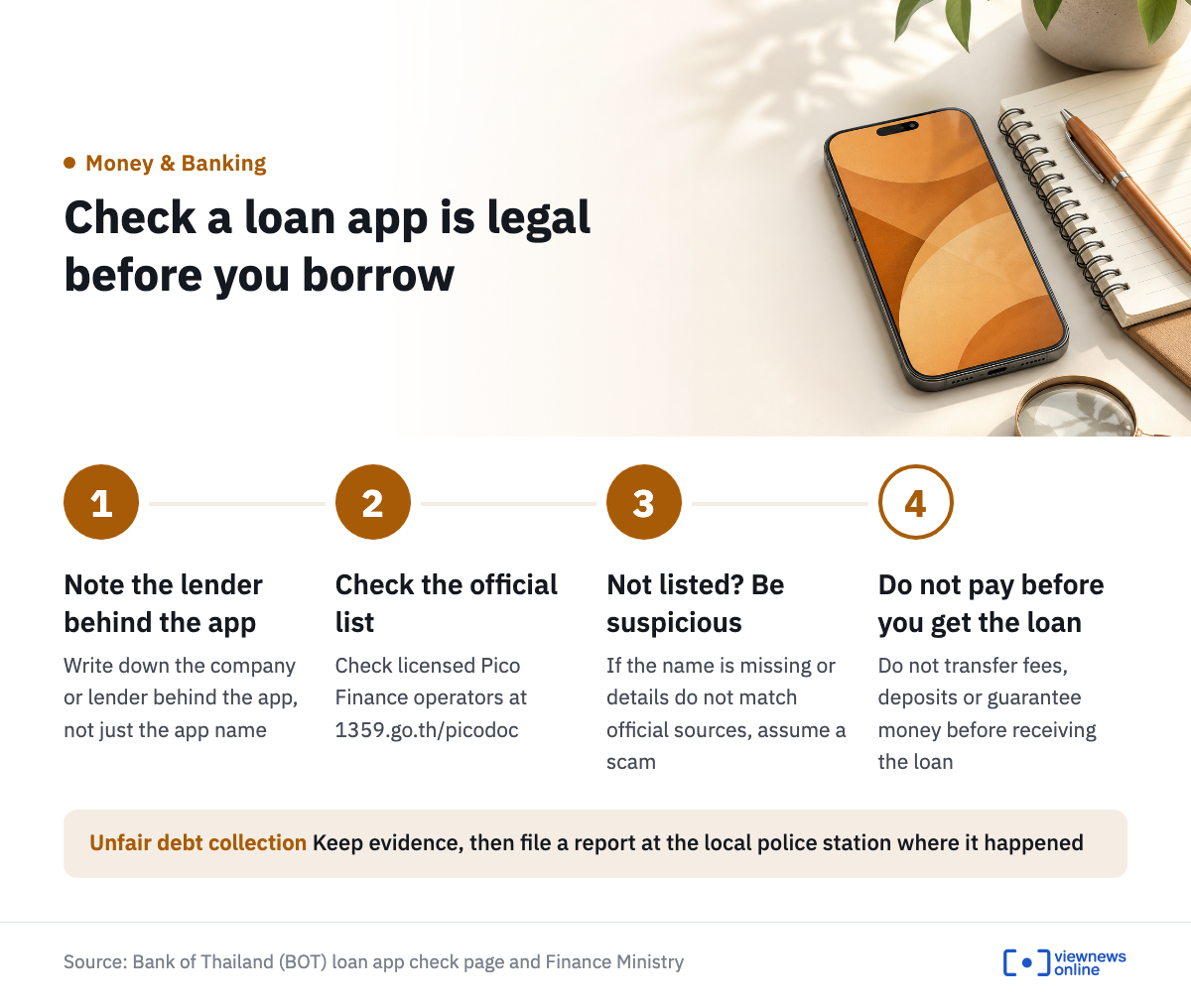
How to check a loan app before you borrow
The BOT advises checking every time whether a service provider is under official supervision. You can do this before you enter any details or confirm anything.
- Write down the name of the company or lender behind the app, not just the app name.
- Check the list of licensed Pico Finance operators at 1359.go.th/picodoc, which the BOT page links to.
- If the name is not on the list, or the details do not match official sources, assume it is a scam.
- Do not transfer any fee, deposit or guarantee payment before you receive the loan.
If you notice anything unusual, you can report financial scams through the BOT's channels.
Warning signs of loan scams
The BOT warns that scammers typically claim loans are easy, interest is low and no collateral is needed. They then ask for your personal documents.
Next they pressure you to transfer a fee, a deposit or a guarantee payment before the loan is paid out. If you see this pattern, stop. Check the lender's name against the official list before you send any documents or money. The ministry has said that charging extra fees is one of the conditions it is now checking among licensed operators.
Where to report threats and unfair debt collection
If you are threatened, harassed or pursued unfairly for a debt under the Debt Collection Act of 2015, keep your evidence first. Then file a report at the local police station where the incident happened.
You can also complain to the Debt Collection Supervision Committee. In Bangkok, file the complaint at the Metropolitan Police station covering the area where it happened. In other provinces, file it at the provincial administration office (ที่ทำการปกครองจังหวัด). Victims of illegal apps that falsely use the Finance Ministry's name can also file a police report.
Source: Thailand's Finance Ministry (statement by the ministry spokesperson) and the Bank of Thailand's loan app checking page.
This article is adapted from ViewNews' Thai-language report.