Travellers booking domestic flights in Thailand for the holidays can check whether a legal fare ceiling applies to their trip. First find out if the route is in a price-controlled group. Then compare the flight distance with the rate for that group. A proposed 20% fare cut for New Year 2027 has not been confirmed. Airlines are at the stage of agreeing to consider it, so check the actual price and conditions of your flight before paying.
Which routes have a domestic airfare ceiling
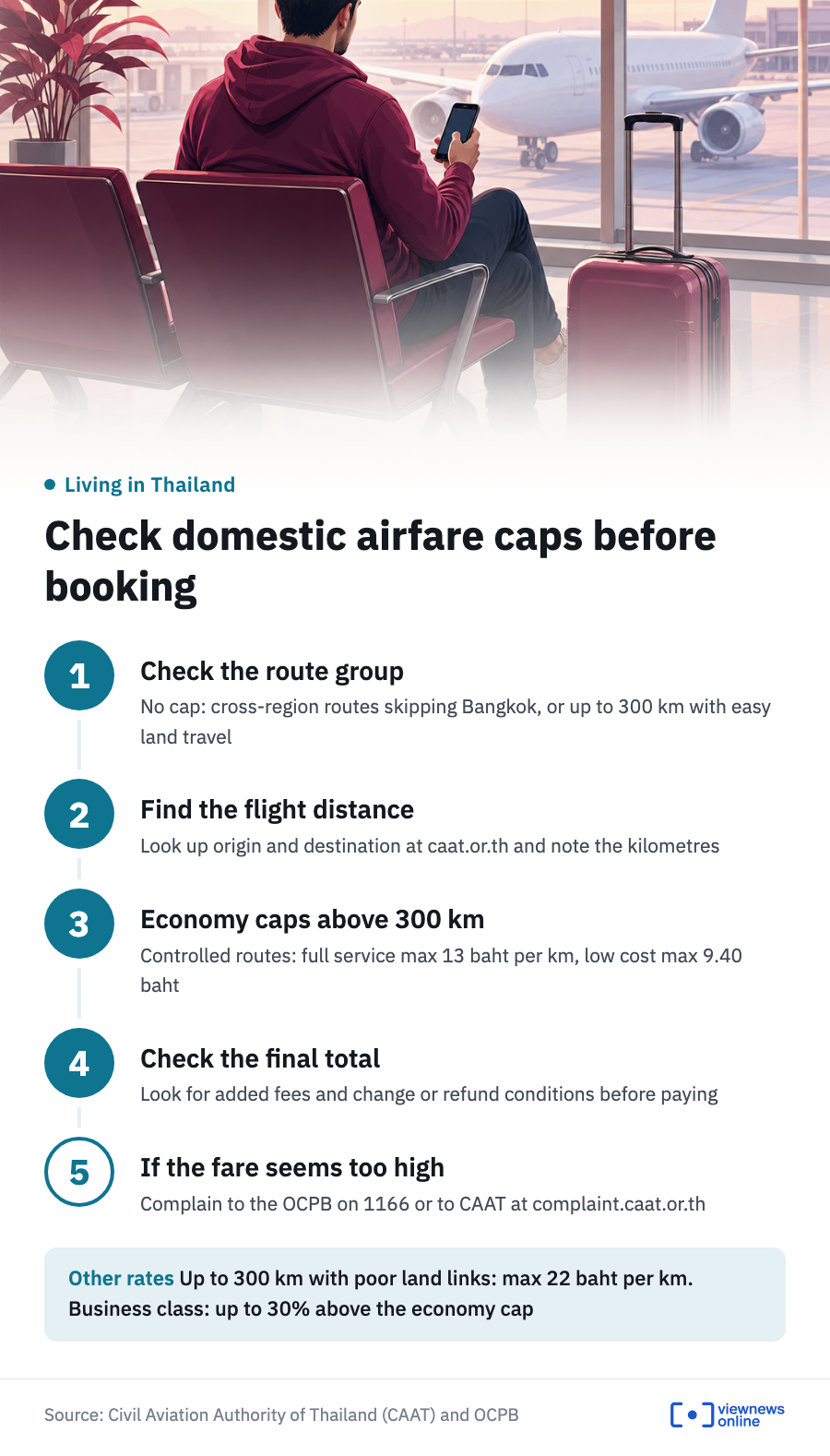
The Civil Aviation Authority of Thailand (CAAT) divides domestic routes into those with fare controls and those without. Its fare report for the second quarter of 2026 lists two types of uncontrolled routes. The first covers flights of no more than 300 km where overland travel is convenient. The second covers routes between regions that do not stop at a Bangkok airport.
On controlled routes, the economy class ceiling depends on distance and type of service. The rates for flights over 300 km apply only to controlled routes. A cross-region flight that skips Bangkok remains uncontrolled even if it is long.
- Up to 300 km where overland travel is inconvenient: no more than 22 baht per km
- Over 300 km on a full-service airline: no more than 13 baht per km
- Over 300 km on a low-cost airline: no more than 9.40 baht per km
Business class follows a different rule. Airlines may price it no more than 30% above the economy ceiling.
Short routes that the report places in the controlled group include Hat Yai to Phuket, Krabi to Samui and Bangkok (Suvarnabhumi) to Trat.
The report counted 28 uncontrolled routes in that quarter, including Chiang Mai to Hat Yai, Chiang Mai to Phuket and Chiang Rai to Phuket. CAAT's distance table shows 1,338 km between Chiang Mai and Hat Yai. Because that route is not price-controlled, you cannot multiply the distance by the rates above to find a ceiling.
How to find the distance and estimate an economy ceiling
Distances are listed on the CAAT website, caat.or.th, on its page of domestic flight distances and fare ceilings. The page is in Thai. Its table has columns for origin (ต้นทาง), destination (ปลายทาง) and distance in kilometres.
Find your pair of cities, note the distance and apply the rate for the route group and service type. For example, Bangkok to Chiang Mai is 566 km, Bangkok to Hat Yai is 773 km and Bangkok to Phuket is 698 km.
CAAT's report places low-cost flights from Bangkok's Don Mueang airport to all three destinations in the controlled group for flights over 300 km. At the economy rate of 9.40 baht per km, the results are about 5,320 baht to Chiang Mai, 7,266 baht to Hat Yai and 6,561 baht to Phuket, each way.
These figures are only sample calculations for economy class on low-cost airlines. They are not officially announced ceilings for each route. They do not apply to full-service airlines or business class, and they cannot be used to decide whether a particular ticket is illegal. If you suspect a fare is above the limit, check it again against CAAT's information.
Airlines are another place to look. A meeting on fares stressed that ticket prices must not exceed the legal maximum. CAAT said it has asked airlines to display fare ceiling information clearly on their website home pages and in all sales channels. The per-kilometre rates apply only to controlled routes.
What to check before buying from an online travel agency
If you buy through an online travel agency (OTA), look at the price, added charges, conditions and the seller's reliability before you pay:
- The fare and the total amount you will actually pay
- Added fees and service charges
- Conditions for changing flights and getting refunds
- Whether the seller is reliable
- Whether the ticket is for a non-stop flight from your origin to your destination
CAAT encourages passengers to book directly through an airline's website or app. This gives clear information on prices and conditions, lowers the risk of problems linked to booking through agents and lets you contact the airline directly if you need help. Compare the final total and conditions for the same flight before choosing where to buy.
Supamas Isarabhakdi, a minister attached to the Prime Minister's Office, said the high fares that had been found came from purchases through OTAs, which may add various service charges. Supamas advised buying directly from airlines, either online or offline.
Where to complain about an unusually high fare
If you find an unusually high fare or believe you have been treated unfairly, you can complain to the Office of the Consumer Protection Board (OCPB) on its 1166 hotline or through the OCPB Connect app. Check with the OCPB whether help is available in English.
CAAT accepts complaints about airlines at complaint.caat.or.th. Its English-language page on passenger rights also directs passengers to that site for complaints when they do not receive their legal rights. The numbers for passenger rights protection and follow-up on domestic airline complaints are 02-568-8816 and 063-205-8819.
Before making contact, it is generally wise to keep:
- Screenshots of the price showing the website or app name, and the date and time you saw it
- Flight details, your booking confirmation and proof of payment
- Conditions for changes or refunds, and your messages with the seller
New Year fares: what has been decided so far
Supamas and Deputy Transport Minister Phattrapong Phattraprasit chaired a meeting on New Year 2027 fares on 27 November 2026. It was attended by CAAT, the OCPB, the Department of Internal Trade and representatives of AirAsia, Thai Lion Air, Nok Air, Thai Vietjet Air and Thai Airways.
CAAT said the meeting asked airlines to cooperate by offering promotions and special fares, and to jointly cut fares by 20% from the set ceiling. The requested discount is therefore measured from the ceiling price. Supamas said the airlines agreed to consider lowering the ceiling price by a further 20%, and that CAAT would add flights or seats on high-demand routes.
CAAT's announcement did not say when the discount would start, which routes it would cover or how many seats would be available. It also gave no number of extra flights. If details are announced, check whether they cover your travel dates and route before deciding to wait or book.
The OCPB said controls on ticket prices sold through OTAs are still being discussed by several parties because these companies are not registered in Thailand. As a first step, the OCPB will issue a notice and send letters asking them to register.
CAAT advises people without tickets to plan and book early for a better chance of finding a suitable flight and price. It said it will keep monitoring New Year fares and ensure airlines sell tickets within the ceiling.
Source: Civil Aviation Authority of Thailand (CAAT), including news release No. 39/2569, its report on domestic fares for the second quarter of 2026, domestic flight distance data and contact information; and the Office of the Consumer Protection Board's report on the New Year fare meeting. This article is adapted from ViewNews' Thai-language report.