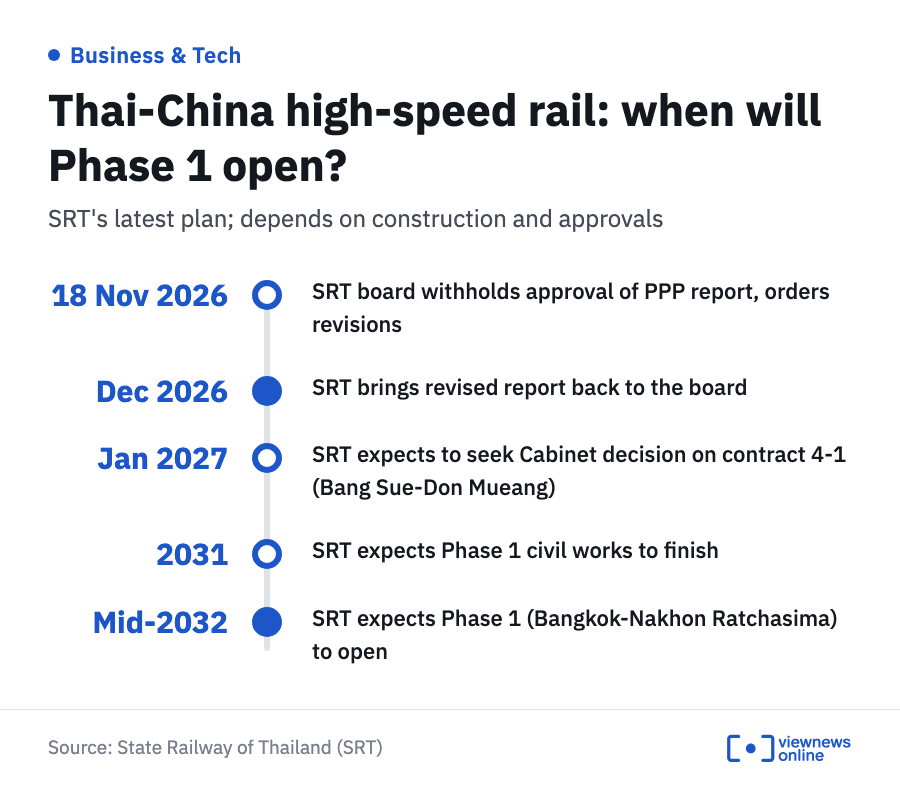
Anyone waiting to ride the Thailand-China high-speed railway will wait longer, and will not know the real ticket price for some time. The State Railway of Thailand (SRT) said its board met on 18 November 2026 and did not approve a public-private partnership (PPP) report for the Bangkok-Nong Khai line. The board told SRT to revise it and bring it back in December 2026. SRT now expects Phase 1, Bangkok to Nakhon Ratchasima (Korat), to open around mid-2032. The 695 baht Bangkok-Korat fare is a figure from an unapproved draft study, not the price that will be charged.
SRT Governor Anan Phoniminaeng disclosed the details.
Board orders PPP report revised on five points
The report is a study of bringing in a private company under the Public-Private Partnership Act of 2019. The company would install the systems, run the trains and maintain the line for the full Bangkok-Nong Khai route. The draft study proposes a 42-year contract.
The board did not approve it and told SRT to take the meeting's comments back for revision. Five issues need fixing: the PPP investment model, the rate of return, revenue forecasts, fares, and an operating period that matches the actual work. The revisions cover both Phase 1 (Bangkok-Nakhon Ratchasima) and Phase 2 (Nakhon Ratchasima-Nong Khai).
SRT stressed that this was not an approval. It was an instruction to fix the details before returning to the board. The proposal has not yet gone to the Cabinet, which would have to approve the PPP model.
Phase 1 is 58.301% complete, opening expected mid-2032
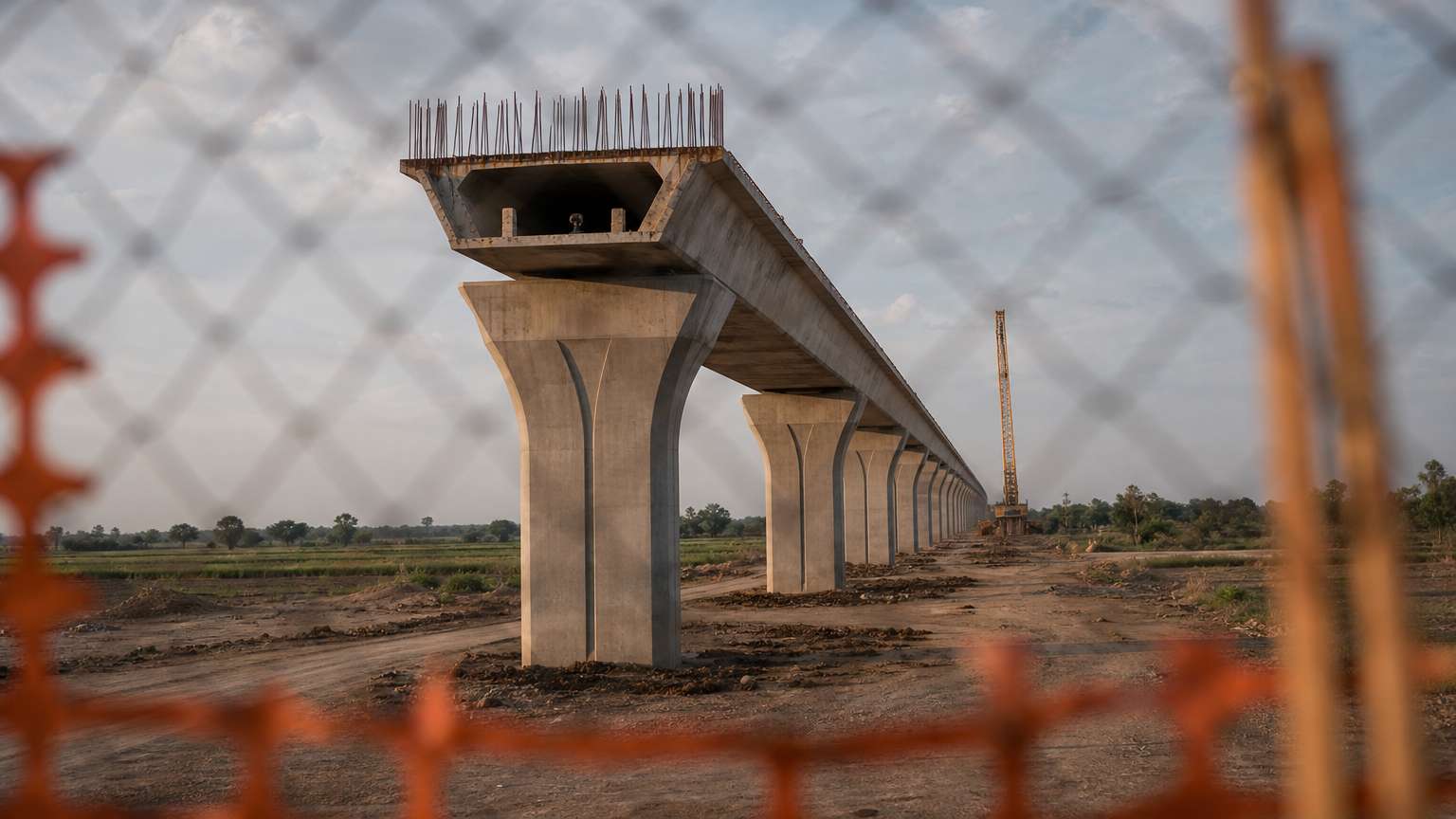
As of 25 October 2026, civil works on Phase 1 were 58.301% complete, according to SRT. The plan called for 92.168% by now, so the project is 33.867% behind schedule. The civil works are split into 14 contracts: 2 are finished, 10 are under construction and 2 have not started.
The two that have not started are contract 4-1, Bang Sue-Don Mueang (15.21 km), and contract 4-5, Ban Pho-Phra Kaeo (13.3 km). Contract 4-1 overlaps with the planned high-speed rail linking three airports (Don Mueang, Suvarnabhumi and U-Tapao). SRT will ask to build it itself instead of using the original private contractor. The earlier budget was about 22,000 million baht. The design and cost are being reviewed, and SRT expects to put the matter to the Cabinet in January 2027.
Contract 4-5 involves a World Heritage issue near the Ayutthaya station, and an earlier tender was cancelled. Consultants are now drilling to survey soil layers and archaeological areas so the work details can be prepared. SRT expects to tender in early 2027. Both contracts need a contractor by 2028.
SRT expects Phase 1 civil works to finish in 2031. Installation of the electric train systems, power supply and train control systems, plus testing, would follow in 2032. Testing includes checks by an independent body and training of train drivers, and takes about 6 months. If testing can start in early 2032, opening is expected around mid-2032.
The opening date has slipped several times. SRT's first target was 2022, then it moved back until it became 2031, and now mid-2032. Travelers and investors along the route should treat it as SRT's latest plan, which still depends on construction progress and approvals.
Draft fares: 120 baht plus a distance charge
The draft study sets a starting fare of 120 baht, then charges by distance. For trips up to 300 km, the rate is 2.29 baht per km. Beyond 300 km, it is 1.98 baht per km. SRT's examples are Bangkok (Krung Thep Aphiwat station) to Nakhon Ratchasima at 695 baht, to Khon Kaen at 1,080 baht, and to Nong Khai at 1,415 baht. All are draft figures that can still change. They are not real prices.
To try the formula for trips up to 300 km, multiply the distance by 2.29 and add 120. A 100 km trip would come to 349 baht. That is only an illustration of the formula, not an actual ticket price for any station.
Mr Anan said the draft numbers are not final and must be reconsidered. The board also asked for changes to fares and revenue forecasts, so the 695, 1,080 and 1,415 baht figures may change as the report is revised. SRT's stated principle is that fares should be higher than traveling by road and comparable to flying. It will also review its passenger and revenue forecasts.
On time, SRT compares Bangkok to Nong Khai at about 9 to 10 hours by car and about 3 and a half hours by high-speed train. A flight takes about 1 hour, but passengers must arrive at the airport about 2 hours early.
Phase 2 and what to watch
Phase 2, Nakhon Ratchasima-Nong Khai, covers 357.12 km. SRT had planned to open bidding in December 2026. That has moved to the second quarter of fiscal year 2027, or about March 2027. The reason is that talks with Laos are continuing on the route on the Lao side and on a second Thai-Lao Friendship Bridge (Nong Khai-Vientiane), which bears directly on Phase 2. SRT wants these settled first.
SRT said Thailand has given Laos alternative designs and design details and is waiting for Laos to confirm its approach, along with conclusions on the investment model and how construction costs are shared.
The PPP report's path from here is:
- SRT revises the report based on the board's comments
- It goes back to the SRT board in December 2026
- It goes to the Minister of Transport for consideration
- It goes to the Cabinet for approval of the PPP model
The key points to follow are the board's December 2026 decision on the revised report, the updated fare figures, and clarity on the Lao-side route, which will set the Phase 2 bidding date.
Source: State Railway of Thailand (SRT), as disclosed by its governor on the SRT board's decision and progress on the Thailand-China high-speed railway.
This article is adapted from ViewNews' Thai-language report.