Thailand's Ministry of Public Health has changed the official wording for extensively drug-resistant tuberculosis (XDR-TB), including how the disease is defined and which symptoms are listed. The change comes from Ministry of Public Health Announcement (No. 6) B.E. 2569 (2026), which took effect on 10 November 2026. It affects patients, their families and people with a long-lasting cough.
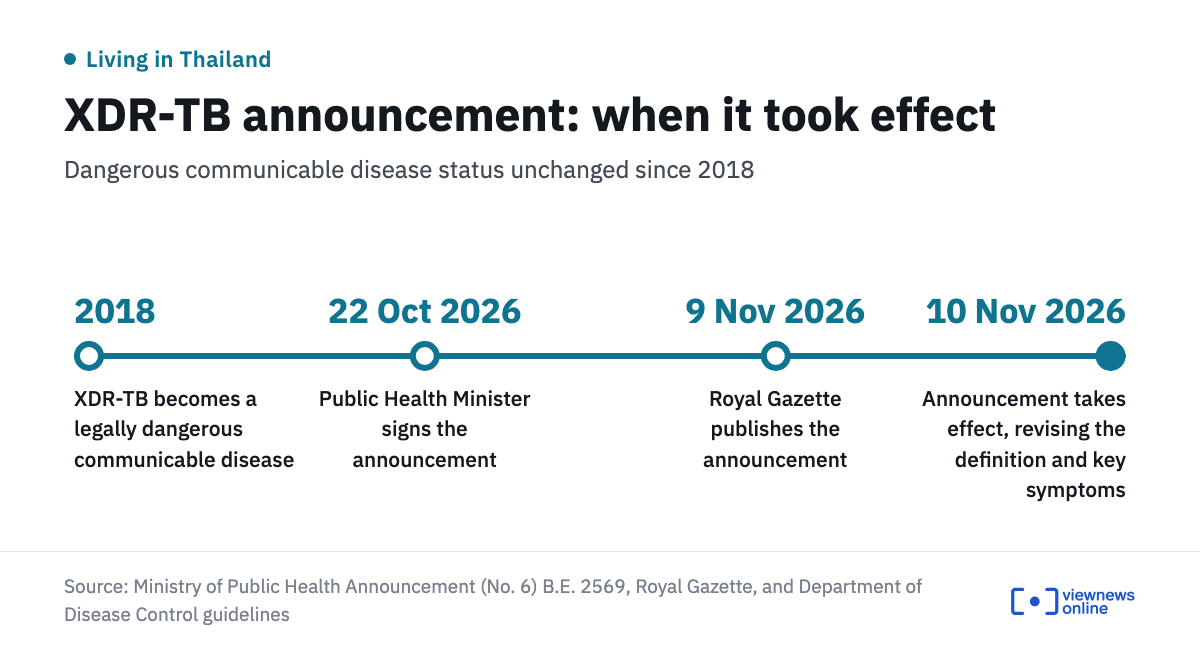
XDR-TB has been on Thailand's legal list of dangerous communicable diseases since 2018, according to the Department of Disease Control. The new announcement does not add a disease to that list. The Minister of Public Health signed it on 22 October 2026, and the Royal Gazette, the government's official legal journal, published it on 9 November 2026.
What the sixth announcement changed
The full title is the Ministry of Public Health announcement on the names and key symptoms of dangerous communicable diseases (No. 6) B.E. 2569. It takes effect the day after publication in the Royal Gazette. Because it was published on 9 November, it has been in force since 10 November 2026.
Article 3 of the announcement cancels the text of item (13) of Article 1 in the original announcement and replaces it with new wording. The part that changed is the definition and key symptoms of the disease.
To be clear, the announcement does not declare drug-resistant TB a dangerous communicable disease for the first time. The Department of Disease Control's Tuberculosis Bureau said in its practice guidelines, first printed in August 2018, that the ministry declared XDR-TB a dangerous communicable disease in 2018 under the Communicable Diseases Act B.E. 2558 (2015). What is new is the wording used to describe the disease and its symptoms.
The new definition: resistance in three parts
The announcement defines extensively drug-resistant tuberculosis as bacteria that resist several groups of drugs at once. The World Health Organization (WHO) explains that TB that does not respond to standard drugs is called drug-resistant TB and must be treated with different medicines. The WHO also says resistance develops when TB drugs are used improperly.
The new definition has three parts, joined by the word 'and'.
- Resistance to rifampicin, with or without resistance to isoniazid. The WHO describes these two as the most effective first-line TB drugs. TB that does not respond to both is called multidrug-resistant TB (MDR-TB).
- Resistance to at least one fluoroquinolone, such as levofloxacin or moxifloxacin. In WHO documents, drug-resistant TB that also resists this group is classed as pre-XDR-TB, so this resistance makes the disease more severe.
- Resistance to at least one of bedaquiline or linezolid.
Under the wording of the announcement, bacteria must resist all three parts to meet the XDR-TB definition. Resistance to only one part is not enough.
Doctors decide whether a patient meets the definition, based on lab tests that show which drugs the bacteria resist. Patients and relatives should not guess from drug names, and should not stop or change medication on their own.
Symptoms listed in the announcement
Besides the drug-resistance definition, the announcement lists the key symptoms of the disease:
- A long-lasting cough, or coughing up blood
- Loss of appetite and weight loss
- Fatigue
- Fever
- Chest pain
- Shortness of breath
The announcement adds that patients may have symptoms related to whichever organ is infected, so symptoms are not always in the lungs. Patients can pass the infection to others, and severe cases can lead to respiratory failure and death.
Anyone with these symptoms should see a doctor at a medical facility for a diagnosis. This applies especially to people already being treated for TB and people who live close to someone with TB. The list describes symptoms named in the announcement. It does not replace a medical examination, and the same symptoms can come from other illnesses. If you are unsure, let a doctor assess you.
What dangerous communicable disease status means
The Department of Disease Control says in its guidelines that, before 2018, the disease fell under the surveillance disease rules. Those rules could not require patients to come for examination, undergo treatment or be isolated. The ministry therefore declared XDR-TB a dangerous communicable disease under the Communicable Diseases Act B.E. 2558 (2015) in 2018, so that legal measures could support disease control.
In plain terms, being on the dangerous communicable disease list allows legal measures to help control the disease, which surveillance status did not allow for XDR-TB patients, according to the department's document. How each patient is handled depends on the officials and the medical facility treating them.
For general readers, the sixth announcement changes only the wording that defines the disease and its symptoms. The disease's status as a dangerous communicable disease is unchanged since 2018. If you suspect that you or someone close to you has matching symptoms, consult a doctor or pharmacist before starting or changing any treatment.
Source: Ministry of Public Health announcement on the names and key symptoms of dangerous communicable diseases (No. 6) B.E. 2569, published in the Royal Gazette; practice guidelines of the Tuberculosis Bureau, Department of Disease Control, Ministry of Public Health; and World Health Organization tuberculosis documents. This article is adapted from ViewNews' Thai-language report.