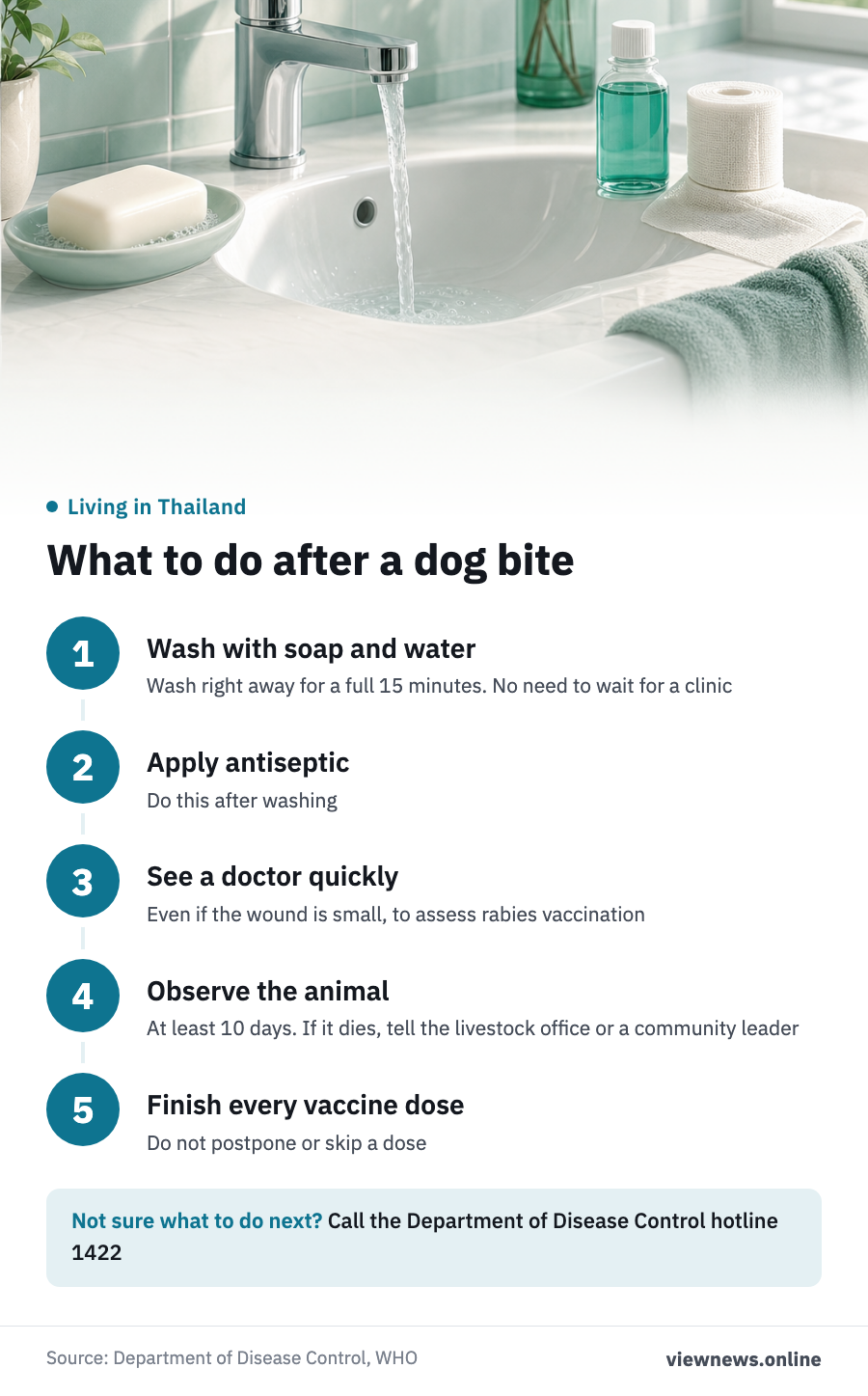
If a dog bites you in Thailand, wash the wound with soap and water straight away for 10 to 15 minutes, then apply antiseptic. Do the same for a cat bite or scratch. After that, see a doctor as soon as possible so they can decide whether you need rabies vaccination. Do not wait to see whether symptoms appear, even if the wound is small. The World Health Organization (WHO) says rabies is almost always fatal once symptoms start.
Wash the wound for long enough
Thailand's Department of Disease Control (กรมควบคุมโรค) advises washing with soap and water for 10 to 15 minutes, then applying antiseptic. WHO advises at least 15 minutes. The figures differ slightly, so washing for a full 15 minutes is the safest approach.
You can wash the wound right where it happened. You do not need to wait until you reach a clinic or hospital. Once you have washed it, go to a doctor. The recommended order is:
- Wash the wound with soap and water for a full 15 minutes.
- Apply antiseptic.
- See a doctor as soon as possible, even if the wound is small.
- Keep the animal that bit you under observation for at least 10 days.
- For more advice, call the Department of Disease Control hotline on 1422.
Even a small wound should not wait: the three WHO categories
WHO groups exposure to a possibly infected animal into three categories. Category I is touching or feeding an animal, or being licked on unbroken skin. No vaccine is needed. Category II is nibbling on bare skin, or minor scratches that do not bleed. In this case the wound must be washed and vaccination started immediately.
Category III is the most serious. It covers bites or scratches that break the skin, and animal saliva that touches a mucous membrane or broken skin. People in this category need wound washing and immediate vaccination. They also receive immunoglobulin or a monoclonal antibody when a doctor decides it is indicated.
Do not judge the category yourself. A wound that looks minor may still fall into Category II or III. The doctor decides whether a vaccine alone is enough or extra treatment is needed.
The risk of skipping treatment is real. The Department of Disease Control reported that two people who died between 1 January and 9 March 2025 had been bitten by dogs and did not get a vaccine after exposure.
Observe the animal and finish the vaccine course
The animal that bit you should be kept under observation for at least 10 days. If it dies during that time, notify the local livestock office or a community leader so the carcass can be tested for rabies.
If you cannot trace the animal, for example because it ran away, you should not wait. See a doctor as usual and tell them the animal could not be found. If you are unsure who to notify, call the 1422 hotline.
On the vaccine itself, the Office of Disease Prevention and Control Region 12 Songkhla says people who have never been vaccinated need about 4 to 5 doses. People who have been vaccinated before need 1 to 2 doses. The exact number of doses and appointment dates depend on the doctor, the type of vaccine and your medical history.
The hospital or clinic that treats you will assess you and give the vaccine as the doctor directs. If you are not sure where to go, call 1422. Once the doctor sets appointment dates, attend all of them. Do not postpone or skip a dose, and do not choose a vaccination schedule yourself without medical advice. If you are a visitor, ask the hospital how to complete the course if your travel plans may change.
Symptoms and the numbers to know
Symptoms usually appear 15 to 60 days after exposure. In some people they appear in less than 10 days, and in others after a year or more. Early symptoms are headache, mild fever, sore throat, loss of appetite and tiredness. Later, itching or burning at the wound site, fear of water, fear of wind, and sensitivity to light and sound can follow. Patients can die within 2 to 7 days of symptoms starting.
This is why vaccination has to happen before symptoms. Once symptoms start, almost every patient dies. Because the virus can take 15 to 60 days, or even longer, to cause symptoms, some people assume they are fine and skip the doctor. That waiting period is the chance to prevent the disease.
WHO says dogs are the source of up to 99% of human cases. In Thailand, the Department of Disease Control reported 7 deaths in 2025 up to 7 July, three times the number in the same period of 2024. About 90% of cases were infected by dogs and about 10% by cats. A total of 164 infected animals were found.
Preventing bites in the first place
Vaccinating pets is the first line of defence. The Office of Disease Prevention and Control Region 9 recommends the first shot at 2 months of age, a second shot 3 to 4 weeks later, and a booster every year.
Around unfamiliar dogs, follow the Thai "five don'ts" rule: do not tease, step on, separate, pick up or bother them, especially when they are eating or fighting. If you are bitten or scratched anyway, go back to the first step: wash the wound immediately, then see a doctor.
Treatment depends on the individual. Consult a doctor or pharmacist before starting or changing any treatment.
Source: Department of Disease Control, Offices of Disease Prevention and Control Regions 9 and 12, and the World Health Organization (WHO).
This article is adapted from ViewNews' Thai-language report.