People in Thailand without a salary can still claim personal income tax allowances if they had income during the tax year and file a return. Freelancers, online sellers, general contractors and people who earn interest or rent use the same allowances as salaried employees. People with no income, or income below the filing threshold, do not need to file.
The figures here are for tax year 2025, taken from the Revenue Department's guide. The filing deadline was 31 March 2026 and has passed. Anyone filing for tax year 2026 in early 2027 should check that year's guide first, because limits and conditions for some items can change every year.
Foreign freelancers and sellers should confirm with the Revenue Department whether and how they must file.
Which income must be filed, and what is the threshold?
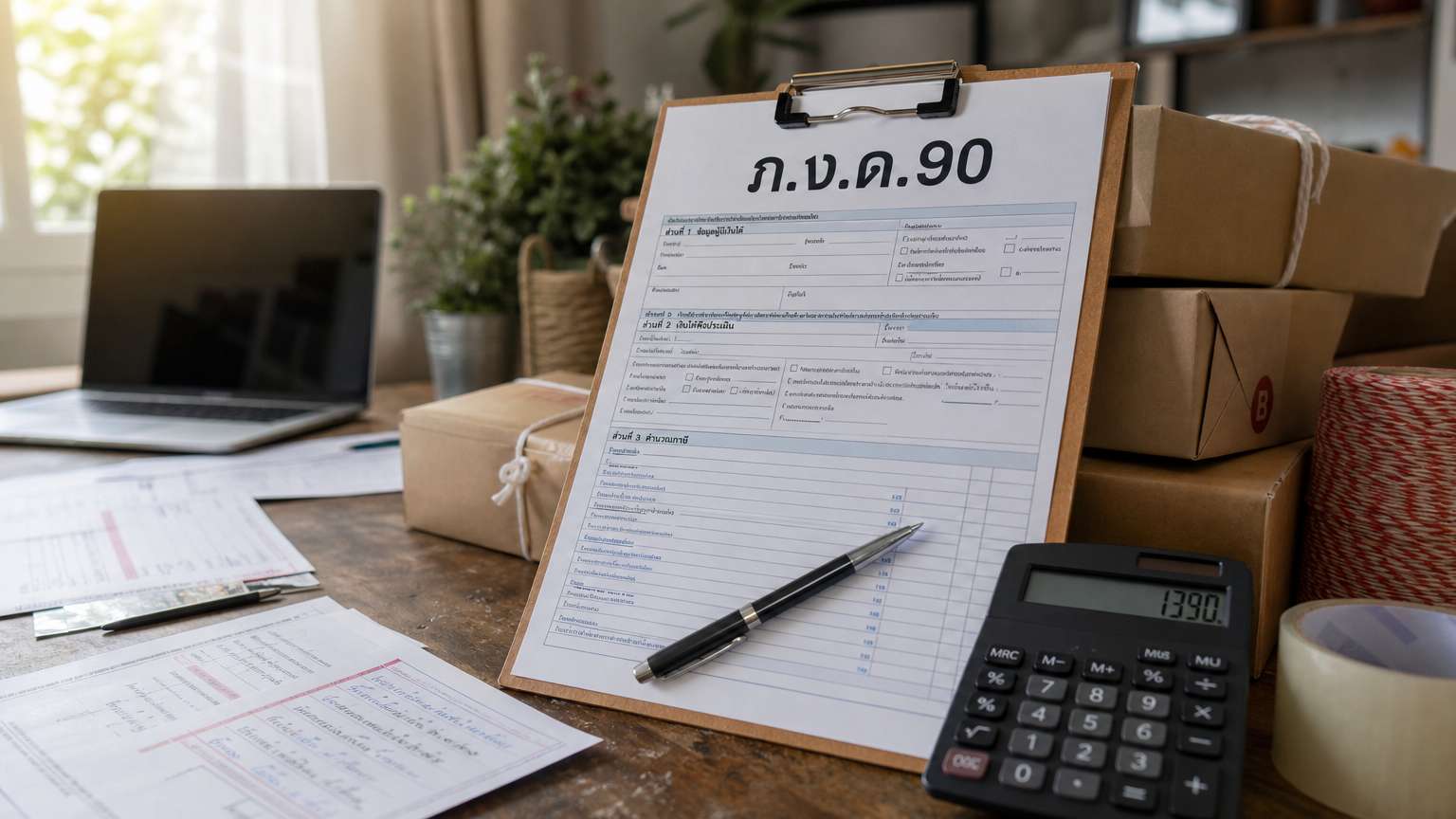
People with income beyond a salary file Form PND 90 (ภ.ง.ด.90). It is the personal income tax return for people with several types of income, or one type that is not a salary. Form PND 91 is for people whose only income is a salary or wages. Someone who earned a salary for part of the year and also did freelance work must use PND 90.
Income that must be included covers several types. These include fees for work and commissions, interest and dividends, rent on property, and income from business, trade or farming. The Revenue Code lists these types in Section 40, which matters again when choosing how to deduct expenses below. Foreign income brought into Thailand in the tax year is covered by a separate Revenue Department guide.
For tax year 2025, you must file if either of these applies:
- You are single and your assessable income is over 60,000 baht a year.
- You are married and your assessable income, either partner's or both combined, is over 120,000 baht a year.
The threshold is based on assessable income, meaning money received before expenses and allowances. Going over the threshold means you must file. It does not always mean you owe tax. You still have to file even if no tax is due after expenses and allowances.
Under the Revenue Department's rate table, the first 150,000 baht of net income is exempt. The rest is taxed at 5% up to 300,000 baht, 10% up to 500,000 baht, 15% up to 750,000 baht, 20% up to 1,000,000 baht, 25% up to 2,000,000 baht, 30% up to 5,000,000 baht, and 35% above 5,000,000 baht. Net income is what remains after expenses and allowances.
Which allowances can people without a salary claim?
Every taxpayer can claim a personal allowance of 60,000 baht. If your spouse has no income, you can claim another 60,000 baht for the spouse. If both spouses have income, each claims their own personal allowance and neither can claim the spouse allowance.
For children, a legitimate or adopted child is worth 30,000 baht each. A second or later child born in 2018 or after is worth 60,000 baht each. The child must be a minor, or aged up to 25 and studying at university level. Prenatal and childbirth costs are deductible as actually paid, up to 60,000 baht per pregnancy.
If you support a parent aged 60 or over whose income is no more than 30,000 baht a year, you can claim 30,000 baht per parent. You can claim another 30,000 baht per parent of your spouse if the spouse has no income. Supporting a person with a disability is worth 60,000 baht per person.
On insurance, the Revenue Department's allowance summary sets these limits:
- Life insurance premiums (policies of 10 years or longer): as actually paid, up to 100,000 baht.
- Your own health insurance premiums: up to 25,000 baht, but combined with life insurance the total cannot exceed 100,000 baht.
- Health insurance premiums for your parents: up to 15,000 baht.
Social security contributions are deductible up to 9,000 baht.
For Retirement Mutual Fund (RMF) investments, the deduction is up to 30% of income, and together with other retirement savings it cannot exceed 500,000 baht. You must hold the units for at least 5 years and until age 55. Both conditions must be met.
Limits and conditions can change from year to year, so check the details with the Revenue Department before filing.
Deducting expenses first, with worked examples
Expenses come off your income before allowances. For income from work or commissions (Section 40(2)), you can deduct a flat 50% of income, capped at 100,000 baht. If you also have a salary, the combined deduction cannot exceed 100,000 baht. Interest and dividends allow no expense deduction. Rent from houses or buildings allows a flat 30% deduction.
For income from business, trade or farming (Section 40(8)), you can deduct actual expenses that are necessary and reasonable. Or you can use the flat rate for your business type from the Revenue Department's table. For example, the rate is 60% for cooking food or drinks for sale and for sewing clothes. If your activity is not in the table, the Revenue Department requires actual expenses, and you need records to support them.
First example: a freelancer earns 180,000 baht a year from contract work. The 50% flat deduction is 90,000 baht, leaving 90,000 baht. After the 60,000 baht personal allowance, net income is 30,000 baht. That is inside the exempt first 150,000 baht, so no tax is due.
Second example: someone cooks food to sell online and earns 180,000 baht a year from the business. They choose the 60% flat deduction, which is 108,000 baht, leaving 72,000 baht. After the 60,000 baht personal allowance, net income is 12,000 baht, and again no tax is due. Children or life insurance would allow further deductions.
There is one more check. If your non-salary income (Section 40(2) to (8)) totals 120,000 baht or more, the guide requires a second calculation: 0.5% of assessable income. You then pay whichever tax is higher. If the 0.5% figure is no more than 5,000 baht, you pay under the normal method. In both examples above it comes to 900 baht, which is under 5,000 baht, so the normal method applies and no tax is due.
How to file, pay in installments, and what happens if you are late
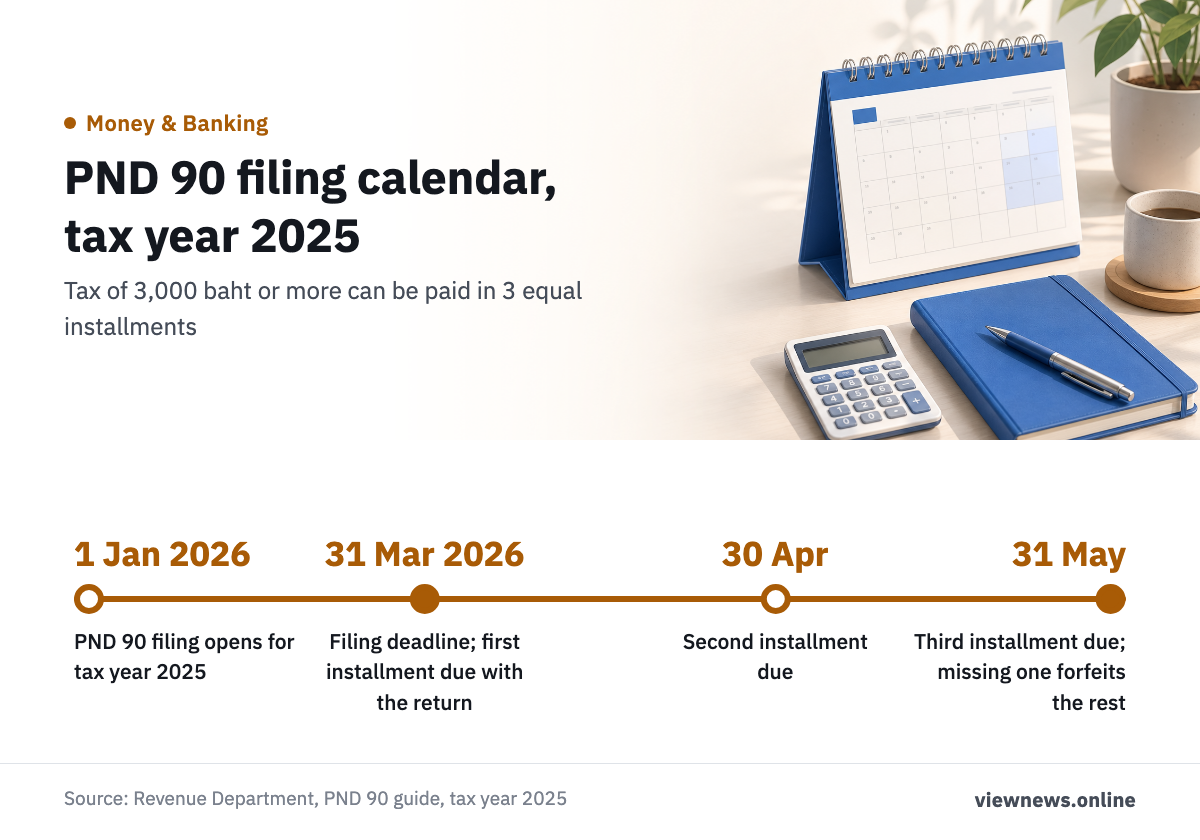
For tax year 2025, the Revenue Department set the PND 90 filing period from 1 January to 31 March 2026, with any tax paid at the same time. Under the guide, you can file in three ways:
- Online through the Revenue Department's internet system.
- In person at an area Revenue office branch.
- By registered mail, under the department's conditions.
If the tax due is 3,000 baht or more, you can ask to pay in three equal installments. The first is paid when you file, the second by 30 April and the third by 31 May of the same year. If you miss any installment deadline, you lose the right to pay the remaining ones in installments.
Filing or paying late adds a surcharge of 1.5% a month on the tax due, with part of a month counted as a full month. A fine of up to 2,000 baht also applies.
If too much tax was withheld, you can claim a refund through PromptPay. To do this, you must first register PromptPay with a Thai bank using your national ID number. Foreign residents should ask their bank whether they can register PromptPay.
Source: Thailand's Revenue Department, guide to completing Form PND 90 for tax year 2025, its allowance summary page, and the Director-General's notification on personal income tax returns.
This article is adapted from ViewNews' Thai-language report.