The Bank of Thailand (BOT) plans to let people choose to send their own financial data to other service providers through a project called Your Data. The central bank says it will start within 2026, beginning with individuals' deposit account data. It is not live yet. Separately, the BOT and the Ministry of Finance are taking public comment on draft rules for buy now, pay later (BNPL) lending until 15 November 2026. Those rules are not in force, so anyone paying in instalments on a digital platform in Thailand, foreign residents and visitors included, remains under each provider's own terms for now.
The changes matter to anyone who uses financial apps, pays for online purchases in instalments or has applied for credit. Payment history, debts and account transactions are what lenders use to decide whether to approve a loan. Letting the data owner choose where that information goes changes who gets to see it.
Why financial data matters
Banks were once the main players in finance because they held deposits and customer records. Large technology companies, known as Big Tech, now offer financial services too. The Bank for International Settlements (BIS) describes this in Working Paper 1129, "Big techs in finance". It says Big Tech business models rest on a feedback loop of data, network and activity, in which large amounts of user data are used to provide financial services.
The BIS says large networks, non-traditional data and machine learning can make credit easier to get. The same models can also let a few firms dominate the market, charge different users different prices, discriminate through algorithms and harm consumer privacy. It concludes that financial stability, competition and data privacy goals can pull in different directions, so regulators need to coordinate more closely.
How Your Data works
Your Data lets customers choose to send their data, held by financial institutions and other bodies, to a provider they want to use, through digital channels. The BOT gives loan applications and personalised money management as examples. The data covered includes deposit accounts, payments, loan balances and repayments, holdings of securities and funds, and insurance policies.
Before drafting the rules, the BOT asked for public views on a policy called Open Banking Data for Consumer Empowerment. Its summary of the responses, published in early 2024, says most respondents backed the principle and goals. The most discussed use was credit assessment, drawing on account transactions, income from tax filings, social security contributions and sales history on e-commerce platforms. Another was financial planning based on several accounts at once, including deposits, credit cards, e-money, securities, insurance and debts.
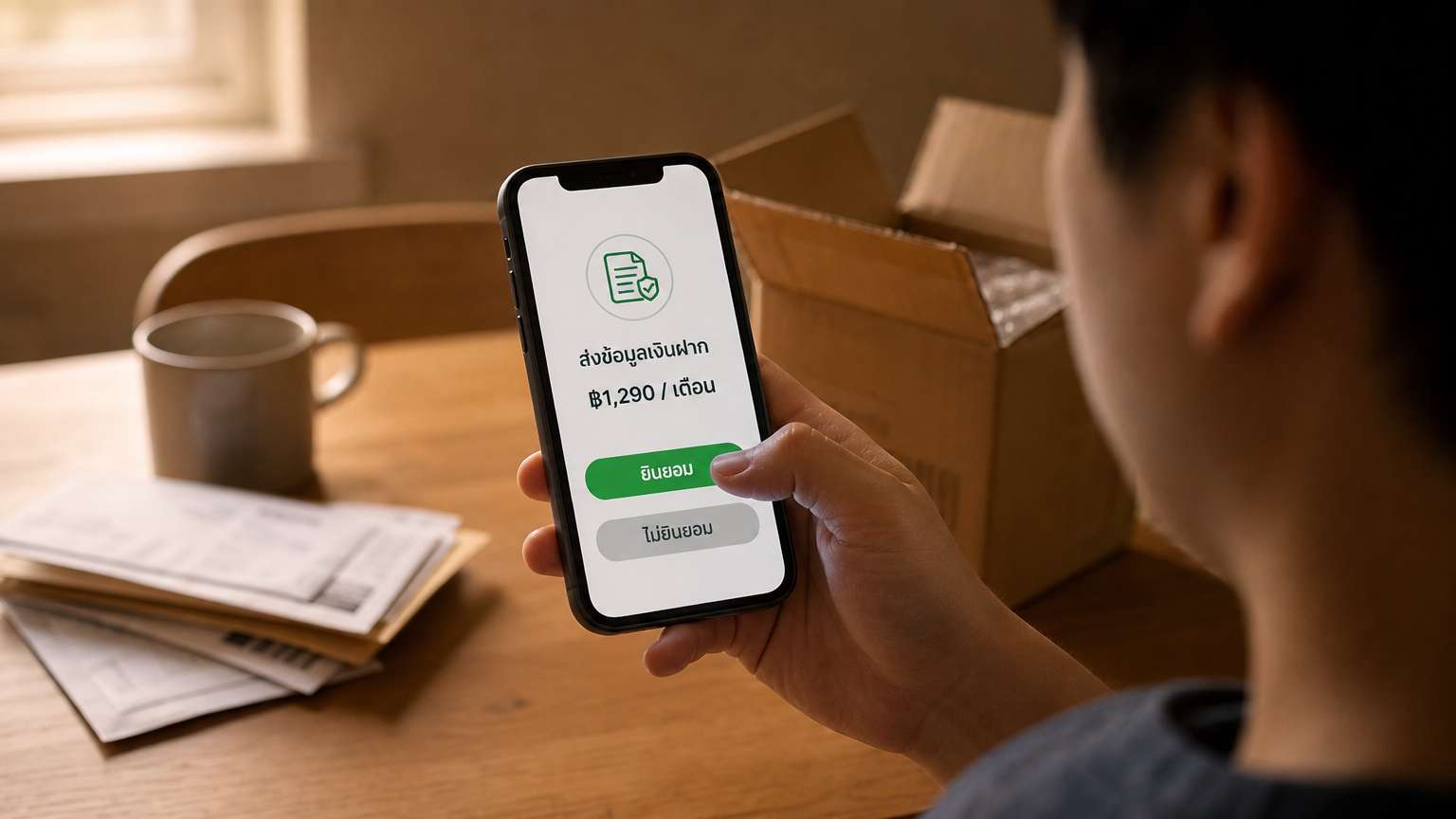
Sharing is based on the data owner's consent. Providers must ask for consent clearly and in plain terms, and use the data only for the stated purpose. Their systems must meet the BOT's IT and data-transmission security standards. They must also be able to trace transactions so problems such as leaks can be investigated and fixed, and they must offer a complaints channel. The BOT will assess providers before admitting them and monitor them afterwards.
- Data senders at first: institutions supervised by the BOT, securities firms, fund managers, insurers and government bodies such as the Revenue Department, electricity utilities and water utilities.
- Data receivers at first: providers supervised by the BOT, the Securities and Exchange Commission (SEC) or the Office of the Insurance Commission (OIC).
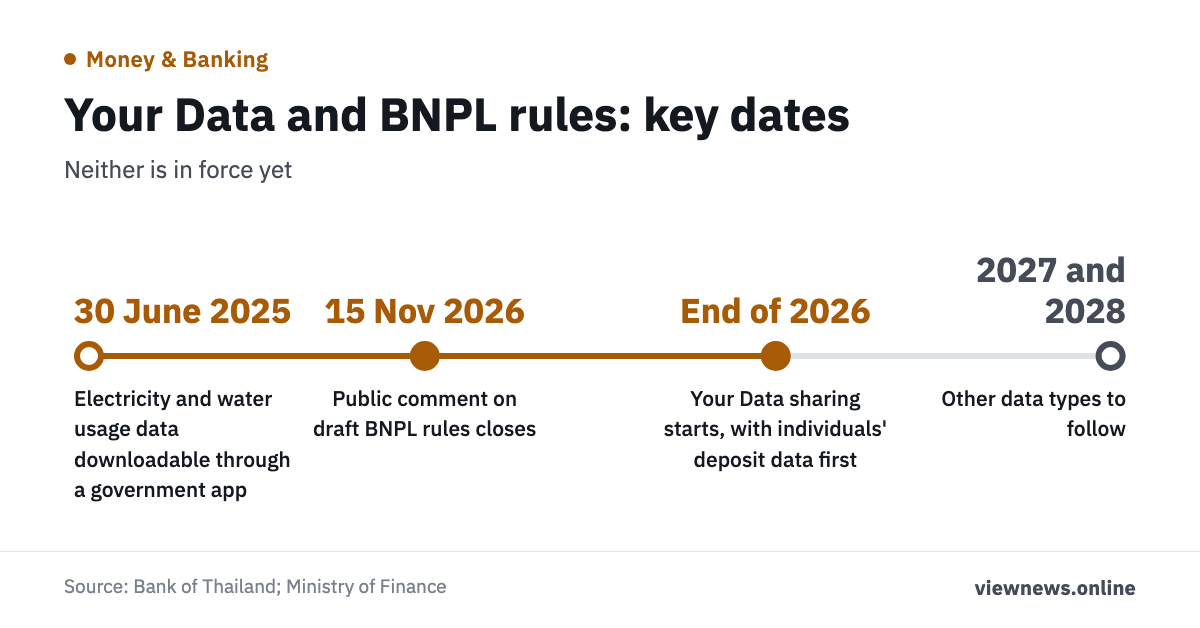
Some non-financial data is already available. Electricity and water usage and payment history can be downloaded through a government app, and that has been possible since 30 June 2025, so it can be attached to applications for financial services. This kind of data must first be downloaded from the agency and then passed on to the financial provider.
The BNPL concern
In its consultation paper, the BOT says BNPL is growing fast, is often used to buy goods on digital platforms, and is often a consumer's first credit product. Approval is quick and built into the checkout step, so people can take on debt without noticing. Some providers on digital platforms are also not supervised, so standards and consumer protection may differ. Their data is not reported to the BOT either, which leaves a gap in the picture of household debt.
The draft guidelines propose bringing BNPL businesses that affect many people, especially those on digital platforms, under supervision. They would become businesses that need a licence from the Minister of Finance. Two drafts are open for comment together: a Ministry of Finance notice on businesses that require a licence, and a BOT notice on the rules, methods and conditions for running a BNPL business, which includes consumer protection provisions.
Where things stand
The BOT says sharing of financial-sector data should start by the end of 2026, with individuals' deposit data first. Other data types are to follow in 2027 and 2028. Users will share data through the apps of participating providers. Until then, financial-sector data cannot be shared this way.
The BNPL draft is open for comment until 15 November 2026. Comments can be sent through the BOT website or the government's central legal consultation website. The draft is not in force, so people who pay in instalments on a platform remain under each provider's own terms.
The BOT has not yet said whether foreign residents will be able to use Your Data or which providers will take part. If you hold a Thai bank account, check with your bank about eligibility once the service opens.
For app users, the practical advice is to read what your data will be used for before you tap to consent, and to share it only with providers you actually mean to use. For BNPL users, check your total instalments across all platforms before you buy, since the BOT is concerned that fast approval leads people into debt before they have thought it through.
Source: Bank of Thailand (Your Data project page, Open Data page, summary of responses on Open Banking Data for Consumer Empowerment, BNPL consultation paper) and the Bank for International Settlements (BIS Working Paper 1129).
This article is adapted from ViewNews' Thai-language report.