
The Bank of Thailand (BOT) kept its policy interest rate at 1.00% a year on 28 October 2026. The Monetary Policy Committee (MPC) voted unanimously at its fifth meeting of 2026, with one member absent. The central bank also forecast that the Thai economy will grow 2.4% in 2026 and slow to 2.1% in 2027.
For anyone with a loan, a savings account or a small business in Thailand, the decision means the benchmark rate has not moved. The BOT says the recovery is still uneven, household debt is holding back spending, and lending to small and medium-sized enterprises (SMEs) is still shrinking. Inflation is higher this year, but the BOT expects that to be temporary and to be driven by energy prices and the El Nino weather pattern.
Why the MPC kept the rate unchanged
The MPC said the current rate is appropriate to support the economic recovery. It described monetary policy as accommodative, meaning supportive of growth. It said this works alongside targeted financial measures to help an economy that is recovering unevenly.
The BOT said exports and investment linked to the technology and artificial intelligence (AI) cycle are giving the economy a push. But most of the benefit goes to businesses and workers in the related industrial and service sectors. Private consumption is still weighed down by high household debt. The labor market and purchasing power remain fragile, especially for low-income households facing a high cost of living. Overall, the BOT judges that growth is still below the economy's potential.
The same uneven pattern shows up in lending. Total lending grew, led by large companies, while lending to SMEs shrank in almost every sector. The BOT also said the number of foreign tourists is likely to fall because of higher oil prices.
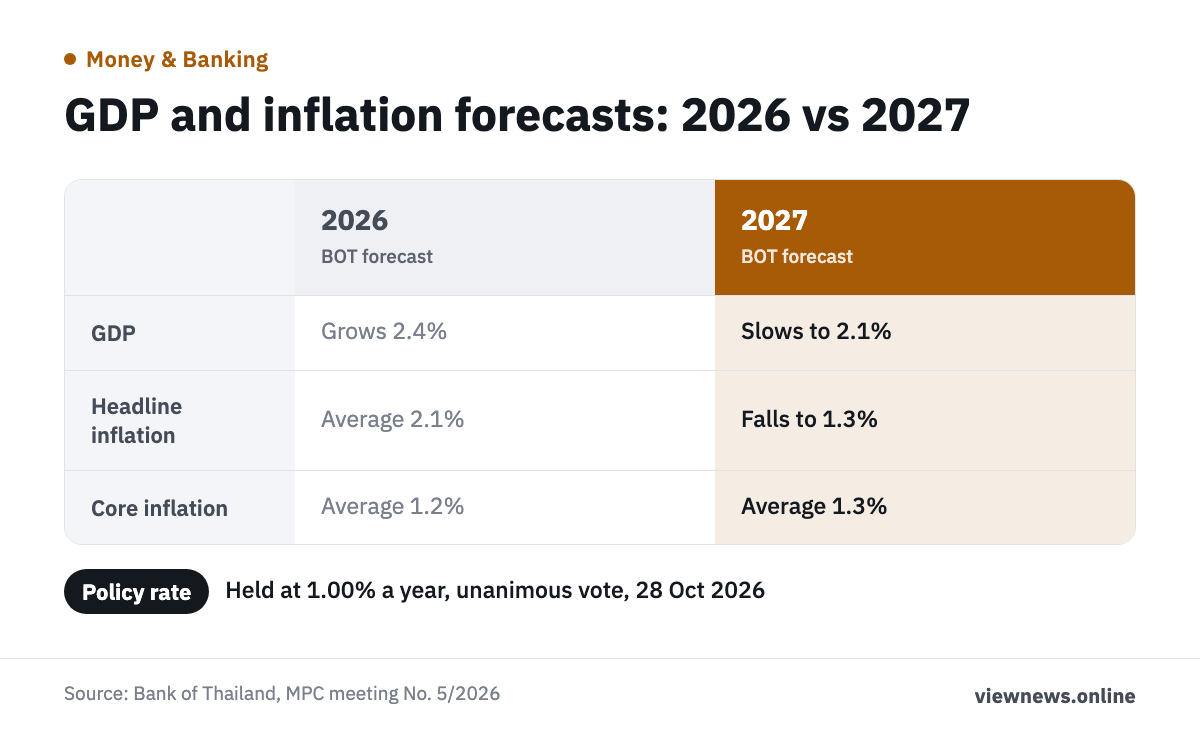
Growth and inflation forecasts for 2026 and 2027
The BOT expects GDP growth of 2.4% in 2026 and 2.1% in 2027, so growth slows slightly next year.
- Headline inflation: an average of 2.1% in 2026, falling to 1.3% in 2027.
- Core inflation, which excludes volatile items: an average of 1.2% in 2026 and 1.3% in 2027.
Headline inflation is higher in 2026 because the BOT expects prices to rise temporarily through the rest of 2026 and into early 2027. It points to energy prices and El Nino as the causes, and expects inflation to ease afterward. The BOT also said medium-term inflation expectations remain within its target range.
What it means for borrowers, savers and small businesses
The BOT said private-sector borrowing costs through loans remain stable, in line with the policy rate. Each bank sets its own lending and deposit rates and announces them itself. If you have a mortgage, car loan or personal loan, check the rate in your contract and in your bank's published rate announcements. If you are unsure how your rate is set, check with your bank.
Overall credit quality is stable, according to the BOT. It added that the ability of SMEs and vulnerable households to repay debt needs to be monitored.
In financial markets, Thai government bond yields rose slightly, following global markets. The baht weakened against the US dollar. The BOT said the causes were market expectations that US monetary policy will become tighter, and higher oil prices. It described the baht's weakness as the result of several factors rather than one.
Risks the BOT is watching
On inflation, the BOT said it could come in higher than forecast. The reasons are continued uncertainty in the Middle East, limits on measures that cushion energy prices, and businesses passing higher costs on to the prices of goods and services. That could push up core inflation and medium-term inflation expectations.
The BOT is also watching the credit quality of SMEs and vulnerable households. It is watching the effect of low interest rates on long-term economic and financial stability as well.
To follow the story, watch the statement from the next MPC meeting. It will show how the BOT revises its GDP and inflation forecasts and how it words these risks.
Source: Bank of Thailand, press release on the outcome of the Monetary Policy Committee meeting No. 5/2026 (28 October 2026).
This article is adapted from ViewNews' Thai-language report.