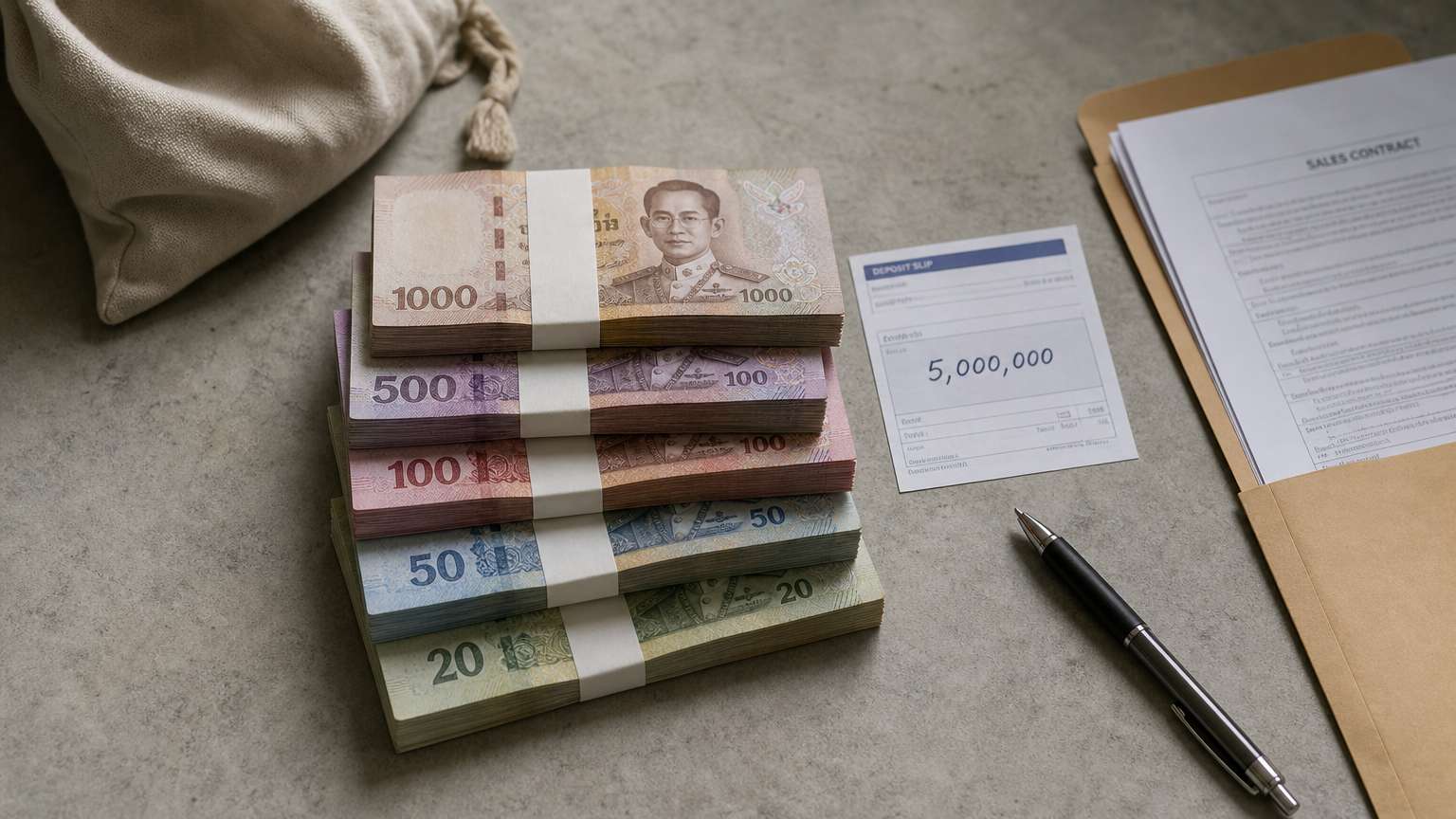
The Bank of Thailand (BOT) began applying a 5 million baht cash threshold at bank branches on 1 November 2026 (about US$150,000, an approximate figure). Anyone who deposits 5 million baht or more in cash on the same day must go through Enhanced Due Diligence (EDD), a stricter check on the customer. The threshold also now covers other cash-related deals, including currency exchange. The rule affects people who pay cash for property or cars, cash-heavy businesses, and money changers.
The central bank announced the change in News Release No. 40/2569 (the 2569 in the number is the Buddhist Era year, equal to 2026), dated 26 October 2026. It follows BOT Notification No. 57/2569, which sets risk-management rules for cash-related transactions at financial institutions.
The rule does not ban cash transactions. It requires banks to look more closely at customers once a deal reaches the set level.
Which transactions are covered
The main trigger is a cash deposit of 5 million baht or more in one day. The BOT says such deposits must go through EDD. A bank may ask where the money came from and why the transaction is being made. It may also ask for supporting documents. How much it asks depends on the risk level of each customer.
The notification extends the 5 million baht threshold to several other types of transaction:
- Depositing cheques or drafts whose source is unclear
- Exchanging baht banknotes
- Receiving cash to issue cheques or drafts
- Buying, selling or exchanging foreign currency
- Receiving payments for insurance premiums, investment products or financial derivatives
The BOT release says only that these transactions now fall within the threshold. It does not say they face the same source-of-funds questions as a cash deposit.
On counting, the release states that amounts are added up within the same day only for cash deposits. For the other types, it says only "5 million baht or more." Definitions and exceptions for each transaction type are in the full notification.
The rule applies only to transactions made at branches. It does not affect electronic banking channels.
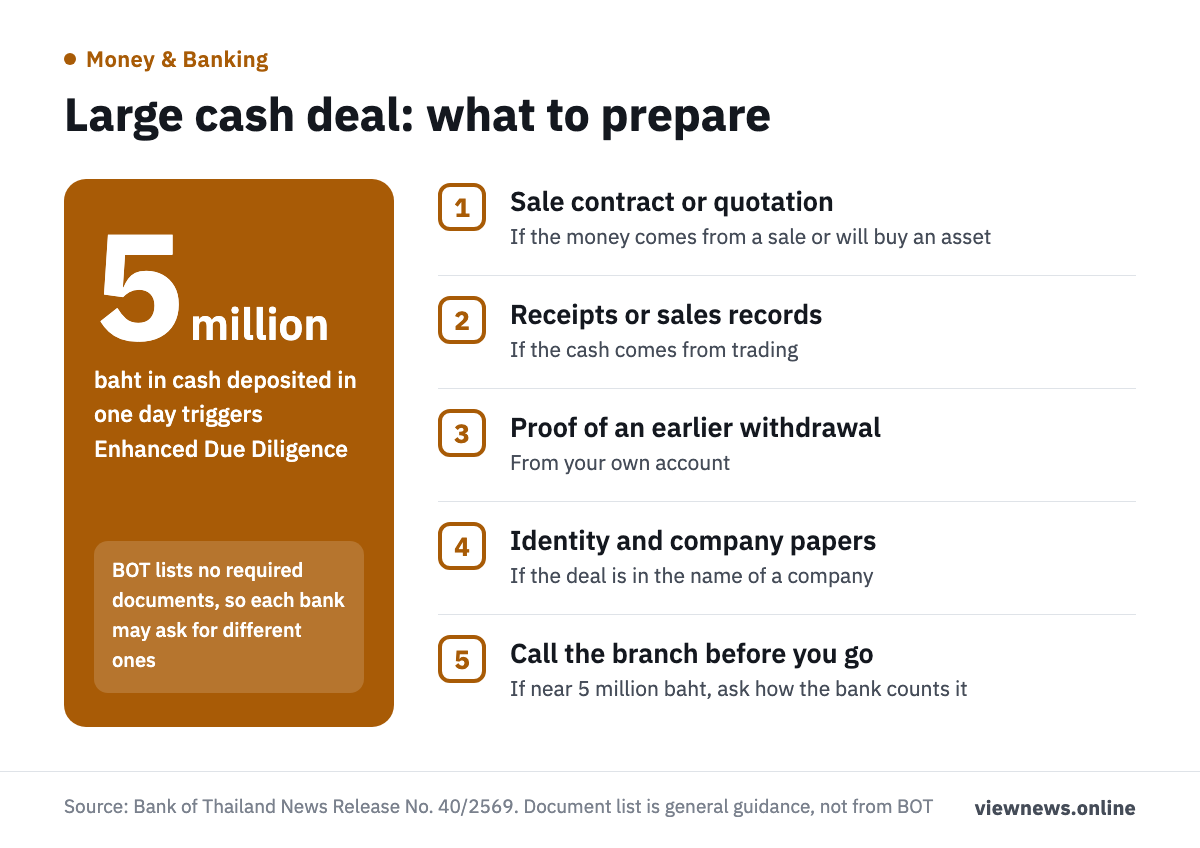
What to prepare before visiting a branch
The BOT does not list required documents, so banks may ask for different things. The following is general guidance, not a BOT list. If you plan a large cash transaction, you could bring papers that explain where the money came from and why you are making the deal:
- A sale contract or quotation, if the money comes from a sale or will buy an asset
- Receipts or sales records, if the cash comes from trading
- Proof of an earlier withdrawal from your own account
- Identity documents and company papers, if the deal is in the name of a company
Consider a common case. A person sells a car, receives cash from the buyer and deposits 5 million baht or more at a branch the same day. That is a cash deposit covered by the notification. The sale contract and registration transfer papers may help explain the source of the money. What the bank actually requests is up to the bank.
Another case is a money changer buying or selling foreign currency worth 5 million baht or more. That type of transaction is among those now covered. Businesses that routinely handle large amounts of cash may want to keep daily trading records and company documents ready, so they can describe their business if asked. Both examples are general observations, not from the BOT.
The BOT release applies to bank customers generally and does not mention nationality. It does not say whether foreigners face different requirements, so ask your bank which documents it accepts from non-Thai customers. If your amount is close to 5 million baht, ask how the bank counts it.
Calling the branch before you go can save time at the counter.
Why the BOT is doing this
The BOT says the notification helps prevent "grey money" problems and raises the transparency and security of Thailand's financial system. It also fits the Bangkok Blueprint for Fraud-Resilient Financial Services, an approach the BOT launched with the International Monetary Fund (IMF) and the World Bank to strengthen the financial sector against fraud.
Banks must still serve customers properly and look after affected customers quickly and fairly. They must report unusual transactions, or those that do not fit a customer's normal behavior, to the BOT. That does not mean everyone who reaches 5 million baht will be reported.
What happens next
Since 1 November 2026, financial institutions have been required to follow Notification No. 57/2569. The BOT has not said which documents each bank will ask for. Anyone planning a large cash transaction should check the BOT website for the full text, including definitions and exceptions.
Source: Bank of Thailand News Release No. 40/2569 dated 26 October 2026, and BOT Notification No. 57/2569 as described in that release. The examples and document suggestions are general observations, not from the BOT.
This article is adapted from ViewNews' Thai-language report.