Business owners in Thailand who display signs outside their shops may eventually pay signboard tax under a new method. On 3 November 2026, the Cabinet approved in principle a draft Signboard Tax Act, proposed by the Ministry of Interior. The Cabinet met away from Bangkok, in Udon Thani province. The draft would charge tax by the month, extend the payment period to 30 days, and double the tax on signs that encroach on public land without permission. It is not yet law, and the actual rates will be set later by a ministerial regulation.
The details come from reports by Thaipublica and Real News Thailand. Both attribute them to a briefing by a deputy spokesperson of the Prime Minister's Office after the Cabinet meeting.
Where the draft stands
Approval in principle means the government agrees with the overall direction of the bill. It does not make the bill law. The draft must still go through further legal steps and Parliament. Sign owners have no new obligations under it for now, and the current law continues to apply.
No date has been set for the bill to go to Parliament, and no effective date has been announced. The criteria for tax cuts in a crisis have not been published either. Be cautious about any claim that the tax will definitely rise or fall, because the real rates have not been set.
Before Cabinet approval, the draft went through a public hearing. A total of 1,737 people commented, and 96.69% agreed with it. That figure shows most participants supported the draft. It does not say what rates the later regulation will set.
Monthly billing, with part-months counted as a full month
The biggest change for sign owners is how time is counted. The draft would charge tax monthly, based on how long a sign is actually used. A part of a month counts as one full month. A sign put up or taken down mid-year would be taxed only for the months it was in use, not for the whole year.
Here is a simple example of the counting. Say a shop puts up a new sign in the middle of one month and keeps it until the middle of the fourth month. That counts as 4 months of use, because the first and last months are each part-months and each counts as a full month. The example shows only how months are counted. It is not an amount of money, because the real rates are not yet known.
Owners of temporary signs, such as festival or promotion signs that stay up for a few months, may want to keep clear records of installation and removal dates. The actual period of use decides how many months are taxed.
Rate caps, late fees and signs on public land
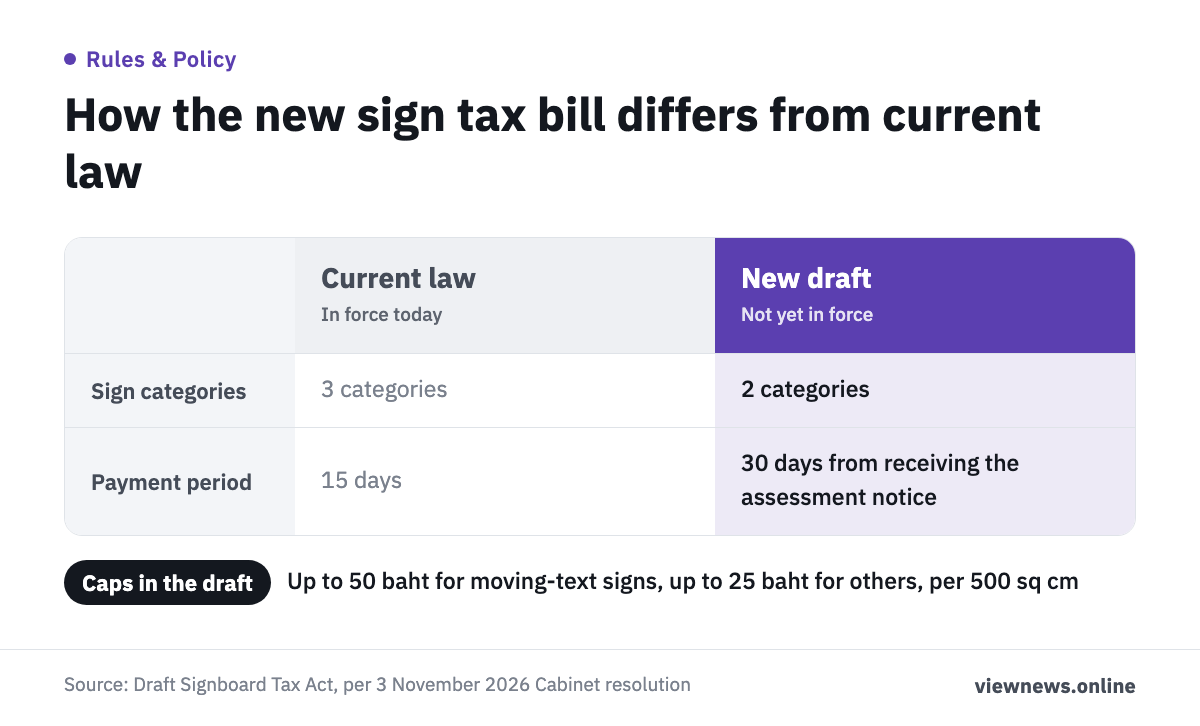
The draft cuts the number of sign categories from 3 to 2. It also sets two caps on the rate. The cap is no more than 50 baht per 500 square centimetres for Thai-language signs with moving text or numbers. For all other signs, the cap is no more than 25 baht per 500 square centimetres. Both figures are ceilings written into the draft. They are not the rates that will be charged. The actual rates will be set in a ministerial regulation, which could set them below the caps. That regulation has not been issued.
The payment period would be extended from 15 days to 30 days, counted from the date the owner receives the tax assessment notice, according to Real News Thailand.
For late payment, the draft sets a surcharge of 2% per month. The total surcharge cannot exceed the amount of tax owed.
Signs that encroach on public land without permission would be taxed at twice the normal amount. This is only a tax rule. Paying the tax does not make the use of public space legal. Owners who are unsure whether a sign sits on their own land or extends onto public space should check now.
Online filing, crisis tax cuts and how to prepare
Real News Thailand reports that the draft would allow owners to file returns, request refunds, lodge appeals and receive assessment notices electronically. Owners who cannot easily visit an office could do these things online in future. Those who prefer to deal with officials in person can still do so.
For a refund after an appeal, the request must be filed within 1 year of receiving notice of the final appeal decision. The draft also allows a ministerial regulation to cut the tax by up to 90% in cases of disaster or economic downturn, under criteria yet to be set. That cut is not a right that can be claimed now. It depends on a regulation and its criteria.
While the bill moves forward, shop and business owners with signs can prepare as follows:
- List every sign and note whether each is a Thai-only sign or one with moving text.
- Keep records of installation and removal dates for each sign.
- Check whether any sign sits on your own land or extends onto public space.
- Watch for the actual rates in the ministerial regulation.
- Watch for when the bill goes to Parliament.
Overall, the draft would tie the tax to the actual period a sign is used, reduce the number of sign categories, extend the payment period and add online channels. How much it affects each business depends on the rates the regulation sets.
Foreign business owners should note that the reports do not say whether the draft treats foreign-owned businesses differently. If you operate a shop or office with signage, ask your local administration office how the rules would apply to you once the final text is published.
Source: Summary of the Cabinet resolutions and a briefing by a deputy spokesperson of the Prime Minister's Office on the 3 November 2026 Cabinet meeting, as reported by Thaipublica and Real News Thailand. This article is adapted from ViewNews' Thai-language report.