A heatwave is a spell of unusually hot days and nights in which excess heat builds up in an area, according to the World Health Organization (WHO). When the body cannot shed heat fast enough, the risk of heatstroke rises and existing health conditions can get worse. Extreme heat also disrupts work and public services. This guide explains what the term means, how Thailand's Department of Health reads the heat index, and what to do if someone shows signs of heatstroke.
A reading of 40 degrees Celsius is not a global threshold for a heatwave. The World Meteorological Organization (WMO) says heatwaves are usually defined by local thresholds, not one temperature for the whole world. As examples, the WMO notes that temperatures above 30 degrees Celsius produced the most severe heatwaves on record in parts of Norway, Sweden and northern Finland in 2025. Tropical cities such as Kuala Lumpur, Malaysia, can see daily temperatures of 31-33 degrees Celsius all year.
How a heatwave differs from a normal hot season
A heatwave is more than a run of hot days. The WMO says the key feature is excess heat building up over several days and nights in a row. Normally, cooler nights let people, buildings and the environment release the heat absorbed during the day. If nights stay unusually warm, the heat cannot escape and accumulates each day.
The WMO also points out that heat can be dangerous without a heatwave. In many tropical areas, prolonged heat and humidity can create dangerous conditions even when a heatwave is weak. It calls the strain on the body from humid or dry heat beyond what it can manage "thermal heat stress". This depends on temperature, humidity, solar radiation and wind speed. The two can occur together, but not always.
That is why temperature alone is not enough. High humidity, or hot dry air with strong wind, makes sweating less effective at cooling you. Scientists therefore use indices that combine temperature with humidity, radiation and wind to estimate health risk.
In Thailand, the Department of Health advises people to follow the Heat Index from the Thai Meteorological Department. This is the temperature the body actually feels. The "dangerous" level (orange) is 42.0-51.9 degrees Celsius, and the "very dangerous" level (red) is higher.
The Department of Health's news release of 30 April 2024 gives an example. In late April that year, northern Thailand recorded highs of 40-44 degrees Celsius, with a peak of 44.1 degrees Celsius in Mueang district, Phetchabun. Seven provinces had a heat index at the very dangerous level: Phuket, Phang Nga, Krabi, Surat Thani, Trat, Chon Buri and Chanthaburi.
Health effects and everyday impact
The WHO says heatstroke is a medical emergency with a high death rate. When the body cannot cool itself, the heart and kidneys work harder. Heat can worsen chronic conditions, including cardiovascular disease, respiratory disease, diabetes and mental health problems, and can cause acute kidney injury. The WMO adds that heat illness ranges from mild cramps to fainting and potentially fatal heatstroke.
Heat also affects things people rarely think about. The WMO says it can disturb sleep, concentration and reaction time, and long hot spells can cause irritability, low mood and unclear thinking. For outdoor workers, heat impairs decision-making, body coordination and strength, so the risk of accidents rises. The WHO also warns that when a heatwave is followed by power cuts, hospitals, transport and water systems can be disrupted.
According to the WMO, groups at higher risk include older adults, babies and children, pregnant women, people with chronic illness, people with disabilities, people taking certain medicines, outdoor workers, people who live alone and people whose homes do not release heat well. The WHO adds athletes, and notes that poorer people in cities and rural areas often face worse heat because of low-quality housing and no way to cool down. Thailand's Department of Health lists young children, older adults, people with chronic illness, people with obesity, people who drink alcohol, and people who work or exercise outdoors for long periods.
Department of Health figures cover 2019-2023. Over that period, 131 people died from heatstroke-related illness, an average of about 26.1 a year, and cases have been trending upward, especially among working-age adults and older people. The same release reported that in late April 2024, Dr Sarawut Boonsuk, an Inspector-General of the Ministry of Public Health for Health Region 1, said Phrae Hospital had seen 5 suspected heatstroke patients, 1 of whom had died. The most common symptoms in 2023 were headache, constipation, and cramps in the legs, arms or abdomen.
Globally, the WHO estimates about 489,000 heat-related deaths a year in 2000-2019, with 45% in Asia. It also says heat-related deaths among people over 65 rose by about 85% between 2000-2004 and 2017-2021. The WMO cites the 2025 Lancet Countdown report, which found heat-related deaths worldwide rose from about 335,000 a year in 1990-1999 to about 546,000 a year in 2012-2021, an increase of more than 60%. It also says heat stress cost the world about US$835 billion in lost labour productivity in 2023.
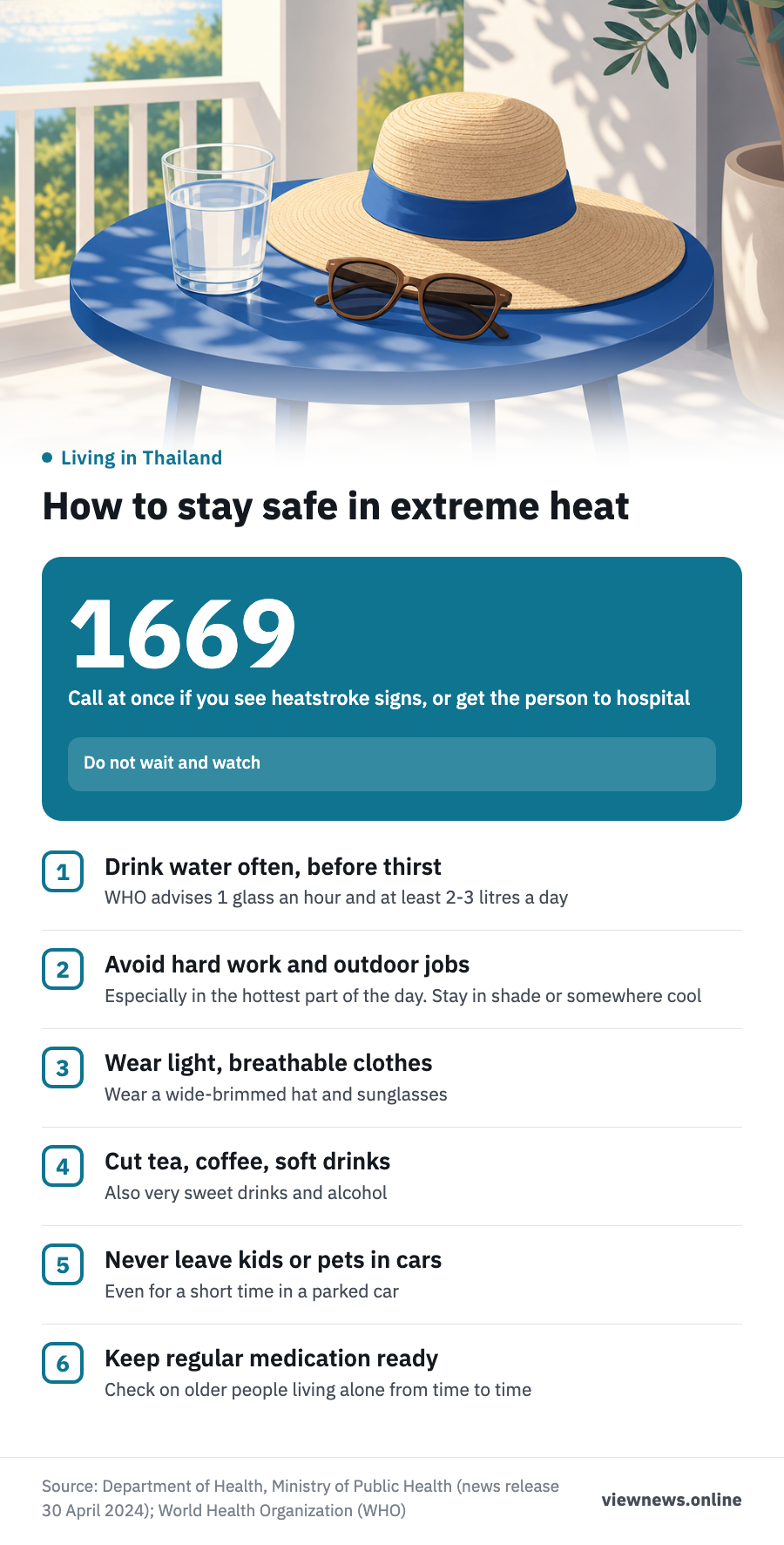
How to stay safe in extreme heat
The Department of Health's advice is simple but needs to be followed consistently, especially when the heat index reaches the dangerous level. A quick checklist:
- Drink clean water often, without waiting until you are thirsty, and have 1-2 glasses before leaving home.
- Spend less time on outdoor activities when the heat is extreme.
- Wear light-coloured, breathable clothes, a wide-brimmed hat and sunglasses, carry drinking water and apply sunscreen regularly.
- Avoid tea, coffee, soft drinks, high-sugar drinks and alcohol.
- Stay indoors with windows open and a fan running. If you have air conditioning, use it together with an oscillating fan.
- If you have a chronic condition, keep your medicines ready.
The Department of Health especially stresses that babies and young children must never be left in a car parked in the sun. Its 2023 surveillance data also found common risky habits: not checking the weather forecast before going out, staying in poorly ventilated rooms or rooms without air conditioning, and not showering to cool down after outdoor activity. These three are easy to fix at no cost.
Checking the Thai Meteorological Department's heat index regularly helps you plan ahead. The WMO says forecasts can warn of extreme heat in advance, giving health, agriculture, energy and emergency services time to prepare. For individuals, knowing which day will be dangerous means you can move outdoor work or arrange shade and water in time.
Heatstroke signs and first aid
The Department of Health describes heatstroke as a core body temperature above 40 degrees Celsius, red and hot skin, a fast and strong pulse, headache, confusion, dizziness, nausea or vomiting, and a change in consciousness that can lead to collapse and death. If someone shows these signs after being in the sun or a hot place, do not wait and watch.
If you find a heatstroke patient, the Department of Health advises giving first aid and taking them to hospital, or calling 1669 immediately. The WHO stresses that heat-related deaths and hospital admissions happen fast, on the same day or within a few days, so people should act quickly once a warning is issued. Knowing the symptoms in advance helps you decide in time.
This article is general information. People with chronic conditions, who take regular medication or who are in a higher-risk group should ask a doctor or pharmacist how to look after themselves in extreme heat before starting or changing any treatment.
Source: World Health Organization (WHO) fact sheet "Heat and health" (last updated 31 July 2026); World Meteorological Organization (WMO) Extreme Heat page; Department of Health, Ministry of Public Health, news release of 30 April 2024.
This article is adapted from ViewNews' Thai-language report.