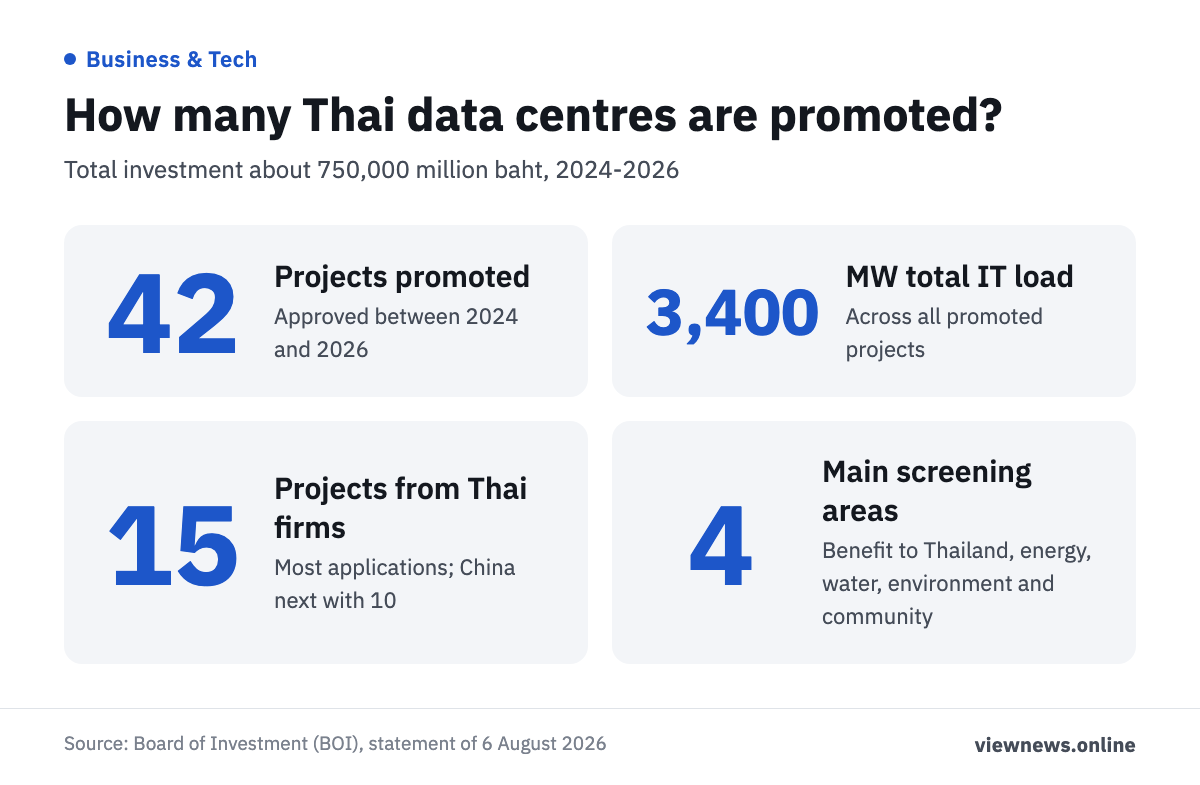
Thailand's data centre boom is growing fast enough that the government is preparing a dedicated oversight body. On 5 August 2026, the Cabinet approved a draft Prime Minister's Office regulation to set up a data centre policy committee. The Board of Investment (BOI) said it approved promotion for 42 data centre projects between 2024 and 2026, with total investment of about 750,000 million baht. The issue affects electricity and water users, communities near the sites, and people who work in IT.
The BOI announced the figures on 6 August 2026. It also outlined how it will screen new projects in line with the new committee's approach.
42 projects promoted so far
The promoted projects have a combined IT load of 3,400 megawatts. The BOI counts an investor's nationality by its parent company or ultimate controller.
On that basis, Thai companies applied for the most projects, with 15. China followed with 10, the United States with 5, the United Arab Emirates with 4, and Japan with 2. Malaysia-Hong Kong accounted for 1 project. The other 5 came from Hong Kong, Singapore, India, Australia and France.
The BOI also said no new applications for data centre promotion have been filed since April 2026.
Four screening areas, a separate power tariff and new maps
Under the draft regulation approved by the Cabinet, the policy committee will be chaired by a deputy prime minister, with the BOI secretary-general as a member. The BOI will adjust its screening to follow the committee's guidance, looking at 4 main areas.
- Benefit to Thailand: jobs and skills development, use of local equipment and service providers, technology development, and a domestic AI ecosystem.
- Energy: generation capacity, grid capability, efficiency, and who pays for infrastructure costs.
- Water: water sources, cooling technology, water reuse, special water rates, and drought management.
- Environment and community: city planning, fire and pollution risks, and impact over the life of the project.
On energy, the National Energy Policy Council has agreed that data centres should pay a separate electricity tariff, set higher than the rate for other user groups. Projects must have guarantees for their power use, and the state encourages a larger share of clean energy. The BOI said the idea is for investors to bear their own infrastructure costs so that other electricity users do not carry the burden.
On water, the BOI said it will assess how well a project can manage water in the dry season, so that farming and communities are not affected.
The government is also preparing a Power Map and a Water Map to help set suitable zones for new projects.
Cloud providers and local supply chain
According to the same statement, AWS and Google already have cloud regions in Thailand. AWS has worked with King Mongkut's Institute of Technology Ladkrabang (KMITL) to open a master's programme in data centre engineering. The BOI described it as the first of its kind in Thailand, with scholarships to train data centre engineers.
AWS also runs a programme called ThaksaAI, which teaches cloud and generative AI skills to more than 23,000 students in 50 provinces. Google runs Digital Bridge, which has trained more than 100,000 small business owners and members of the public, and Samart Skills, which offers 22,000 scholarships aimed at labour market needs.
The BOI said Thailand already has relevant manufacturing. This includes hard disk drives (Seagate, Western Digital), AI servers (Inventec, QMB), optical transceivers (Innolight, Eoptolink, Fabrinet), printed circuit boards from more than 50 global makers, and cooling systems (Delta Electronics). The agency plans to promote investment across the whole supply chain, as well as domestic trade in equipment.
What is still unclear
As of the BOI's 6 August 2026 statement, the Cabinet had approved only the draft regulation. The committee itself had not yet been fully established. The statement did not give the new electricity tariff figures or the detailed screening criteria the BOI will actually use.
There are 3 things to watch: how strict the new criteria will be, whether projects already approved will go ahead as planned, and how the separate tariff will affect operators' costs.
Source: Board of Investment (BOI) statement, published on the Government House website.
This article is adapted from ViewNews' Thai-language report.