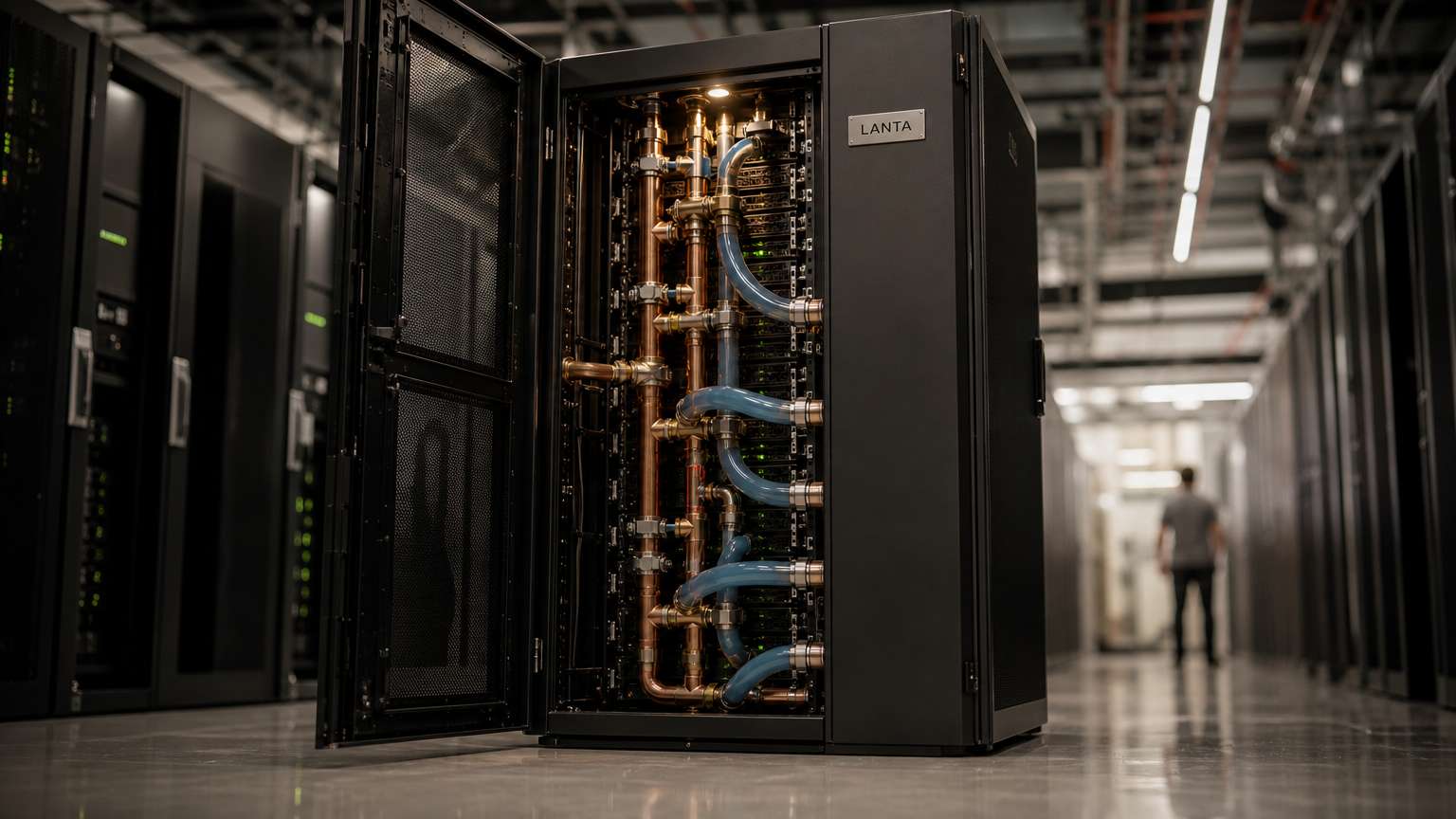
Thailand's National Science and Technology Development Agency (NSTDA) said on 27 February 2026 that public and private organisations can apply to use LANTA, the national supercomputer. Projects start at 5,000 baht (about US$150). LANTA is the core of Thailand's AI infrastructure. It is used to train Thai-language models, forecast PM2.5 dust and support health research.
The news matters to two groups. Companies, universities and agencies that want to test AI can buy computing time without buying their own machines. Everyone else will meet the results in everyday services, such as longer-range PM2.5 forecasts and a depression screening app.
LANTA: the core of Thailand's AI infrastructure
LANTA is run by the National Supercomputer Centre (ThaiSC), part of NSTDA. It is an HPE Cray EX system with 346 compute nodes, 31,744 CPU cores and 704 NVIDIA A100 GPUs. Its peak performance is 8.15 petaflops. It has 10 petabytes of parallel storage and a 200 Gbps network. It was funded from the science, technology and innovation fund for 2021, managed by the Office of the National Council for Science, Research and Innovation Policy (known by its Thai acronym, สกสว./OPS-TSRI).
NSTDA explains why Thailand needs its own machine. Training a language model with 8 billion parameters would take more than 160 years on a single GPU. On about 700 GPUs, as on LANTA, it would take about 87 days. Without its own high-performance computing, NSTDA says, Thailand would depend on foreign resources, with limits on time, cost and the security of research data.
The system is liquid-cooled, which NSTDA says is a first in Thailand. It uses 33% less cooling energy than air cooling.
Who can use LANTA, and what it costs
Applicants must be legal entities, either government or private. NSTDA's information also includes users from overseas. Individuals applying on their own do not fit this description.
- Applicants must be a public or private legal entity.
- A proof-of-concept (PoC) project to test an idea is free.
- A research voucher scheme for computing resources opens in rounds.
- Details and application channels are at thaisc.io or thaisc@nstda.or.th.
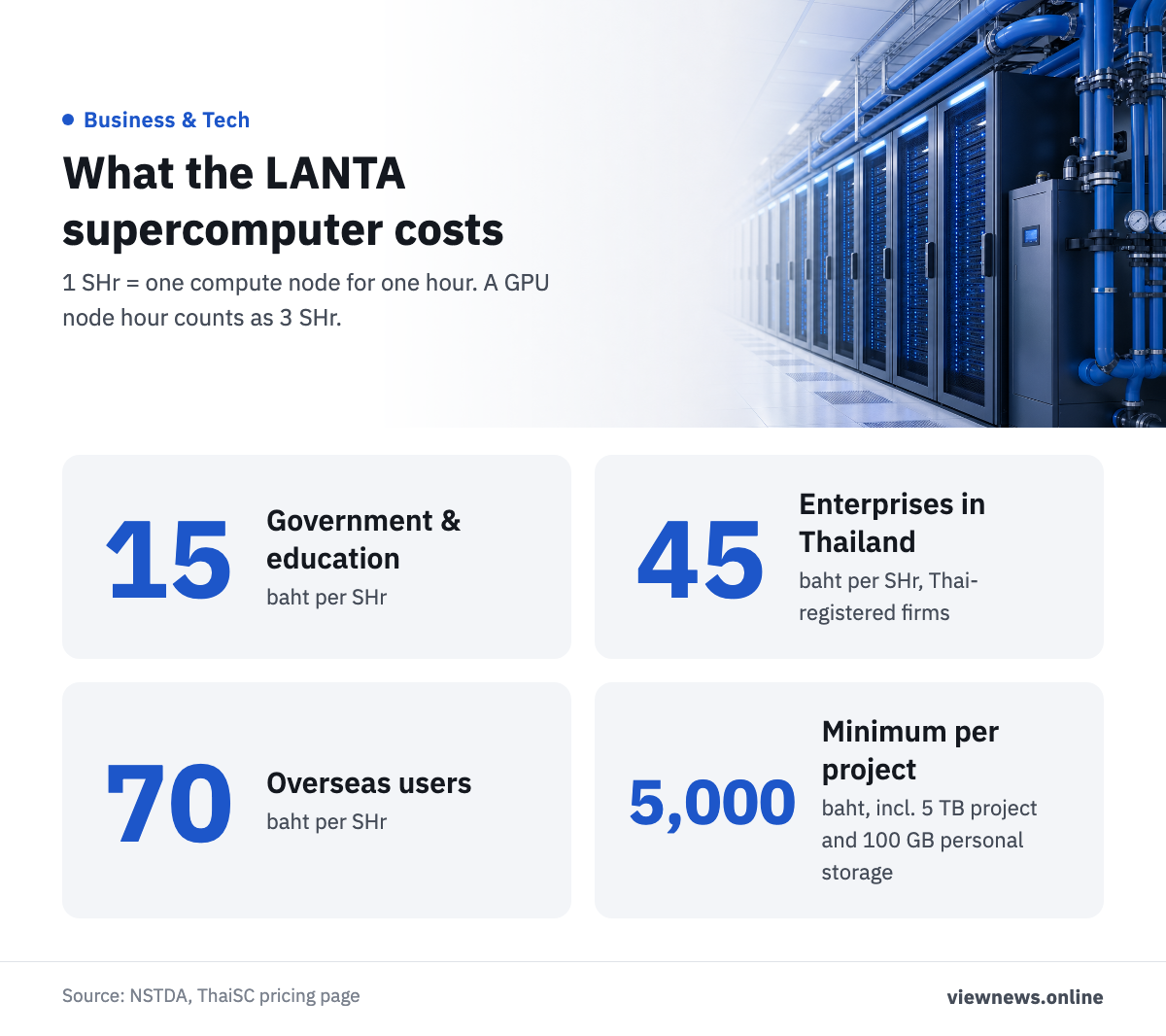
Fees are charged in Service Node-Hours (SHr). One SHr is one compute node running for one hour. One hour on a GPU node counts as 3 SHr. The price per SHr is:
- 15 baht for government and education users
- 45 baht for enterprises registered in Thailand
- 70 baht for overseas users
For example, a government agency using a GPU node for one hour pays 45 baht.
The minimum budget per project is 5,000 baht. It includes 5 TB of project storage and 100 GB of personal storage per user. NSTDA says the service also includes computing software and advice from specialists.
What LANTA has been used for
The clearest example is PM2.5 forecasting by the Pollution Control Department. It used to forecast 3 days ahead, and the run took 22 hours. On LANTA the forecast extends to 7 days and the run takes 45 minutes. The Asian Institute of Technology (AIT) uses the machine for high-resolution weather forecasts six months ahead, to support precision farming.
In health, the Medical AI Consortium is building a central AI diagnosis platform. The DMIND depression screening app uses a model trained on LANTA and is offered through the national health app. For language, models include Pathumma LLM, an open-source generative AI model, and ThaiLLM, the country's Thai-language foundation model, launched in early 2026.
NSTDA says LANTA has supported more than 690 projects, with estimated total impact of more than 6.9 billion baht. It also supports the Super AI Engineer programme, which trains more than 1,000 specialists a year.
How the national AI plan is going
According to the same NSTDA information, LANTA ranked 199th in the world in the 2025 TOP500 list. In 2022 it ranked 70th, which was first in ASEAN at the time. On the Green500 list of energy efficiency it ranked 91st in 2025, down from 24th in 2022. The machine has been in service since 2022.
On policy, the Cabinet approved the draft national AI strategy and action plan for 2022 to 2027 on 26 July 2022. It has 5 strategies. Strategy 2 is building national infrastructure for sustainable AI development. One target is for investment in AI-ready digital infrastructure to grow 10% a year.
At the first National AI Committee meeting of 2025, held on 1 May 2025 and chaired by the prime minister of the time, officials projected investment in AI infrastructure such as cloud, data centres and GPUs of no less than 500 billion baht (about US$15 billion). The state and private companies, both Thai and foreign, are expected to invest. The meeting set targets for the next 2 years of at least 10 million AI users, 90,000 AI specialists and 50,000 AI developers. It also reported that the National AI Service Platform lists more than 76 AI services developed in Thailand.
The 500 billion baht figure is a projection of combined public and private investment, not a government budget. Organisations interested in LANTA can find research voucher details and application channels through ThaiSC.
Source: National Science and Technology Development Agency (NSTDA), including its LANTA service information, ThaiSC news releases and pricing page, and the national AI strategy and action plan (2022 to 2027) from the National Electronics and Computer Technology Center (NECTEC).
This article is adapted from ViewNews' Thai-language report.