Formula 1 brings money to a host city in two main ways: visitors who travel to watch the race, and fees the organiser pays to the owner of the series. Singapore has the clearest official figures in Asia. Its Ministry of Trade and Industry says the race, held since 2008, has drawn more than 720,000 foreign visitors and generated more than 2,200 million Singapore dollars in incremental tourism receipts.
Thailand is part of this story. The Cabinet has approved in principle a bid to host F1 in Bangkok for five years, from 2028 to 2032. For foreign residents and visitors, the Singapore numbers show where the money comes from, where it goes, and how far Thailand's plan has come.
Singapore's numbers: the most open data from a host city
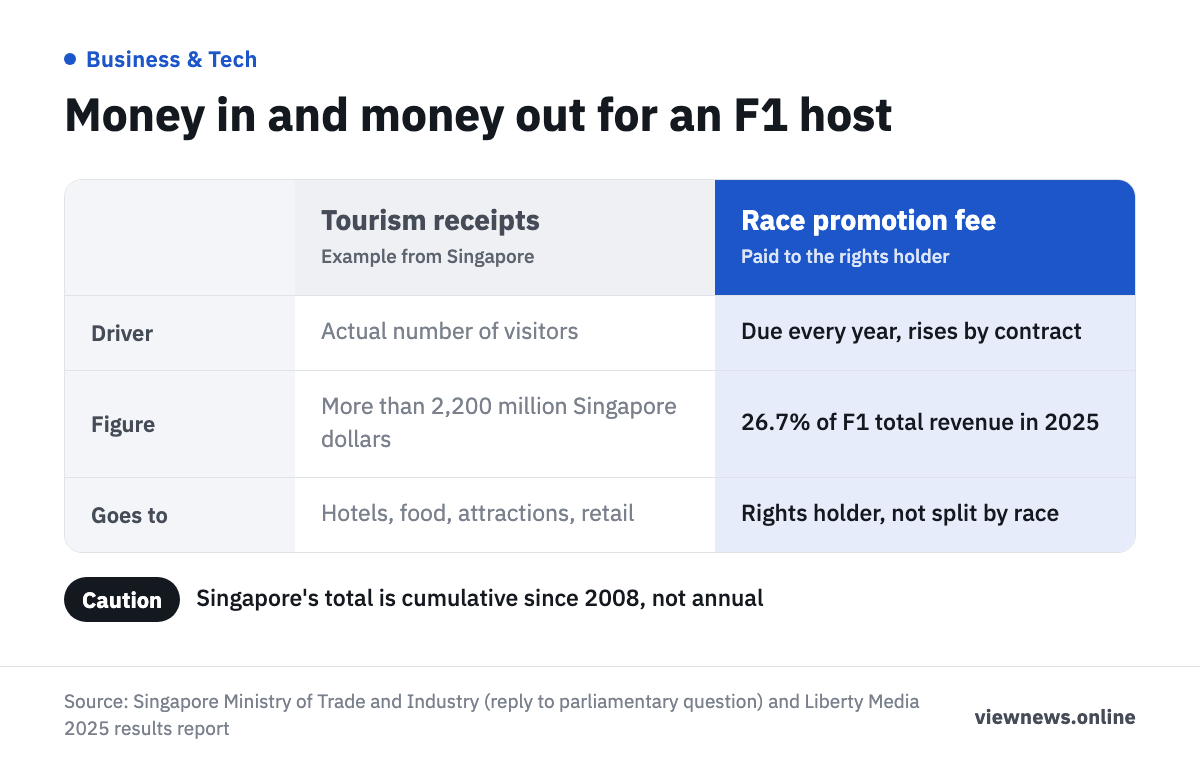
In a reply to a parliamentary question on 14 October 2025, Gan Kim Yong, Singapore's Deputy Prime Minister and Minister for Trade and Industry, said the Singapore Grand Prix has attracted more than 720,000 foreign visitors and more than 2,200 million Singapore dollars in incremental tourism receipts. The receipts are spread across hotels, food and drink, attractions and retail.
Both figures are cumulative totals since 2008, not figures for a single year. They cannot be compared directly with annual figures from other cities. The money came from many years of races, not one big year.
The same reply covers the costs to the city. The race requires road closures around Marina Bay. These lasted 12 days in 2008 and have been cut to 7 days today. Singapore's Tourism Board (STB), the Land Transport Authority (LTA) and the race organiser Singapore GP Pte Ltd meet local businesses regularly to hear their views. They encourage businesses to join the festival events during race week (GPSS), which runs for 10 days, or to hold their own events to serve the larger crowds.
The money that goes to the rights holder
The other side of F1 economics is what a city or organiser pays the series owner. Liberty Media, which owns Formula 1, reported that F1's total revenue in 2025 was US$3,873 million, up 14% from US$3,411 million the year before.
Race promotion fees made up 26.7% of that revenue, or about US$1,030 million based on the reported share. That is the second-largest source after broadcasting rights (31.3%) and larger than sponsorship (21.7%). Liberty Media said the increase came from 'contractual increases in fees'.
Liberty Media reports a combined share and does not say what each race pays. The fee is due every year and rises under the contract. Tourism receipts depend on how many visitors actually come. A host city has to weigh both sides before it bids.
Fans and viewers behind the marketing value
In its first-half review of the 2025 season, published on 28 August 2025, F1 reported 827 million fans worldwide. That is up 12% on the previous year and 63% above 2018. The figure covers the middle of the season, not the full year. Attendance at the first 14 races of the season totalled 3.9 million, the highest mid-season figure in F1 history. Silverstone in Britain drew about 500,000 and Albert Park in Melbourne about 465,000.
These numbers help explain why host cities treat the race as a promotion for the city too. The city's name appears in broadcasts and F1 content all race weekend. But F1 does not publish how much that exposure turns into extra tourists. The figures that can be checked are visitor numbers and tourism receipts, as Singapore reports them.
Where Thailand's plan stands
On 17 June 2025 the Cabinet approved in principle a bid to host F1 in Bangkok over five years, from 2028 to 2032, at a cost of about 41 billion baht, according to reports by Thansettakij and Bangkok Biznews. This is a bid stage only. It does not mean Thailand has won the right to host a race.
The Thai government's Public Relations Department (PRD) news website says the approved proposal is worth US$1,230 million for races from 2028 to 2032 on a 5.7-kilometre street circuit in the Chatuchak area of Bangkok. Each event would run for 3 days: practice, qualifying and the race. The Tourism Authority of Thailand, the Sports Authority of Thailand and the Bangkok Metropolitan Administration are among the agencies involved. The government expects returns of about US$570 million a year, and a minister has said the project could break even in its first year. All of these are government estimates.
F1 and Thai agencies have not announced that Bangkok is on the race calendar. Thai agencies have not published the full study and budget details in a source open to public checking. The Singapore figures are published data that can be used to judge what Bangkok would need to achieve if the race goes ahead.
Source: Singapore Ministry of Trade and Industry (reply to a parliamentary question); Liberty Media (2025 results report); Formula 1 (2025 first-half season review); Thailand's Public Relations Department (Thailand PRD news website); Cabinet resolution as reported by Thansettakij and Bangkok Biznews.
This article is adapted from ViewNews' Thai-language report.