
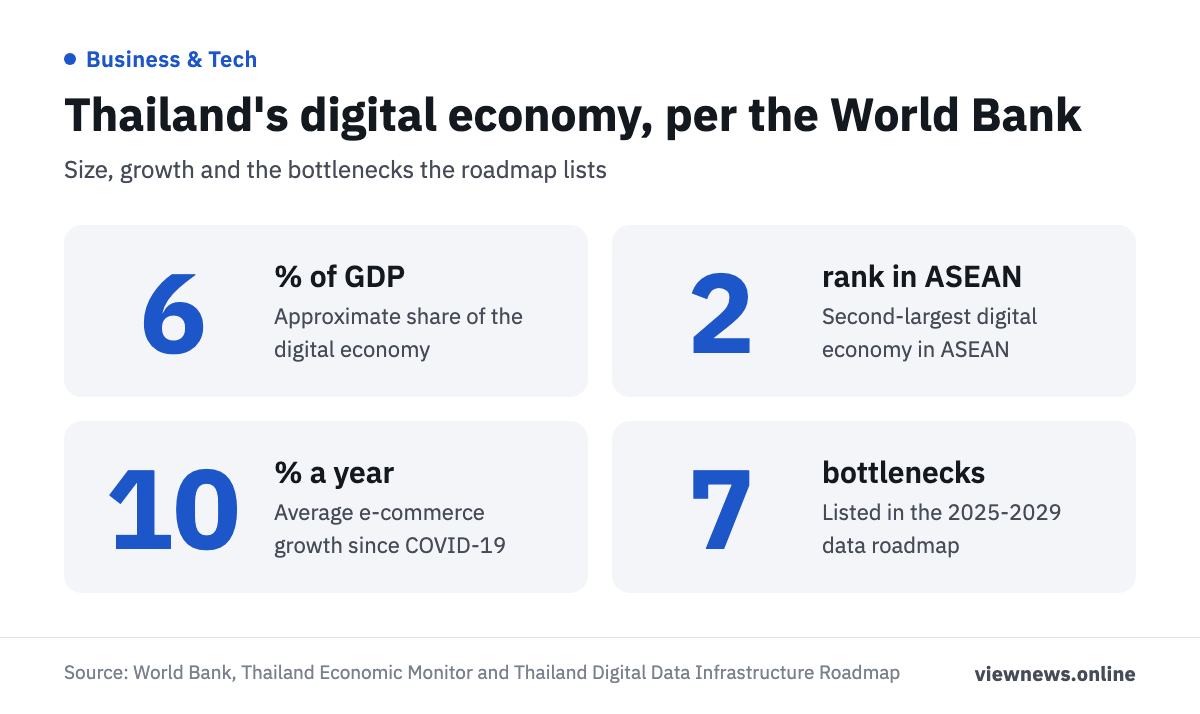
Thailand's digital economy is about 6% of gross domestic product (GDP), the second largest in Southeast Asia. The World Bank says it can grow much more if Thailand closes gaps in high-quality data, computing infrastructure and digital skills. The conclusion comes from the World Bank's Thailand Economic Monitor report, Digital Pathways to Growth, published on 3 July 2025. The bank later issued a separate roadmap for Thailand's digital data infrastructure.
Digital tools touch jobs, small-business income and the government services that residents use every day. The report says Thailand has a lot going for it, but is held back by data, computing and skills. It also proposes remedies.
Strengths the World Bank sees
The report says the digital economy is about 6% of GDP. Mobile internet covers nearly the whole country, and Thailand's government digital infrastructure is described as among the most advanced in the region.
The report points to the ThaID digital identity system and the PromptPay payment system. PromptPay is the QR and phone-number payment system that many people in Thailand use for everyday purchases. The World Bank says these systems widen access to financial services, support digital government and make online buying and selling easier.
On jobs, the report says financial services, digital payments, fintech, software and engineering have been among the fastest-growing areas of hiring over the past decade. E-commerce has grown by about 10% a year on average since the COVID-19 pandemic.
The gaps, and what the World Bank proposes
Despite these strengths, the World Bank says Thailand still lacks high-quality data, computing infrastructure and digital skills. Jieun Choi, a senior digital economist at the World Bank, said Thailand can unlock its potential by closing the first two gaps. In other words, widespread internet access is only the starting point.
The report urges faster use of technology in sectors tied to daily life: micro, small and medium-sized enterprises (MSMEs), e-commerce, health and finance. It also proposes expanding broadband, protecting personal data and encouraging innovation, with all three policy areas moving together.
On the wider economy, the July 2025 report recommends keeping macroeconomic conditions stable, shifting to more efficient public investment and deepening trade cooperation, so that digital technology supports long-term growth. On the latest figures, the World Bank said on 6 October 2026, in its East Asia and Pacific economic update, that it raised its 2026 growth forecast for Thailand by 0.7 percentage points to 2.0%. That replaces the 1.7% forecast for 2026 in the July 2025 report.
Roadmap lists 7 bottlenecks
The World Bank published the Thailand Digital Data Infrastructure Roadmap on 3 December 2025. It is a plan for 2025 to 2029 to strengthen data infrastructure, data governance, cybersecurity, AI adoption and data analytics capacity. It is meant as a base for Thailand to reach high-income status by 2037.
The roadmap sets out 7 obstacles. The first is an uneven digital transition, caused by weak digital skills and patchy broadband, especially in rural areas, small businesses and government agencies. The second is data rules. The World Bank says the personal data protection law and related rules have grown stronger, but businesses are still unsure how to comply and how much data they can share. Cross-border data policy and open data also lag regional leaders.
The third is fragmented government systems. Agencies run separate systems, duties overlap and connections are poor, especially in social services. The government data exchange platform, GDX, has helped, but the state still makes little use of AI and advanced analytics. The fourth is shallow cloud and AI adoption. Investment by large cloud providers has added computing capacity, but AI use by people and businesses is well below the regional average. The World Bank points to limited government strategy and budgets, and gaps in connectivity standards, governance and personnel.
The fifth is MSME capability. Most use digital platforms daily, but few use data analytics, automation or e-commerce to sell exports. The sixth is social protection, where data sits in separate silos. There is no sector-specific data framework and no Federated Social Registry, which weakens the targeting of aid and policymaking. The last is the need for a phased plan. Thailand's starting point has improved, so the focus must now shift to the quality, depth and reliability of data use in both the public and private sectors.
What to watch
In the July 2025 report, Melinda Good, the World Bank's country director for Thailand and Myanmar, said digital transformation is a flagship theme of the 2026 annual meetings of the World Bank and the International Monetary Fund (IMF), which Thailand was set to host.
For readers who run small businesses, the things to watch are clear guidance on using data under the personal data protection law, and measures that help businesses use e-commerce and data analytics. For people working in technology or finance, the report says digital skills remain a major gap. How far Thailand's digital economy goes depends on how fast the state links data across agencies, expands broadband and builds confidence in how data is handled.
Source: World Bank press release "Thailand's Digital Future Key to Boosting Growth" and the report Thailand Economic Monitor: Digital Pathways to Growth; World Bank page for the Thailand Digital Data Infrastructure Roadmap; World Bank press release on the East Asia and Pacific Economic Update, October 2026.
This article is adapted from ViewNews' Thai-language report.